Gouri, a content specialist at Esko, loves adding a dash of creativity to everything she writes.
Disclaimer: This post draws on information from the U.S. Food and Drug Administration (FDA) website, including the FDA’s final Edition 5 allergen labeling guidance issued on January 6, 2025. However, it does reflect the regulatory picture as of mid-2026 as there are no changes to the policy. Always refer to the FDA website for the most current and authoritative information. This article is intended to support label compliance for brands and is not a source of legal or regulatory advice.
A study conducted by the USA Food Safety and Inspection Service showed that over 2% of adults and between 4% and 8% of children in the United States are affected by food allergies.
Each year, that translates to more than 30,000 emergency room visits, 2,000 hospitalizations, and close to 150 deaths. There is no cure for food allergies. The only reliable protection for consumers is accurate, complete labeling on every product they pick up.
For food manufacturers and packaging teams, that means getting allergen declarations right on every label, every time. The FDA conducts regular inspections and enforces strict food allergen labeling requirements. Getting it wrong does not just put consumers at risk. It puts your brand at risk too.
This guide cuts through the regulatory language so you can find exactly what you need. It covers the nine major allergens, how to declare them correctly, what the exemptions actually mean, and what the FDA’s 2026 guidance changes for your label review process.
The Food Allergy Safety, Treatment, Education, and Research (FASTER) Act then added sesame as the ninth major allergen, effective January 1, 2023.
Any packaged food containing one or more of these allergens must declare them on its label.
The nine major food allergens are:
Milk
Eggs
Fish
Crustacean shellfish
Tree nuts
Peanuts
Wheat
Soybeans
Sesame
Here is what accurate labeling looks like for each one.
1. Milk
Even a small amount of milk protein can trigger serious reactions, from hives and wheezing to anaphylaxis. Milk allergies affect people across all age groups, and milk derivatives can appear in products that consumers may not expect to contain dairy.
One important update from FDA’s 2025 guidance: “milk” for allergen purposes includes milk from goats, sheep, and other ruminants, not just cows. If your product uses goat’s milk or sheep’s milk, identify the source by name on the label.
Milk labeling requirements:
List all milk-derived ingredients by name in the ingredient list (for example, whey, casein, lactalbumin).
Avoid vague terms like “dairy products” or “natural flavors” when milk derivatives are present. Be specific.
You may bold or underline milk allergens in the ingredient list, or use a separate “Contains” statement.
2. Eggs
Eggs appear in a wide range of products, from baked goods to pasta to sauces. For individuals with egg allergies, even trace amounts can cause a reaction.
FDA’s 2025 guidance clarifies that “eggs” covers eggs from birds other than chickens. If your product uses duck eggs or eggs from another bird species, include the bird source in your labeling.
Egg labeling requirements:
Use the term “egg” clearly in the ingredient list. Also name specific components where relevant: egg whites, egg yolk, lysozyme.
Avoid hiding egg ingredients behind broad terms like “natural flavor” or “lecithin” without identifying the source.
Bold or underline egg allergens, or use a “Contains” statement.
Keep egg-containing products and equipment separated from egg-free lines to prevent cross-contact.
3. Fish
More than 2% of adults and 0.5% of children are sensitive to fish allergens. Reactions can range from eczema and nasal congestion to severe anaphylaxis.
FDA requires species-level identification on fish labels. Declaring “fish” alone is not sufficient. You must name the specific species.
Fish labeling requirements:
Name the species used in your product. Rather than just mentioning the term “fish”, specify the species involved, like bass, flounder, or cod.
Avoid generic terms. Use specific ingredient names like “fish oil (salmon)” or “anchovy extract.”
When referencing the Acceptable Market Name (AMN) on the label, use the asterisk symbol (*). Do not use the dagger symbol (†).
Refer to the FDA Seafood List for the complete set of acceptable species names and related ingredient names.
Pro tip: Make sure to use the asterisk symbol (*) while mentioning the Acceptable Market Name (AMN) in the product label. Avoid using the ingredients names with the (†) dagger symbol as per the seafood list.
4. Tree Nuts
Around 1% of adults and children globally have tree nut allergies. Reactions can include congestion, abdominal cramps, hives, and anaphylaxis.
FDA’s current tree nut list is evidence-based and has been updated. One significant 2025 development: coconut is no longer treated by FDA as a major food allergen. Only tree nuts on FDA’s current list belong in a “Contains” statement.
If you have been including coconut in allergen declarations as a precaution, review your label copy against the current FDA list.
Tree nut labeling requirements:
Name the specific nut. “Almonds,” “cashews,” and “pecans” are correct. “Mixed nuts” is not sufficient.
Be specific about every nut ingredient and derivative, including those present in sauces, baked goods, and coatings.
Only include tree nuts in your “Contains” statement if they are actually present in the formulation and appear on FDA’s current major allergen list.
5. Crustacean Shellfish
Crustacean shellfish covers species with a hard outer shell: shrimp, crab, lobster, and prawns. It does not cover molluscan shellfish such as oysters, clams, or mussels.
For individuals with crustacean shellfish allergies, exposure can trigger anaphylaxis, histamine reactions, or chronic inflammatory conditions.
Crustacean shellfish labeling requirements:
According to the US FALCPA requirements, it is essential to clearly identify the specific type of crustacean shellfish present such as crab, lobster, or shrimp.
List every derivative and ingredient clearly. Broad terms leave consumers without the information they need.
Refer to the FDA Seafood List for the full set of acceptable names.
There are numerous edible fishes and shellfishes, we’ve included only common species in the lists below.
6. Wheat
Wheat is the foundation of many staple foods, which means wheat allergens can appear in unexpected places: sauces, processed foods, baked products, and coatings.
The FD&C Act identifies wheat as a major food allergen. Wheat refers to any plant species of the genus Triticum, including durum, spelt, kamut, einkorn, and emmer.
Wheat labeling requirements:
Use the word “wheat” on the label. Do not substitute “cereal,” “starches,” or “grains.”
Where specific wheat derivatives are present, name them: “gluten,” “hydrolyzed wheat protein,” “wheat starch.”
Bold or underline wheat allergens in the ingredient list, or use a “Contains” statement.
7. Peanuts
Peanut allergies affect up to 2% of children and up to 0.5% of adults. Reactions can include itching, dizziness, and loss of consciousness.
Peanuts are a rich source of protein and appear in a wide range of products, often in forms that consumers may not immediately recognize.
Peanut labeling requirements:
Be specific. List peanut-derived ingredients precisely: “peanut oil,” “peanut butter,” “peanut flour.”
Avoid broad terms. “Vegetable oil” or “mixed nuts” does not satisfy the requirement when peanuts are present.
Use a “Contains” statement or bold/underline peanut allergens in the ingredient list.
8. Soybeans
Soy allergies affect approximately 0.2% of adults and 0.5% of children globally. Soy appears in a wide range of everyday foods, often under names that consumers may not associate with soy. Reactions can include esophagus inflammation, vomiting, and runny nose.
Avoid broad terms like “vegetable oils” or “vegetable protein” when soy is present.
Bold or underline soy allergens, or use a “Contains” statement.
“Soy,” “Soya,” and “Soybean” are all acceptable synonyms under FALCPA. Use “soybeans” when the product is made of soy (for example, soy sauce) or contains soy as a component of a multi-ingredient product (for example, tofu).
9. Sesame
Sesame was added as the ninth major allergen under the FASTER Act, effective January 1, 2023. More than 300,000 Americans experience allergic reactions to sesame. Even small quantities can trigger severe reactions, including esophagitis and enterocolitis syndrome.
Sesame labeling requirements:
Clearly identify sesame and all sesame-derived ingredients: tahini, sesame oil, hulled sesame, sesame flour.
Avoid broad terms like “seeds” or “spices” when sesame is present.
Do not list sesame in your ingredient list or “Contains” statement if sesame is not actually in your formulation.
That last point matters more than it might seem. In 2024, FDA issued a warning letter to a popular bakery company in the U.S.after inspections found products listing sesame and certain tree nuts in ingredient or “Contains” statements when those allergens were not present in the formulations.
Overlabeling is not a safe compliance posture. Inaccurate allergen declarations, whether they omit allergens or add ones that are not present, are an enforcement issue.
Exemptions to Allergen Labeling
FALCPA applies to most packaged foods, but three categories of products are exempt from the allergen declaration requirement:
Raw agricultural commodities, such as fresh fruits and vegetables.
Foods not pre-packaged with a label, including foods wrapped or placed in containers at the consumer’s request or at the point of purchase.
Highly refined oils made from a major allergen source, or products derived from those oils.
Highly refined oils are exempt under section 403(w) because the refining process removes allergenic protein to a level that does not pose a health risk.
However, non-highly refined oils and derivatives that retain residual protein may still require allergen declaration. If you are unsure whether your oil qualifies as “highly refined” under FDA’s definition, do not assume the exemption applies.
Important: FALCPA does not cover meat products, poultry, shell eggs, or alcoholic beverages. Those products fall under USDA/FSIS or TTB jurisdiction. Check the allergen regulations issued by the relevant agency for those product categories.
You can petition the Secretary of Health and Human Services to exempt a specific ingredient from the allergen declaration requirements.
The petition process works as follows:
The Secretary must post the petition publicly within 14 days of receipt.
The Secretary must approve or deny the petition within 180 days, unless both parties agree to an extension.
Your petition must include scientific evidence and describe the analytical method used to demonstrate that the ingredient does not contain allergenic protein and does not adversely affect human health.
You are exempt from filing a petition if you have already filed a notification demonstrating that your ingredient contains no allergenic proteins, or if the Secretary has already approved the ingredient as non-allergenic under a pre-market or notification program.
Incidental Additives and Processing Aids
One gap that catches manufacturers off guard is that incidental additives and processing aids are not exempt from allergen declaration when they contain a major allergen.
If a processing aid contains milk protein, for example, that must be declared on the label. Cross-contact from shared equipment is a separate issue and should not be treated as an incidental additive situation. The two are governed by different parts of FDA’s framework.
Other Allergenic Substances
Beyond the nine major allergens, FDA has identified more than 160 substances that can cause adverse reactions in some individuals. These substances have their own labeling requirements, separate from the FALCPA major-allergen framework.
Last year, FDA finalized guidance describing how it evaluates the public-health importance of food allergens that are not on the major-allergen list. That guidance makes this area more dynamic: the list of substances requiring attention can change as FDA’s evidence base grows.
One practical note: the “Contains” statement is reserved for major food allergens. It cannot be used for other allergenic substances outside the Big 9.
1. Gluten
Gluten is a group of proteins found in wheat, barley, and rye. In people with celiac disease, gluten triggers an immune response that damages the lining of the small intestine.
That damage leads to malnutrition and, over time, significantly increases the risk of serious conditions, including certain types of cancers. That’s why FDA has established strict standards and labeling regulations for products making “gluten-free” claims.
2. Color and Food Additives
Color additives are substances that impart color to foods, drugs, cosmetics, or the human body. Most are safe when used as directed, but some individuals react to specific additives.
FD&C Yellow No. 5 (tartrazine) is found in beverages, desserts, and processed vegetables. It can cause hives and itching in some individuals and must be identified on your food labels.
Color additives derived from carmine or cochineal extract can cause anaphylaxis, a life-threatening reaction involving nausea, vomiting, breathing difficulties, and shock. These must be declared on food labels.
Sulfiting agents can cause asthma in some individuals. You must declare them when their concentration exceeds 10 parts per million of sulfur dioxide in the finished food.
Allergen Labeling Requirements
This section explains how to declare allergens on a food package and answers some of the most pressing questions on the labeling requirements.
How to Declare Allergens on Your Label
You have two compliant methods for declaring major food allergens.
Method A: Parenthetical declaration in the ingredient list
Include the food source of the major allergen in parentheses immediately after the ingredient name.
If the common name of an ingredient already includes the allergen source name, you do not need to add it in parentheses. “Buttermilk” is a clear example.
Method B: “Contains” statement
Place a “Contains” statement immediately after or adjacent to the ingredient list.
Example: CONTAINS WHEAT, SOY, AND MILK
The statement must begin with a capital “C.” Bold lettering and punctuation are optional.
One critical rule: if you use a “Contains” statement, it must list all major allergens present in the product, not just the ones that are not obvious from ingredient names. A partial “Contains” statement is not compliant.
The table below shows the procedure for the declaration of ingredients from the three allergen food groups, i.e. Tree nuts, fish, and crustacean shellfish.
Declaring Allergens from Food Groups
The table below shows the procedure for the declaration of ingredients from the three allergen food groups, i.e. Tree nuts, fish, and crustacean shellfish.
Placement of Allergen Information
Allergen declarations appear on the Principal Display Panel (PDP) or the Information Panel (IP). The “Contains” statement must appear immediately after or adjacent to the ingredient list. It cannot be placed elsewhere on the package.
2 ways to declare allergens on Labels
Type Size
Allergen statements must appear in type no smaller than 1/16 inch in height, equivalent to the height of a lowercase or uppercase “O.” The type size for a “Contains” statement must be no smaller than the type used for the ingredient list.
Advisory Statements: What "May Contain" Actually Means
Advisory statements like “MAY CONTAIN TRACES OF TREE NUTS” are voluntary. They are not part of the mandatory section 403(w) allergen declaration framework. FDA does not regulate the specific wording of advisory statements, but they must be truthful and not misleading.
Advisory statements cannot replace good manufacturing practices (GMPs) or preventive controls. If your facility has a genuine cross-contact risk, the answer is to control it through manufacturing processes, not to add precautionary language to the label and consider the problem solved.
Allergen Cross-Contact and Preventive Controls
Cross-contact happens when an allergen is unintentionally transferred from one food to another, typically through shared equipment, shared production lines, or airborne particles. It is a manufacturing-control issue, not a labeling issue.
FDA’s current framework is clear: allergen cross-contact must be managed through GMPs and preventive controls under your food safety plan. Advisory label statements are a secondary communication tool, not a primary risk-management strategy.
If your label says “may contain peanuts” but your facility has no documented controls for peanut cross-contact, that is a compliance gap, not a compliance solution.
Allergen-Free Claims and Contradictory Label Combinations
Watch for label copy that sends conflicting signals. FDAspecifically addresses misleading combinations such as:
“Wheat-free” paired with “may contain wheat”
“Dairy-free” paired with “Contains milk”
“Contains milk” paired with “may contain milk”
These combinations are misleading to consumers and create compliance exposure. If your artwork review process does not flag these contradictions, they can make it to print. That is exactly the kind of error that leads to recalls.
Frequently Asked Questions About Food Allergen Labeling
Are single-ingredient foods containing major allergens exempt from FALCPA?
No. Single-ingredient foods that are major allergens or contain proteins derived from them must identify the food source (for example, “all-purpose wheat flour”) or use a “Contains” statement. If you use a “Contains” statement, place it immediately above the manufacturer’s, distributor’s, or packer’s statement. If the product is intended for further manufacturing, place the “Contains” statement on the PDP.
Can singular terms be substituted for plural terms in the declaration?
Yes. You may use singular terms like “almond,” “pecan,” or “walnut” for different types of tree nuts and still satisfy FALCPA requirements.
What synonyms are acceptable for “soybean”?
“Soy,” “Soya,” and “Soybean” all satisfy FALCPA requirements. Use “soybeans” when the product is made of soy (for example, soy sauce) or when soy is a component of a multi-ingredient ingredient (for example, tofu).
What about multiunit packages and bulk containers?
FDA’s current guidance addresses several packaging scenarios that standard retail-pack guidance does not cover:
Multiunit packages: Partially labeled inner units inside a multi-unit outer pack may need a “Contains” statement placed near the statement of identity on the inner unit.
Bulk containers for further manufacturing: These are covered by FALCPA. Allergen declarations must appear on the container, even when the food is not intended for direct retail sale.
Single-ingredient foods for further manufacturing: Place the “Contains” statement on the PDP.
Can I pair an allergen-free claim with a “may contain” statement for the same allergen?
No. A label that claims “dairy-free” while also stating “may contain milk” is misleading. These combinations should be caught and corrected before a label goes to print.
Undeclared Allergens and Recall Risk
Undeclared allergens are consistently one of the leading causes of food recalls in the United States.
Milk is the most common undeclared food allergen, accounting for more than a third of undeclared-allergen recalls over the past decade. FDA has specifically sampled “dairy-free” dark chocolate products for unintended milk presence, which shows how seriously the agency treats this risk category.
A single recall, depending on the scale of your production and distribution, can cost more than $10 million in direct rollback costs, before you factor in reputational damage and lost retail relationships. The connection between allergen recalls and packaging artwork errors is well documented.
Mislabeled ingredients, missing declarations, and contradictory claims on packaging artwork are among the most common root causes.
Compliance doesn’t have to be a burden; it can become a strategic advantage with the right tools in place.
Gwen Bultelle, CPG Category Specialist, Esko
Verify Your Allergen Label Compliance with Comply
A reviewer working through a dense ingredient list under deadline pressure can miss a missing “Contains” statement, an outdated species name, or a contradictory “free-from” claim. The risk is real, and the consequences are expensive.
WebCenter Go’s Comply gives you a systematic way to catch those errors before they reach print. You build your own rulebooks based on your specific regulatory requirements. Comply then runs automated QA checks against every label, flagging missing allergen declarations, incorrect terminology, and contradictory claims.
Just like ChatGPT needs a prompt to understand what you’re asking, Comply needs a rulebook to understand what ‘right’ looks like.
Tabrez Sheikh, Director of Sales and Customer Success at Esko
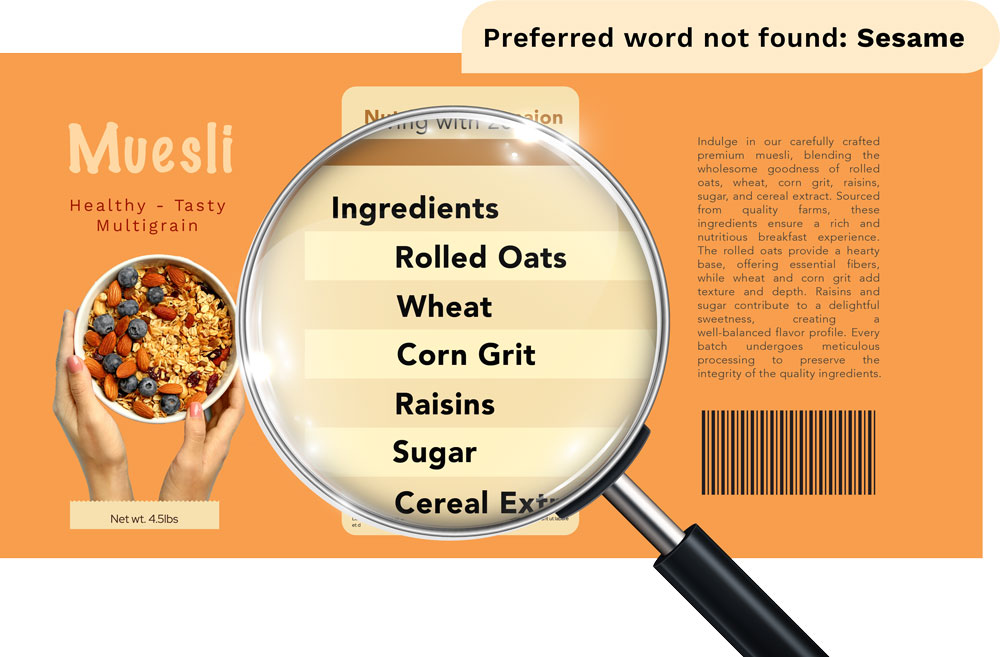
If sesame is a declared ingredient in one of your products, you set sesame as a required keyword in your rulebook. Comply immediately highlights any label version where that declaration is absent, so you can correct it before the file moves forward.
So, if you want to send out error-free labels and save your brand from costly recalls, book a demo today and see how Comply works like magic by automating your label compliance process.