Written by Mitha Shameer
Content Specialist, Esko
In 1978, Kenwood Vineyards commissioned artist David Lance Goines to design a label featuring a simple pencil sketch of a reclining nude. The U.S. government (the TTB’s predecessor) rejected it as “obscene.” Decades later, the label is a collector’s item, but the lesson remains: in the world of wine, your creative vision lives and dies by a federal checklist.
Today’s wine market is at a crossroads. As of early 2026, industry data shows that Millennials now represent 31% of wine drinkers, surpassing Baby Boomers. These consumers aren’t just looking for a drink; 75% are more likely to purchase wine produced sustainably. But here’s the rub: if your label doesn’t meet TTB (Alcohol and Tobacco Tax and Trade Bureau) standards, your sustainable, artisan wine won’t even make it to the shelf.
Creating a compliant wine label means navigating the line between strong design and strict federal regulations set by the Alcohol and Tobacco Tax and Trade Bureau (TTB).
What Makes a Wine Label Compliant
Every element on your wine label has a specific job. The TTB categorizes these into two zones: the Brand Label (the one the customer sees first) and Any Label (usually the back).
Mandatory on the Brand Label
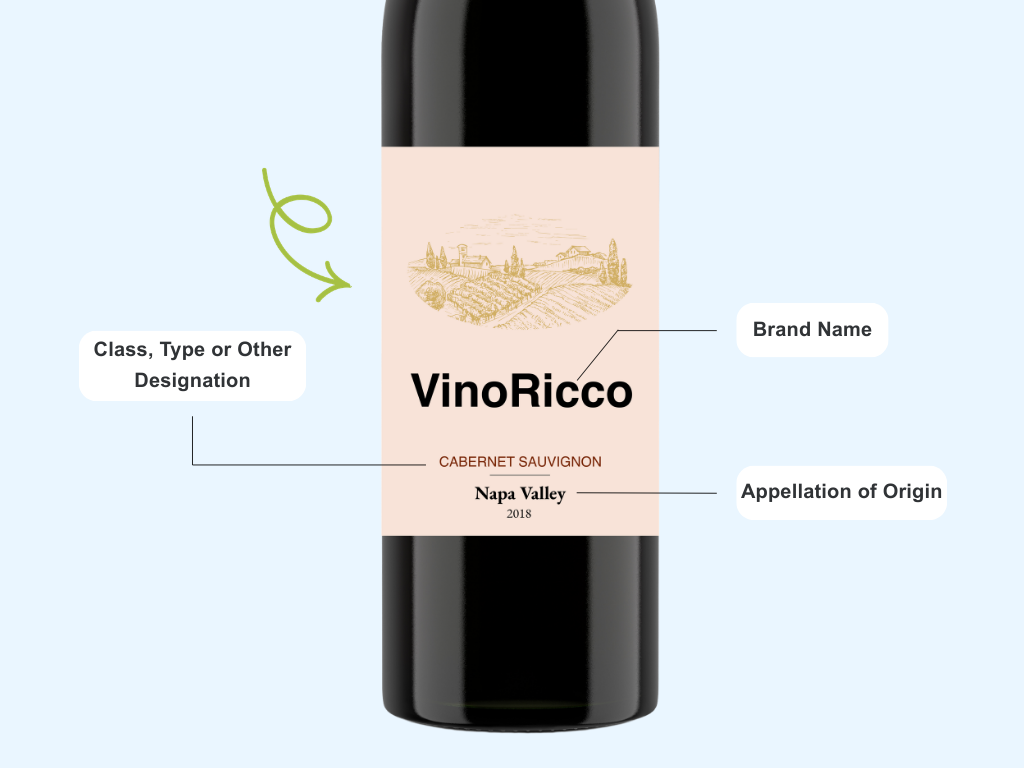
1. Brand Name
The name under which the wine is marketed. It must be truthful.
You cannot suggest an origin, age, or level of quality that isn’t accurate. For instance, naming a wine “Old Napa” when the grapes come from a different region could lead to rejection.
In the mid-2000s, a winery called Calistoga Cellars faced a years-long legal battle. They used “Calistoga” in their name, but their grapes weren’t entirely from that region. When Calistoga became an official AVA, the winery was nearly forced to rebrand.
Note: A class or type designation (like Chardonnay or White Wine) cannot serve as the brand name on its own.
If the label does not show a separate brand name, the name of the bottler, packer, or importer is automatically considered the brand name.
2. Class, Type, or Other Designation
Every wine must state its identity based on federal standards.
Examples: Red Wine, Sparkling Chardonnay, or Hard Cider.
This ensures consumers know what they’re buying.
Specialty Wines: If you add flavors or spices, your wine becomes a “Wine Specialty.” These require Formula Approval before you even apply for a label.
3. Appellation of Origin
This is mandatory if you use a grape variety (Pinot Noir), a vintage date, or a term like Estate Bottled. If none of these are used, it’s optional.
4. Percentage of Foreign Wine
It’s required on blends of American and foreign wines if you make any reference to the presence of foreign fruit (e.g., 30% Grape Wine from Italy).
Type Size: Minimum 2 mm for containers larger than 187 ml; 1 mm for smaller containers.
Mandatory on Any Label
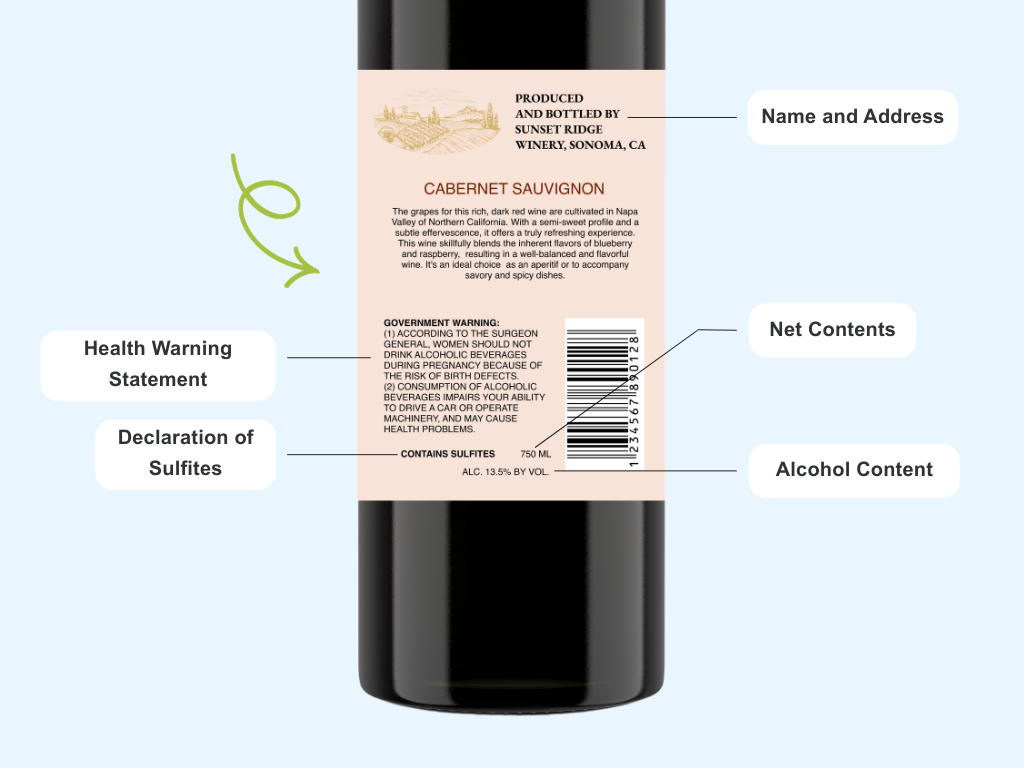
1. Health Warning Statement
This is the most common point of failure. It must be an exact, word-for-word reproduction of the federal text. Miss a single comma or fail to BOLD the first two words (“GOVERNMENT WARNING”), and your Certificate of Label Approval (COLA) application will be rejected.
This exact wording must appear on every alcoholic beverage label sold in the U.S.:
“GOVERNMENT WARNING: (1) According to the Surgeon General, women should not drink alcoholic beverages during pregnancy because of the risk of birth defects. (2) Consumption of alcoholic beverages impairs your ability to drive a car or operate machinery, and may cause health problems.”
Type Size: The minimum type size depends on the container volume:
1 mm for ≤237 ml; 2 mm for >237 ml up to 3 L; 3 mm for >3 L.
The warning statement must also stay within the allowed character density per inch:
2. Sulfite Declaration
Required if the wine contains 10 or more parts per million sulfur dioxide.
If added sulfites exceed a certain level (≥10 ppm), labels must say “Contains sulfites” or “Contains a sulfiting agent”.
This protects allergen-sensitive consumers.
3. Net Contents
The net contents of your wine label must follow Standards of Fill and use metric units.
Examples: 750 mL or 1.5 L
Standardization ensures consumers are comparing apples to apples across products.
4. Name and Address
A compliant wine label must also list the name and city/state of the bottler or importer.
Examples:
- “Produced and Bottled by Silver Ridge Winery, Healdsburg, CA”
- “Imported by Vintage Imports, NYC, NY”
This ensures regulatory accountability.
5. Alcohol Content
It indicates how much alcohol the wine contains, expressed as a percentage of alcohol by volume.
For wines above 14% alcohol by volume, a numerical alcohol statement is required.
For wines between 7% and 14% alcohol by volume, listing the alcohol percentage is optional if the label includes “table wine” or “light wine” as the required class/type designation.
The alcohol content can be shown as either a specific percentage or a range. Acceptable formats include:
- “Alcohol ___% by volume”
- “___% alc. by vol.”
- “___% to ___% alc. by vol.”
“ABV” is a common industry shorthand, but the TTB strictly prohibits using “ABV” in your mandatory statement.
Note: When stating a specific percentage, wines over 14% alcohol by volume are allowed a tolerance of plus or minus 1 percentage point.
Type Size: For containers 5 liters or smaller, the alcohol statement must use a type size between 1 mm (minimum) and 3 mm (maximum).
Imported & Specialty Wines: What Changes?
Imported wines face a similar but slightly expanded set of requirements. In addition to the elements above, labels must include Country of Origin (e.g., Product of France) and meet customs marking regulations.
Importers must also secure a COLA before removing wine from customs for sale, a key step in the compliance pipeline.
And if wine is under 7% ABV, it falls outside the Federal Alcohol Administration (FAA) Act governed by the TTB, but may still need to comply with FDA rules (like allergen labeling).
Optional But Regulated Add-Ons
Just because something isn’t required doesn’t mean it’s unregulated.
1. Appellation & AVA Declarations
Terms like Napa Valley or Sonoma Coast can add prestige, but only if the wine meets specific criteria, like minimum grape sourcing from the region.
2. Grape Variety Statements
If you list a variety (e.g., “Cabernet Sauvignon”), there are rules for minimum percentages.
Using grape names (like Pinot Noir) is allowed under specific standards. If you do, the accompanying appellation may be required to appear.
3. Vintage Dating
If a year appears, a required percentage of grapes must come from that harvest year. These claims add value, but only when used correctly.
4. Graphics/Pictorial Images
Pictures and illustrations on wine labels are regulated too. Any visual element must be truthful and should not create a misleading impression about the wine.
5. Additional (Optional) Information
Many labels include extra details to describe the wine or share its story. While this information is optional, it still needs to be accurate, specific, and not misleading. If you make claims about the wine, you should have records from the winemaking process to back them up.
6. Website Address and Other Digital Content Links
Web addresses and QR codes are now common on wine labels. But the content they lead to is treated as advertising and must follow regulatory rules. Any claims or details shown online must comply with applicable advertising regulations.
7. Fanciful Name
A fanciful name is a creative or descriptive phrase used alongside the brand name to further identify a wine. Brands often use multiple fanciful names within a product line. These names must not mislead consumers about the wine’s age, origin, or characteristics.
Unregulated Add-On: UPC and Bottle Return Information
A UPC is a scannable barcode used for retail checkout and inventory, while bottle return information tells consumers how to return or recycle the bottle, often tied to deposit or sustainability programs.
These elements are not regulated by TTB. You can add, remove, or update them on your labels without submitting a new COLA application.
Beyond these basics, many brands are using connected packaging to turn labels into digital touchpoints. Connected packaging technologies such as Scantrust, Twintag, and io.tt, available within the Esko ecosystem, help generate secure QR codes that enable traceability, authentication, and consumer engagement, so your label does more than just meet regulations.
If you’re exploring how 2D codes and digital product passports affect labeling, our latest guide provides useful context on what these changes mean for packaging teams.
Good Design Still Needs to Follow Rules
Compliance isn’t just about what you say; it’s about how it’s printed. The TTB has strict rules on how text must appear to ensure consumer safety and clarity.
- Legibility: All mandatory info must be on a contrasting background (e.g., no white text on a light cream label).
- Hierarchy & separation: Mandatory info must be “separate and apart” from promotional copy. You cannot bury your health warning inside a romantic paragraph about your vineyard’s soil.
Wine Label Errors That Can Cost You TTB Approval
Even seasoned producers sometimes run into issues:
1. Misplaced or Small Type
The TTB expects all mandatory elements to be legible and sized appropriately. Misjudging font size or placement can trigger a rejection.
2. Inaccurate Alcohol Statements
For wines with specific ABV tolerances, presenting numbers outside accepted ranges can lead to non-compliance or consumer confusion.
3. Incorrect Appellation Use
Claiming an AVA or varietal without meeting sourcing rules invites scrutiny.
Tiny details can cause big delays.
Navigating the TTB Wine Label Approval Process
Getting a COLA (Certificate of Label Approval) doesn’t have to be a black box:
- Prepare a high-resolution label file
- Ensure all mandatory elements are present and correct
- Submit through TTB’s COLAs Online portal
- Expect review time that varies based on workload and label complexity
If rejected, review comments carefully. Many brands find that minor formatting issues are the primary stumbling blocks, not branding claims.
Staying Compliant as Rules Evolve
The TTB periodically updates guidance and interpretation. A few best practices:
1. Keep Records
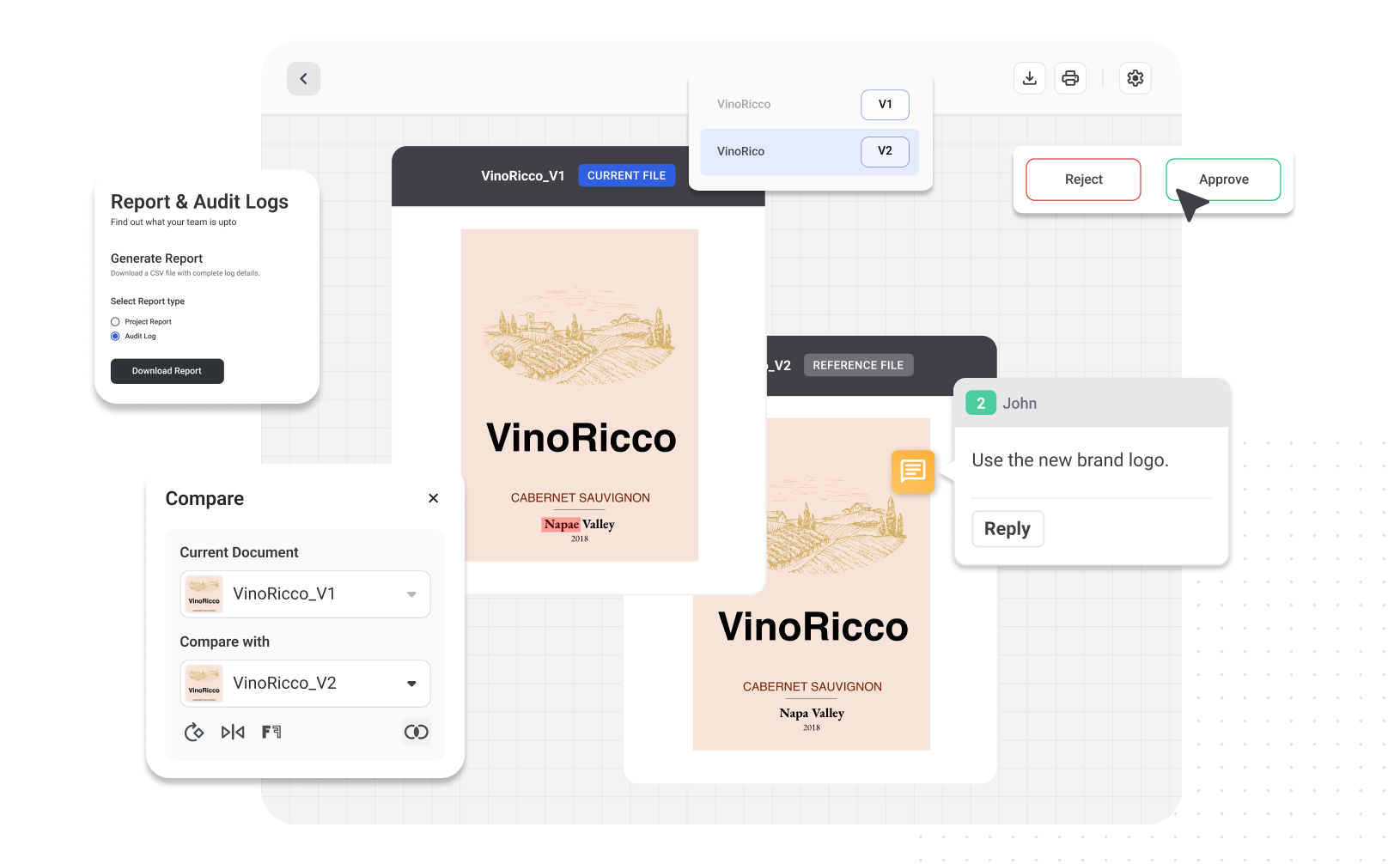
Document label versions, approvals, and reviewer correspondence. In practice, this means more than saving files in folders. It requires a clear history of who approved what, and when.
Many wine brands are moving this record-keeping into structured artwork management systems, where version histories, comments, and approvals are automatically logged. This makes it far easier to retrieve documentation during audits or when questions arise about past decisions.
2. Use Checklists
TTB provides a Mandatory Label Information Checklist to minimize mistakes.
Many teams also build these checks directly into their workflow. Artwork management tools such as WebCenter Go let you attach compliance checklists to review tasks, so reviewers verify items like ABV format, health warnings, and appellations as part of the approval process, not as an afterthought. This creates a documented trail and reduces the risk of missing critical details.
3. Plan for Revisions
Even after label approval, changes (especially mandatory info) may require resubmission or allowable revision tracking.
A centralized system helps teams manage these updates without confusion. Instead of reworking files from scratch or relying on email threads, teams can duplicate approved wine labels, apply controlled edits, and route them through the same compliance checks. This reduces the chance of outdated information slipping back onto press and keeps revision handling structured and defensible.
Why Automation Matters in Wine Compliance
The “to automate or not” question is largely settled for many wine businesses. With category growth under pressure, the financial impact of preventable delays, relabeling, and compliance errors is harder to absorb. Manual reviews and fragmented workflows introduce risk that few teams can justify.
Wineries are increasingly adopting structured artwork management and automated compliance tools to bring consistency and control to label development and approvals.
Reduce Preventable Human Error
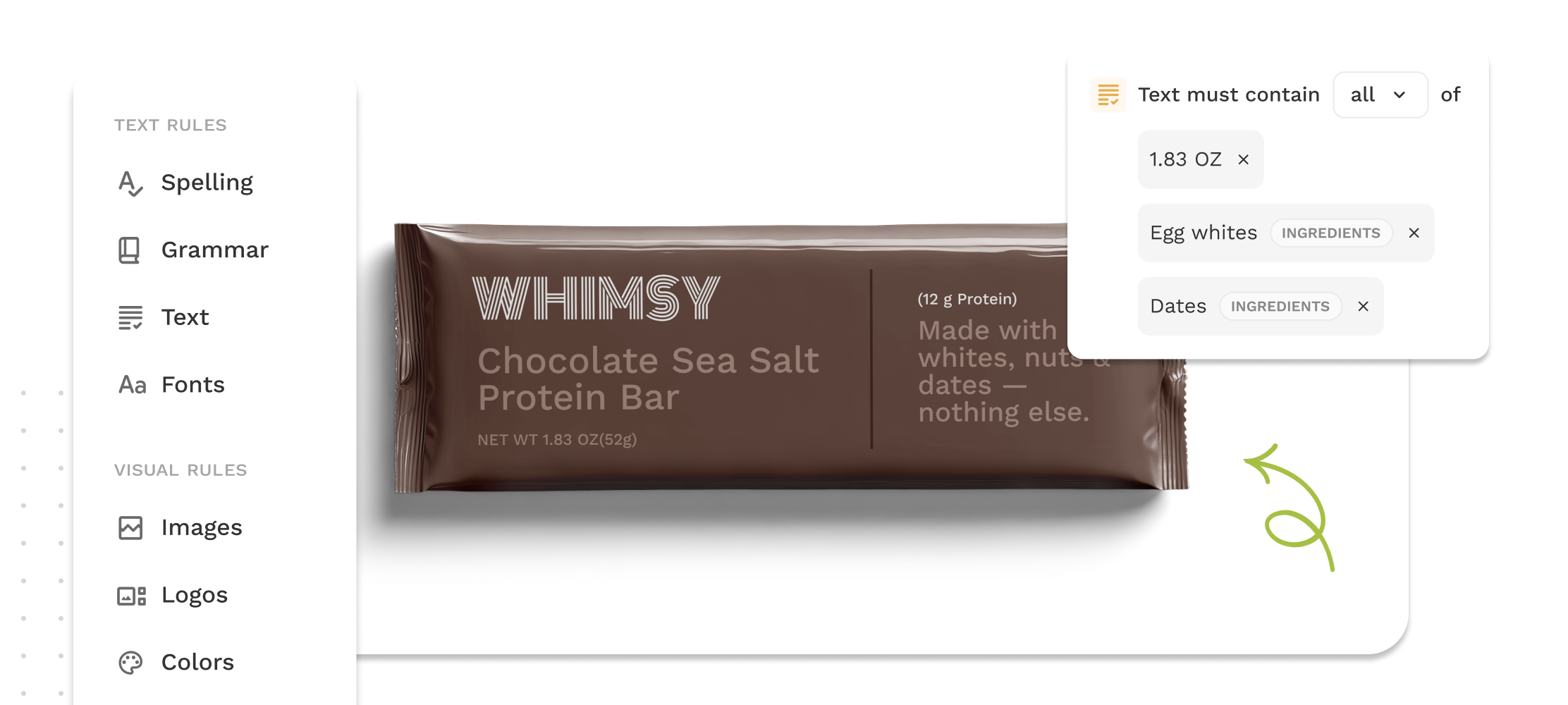
Small technical mistakes, like punctuation in a health warning, incorrect abbreviations, or undersized type, can trigger rejections and launch delays. Automated compliance tools like Comply function as a digital checkpoint by verifying:
- Mandatory copy: Matching text against approved regulatory databases.
- Formatting rules: Enforcing font sizes, styles (like BOLD CAPS for warnings), and contrast.
- Symbol accuracy: Checking that sulfite declarations and logos are present and sized to TTB specs before the designer even hits “export.”
This moves error detection earlier in the process, when corrections are faster and less costly.
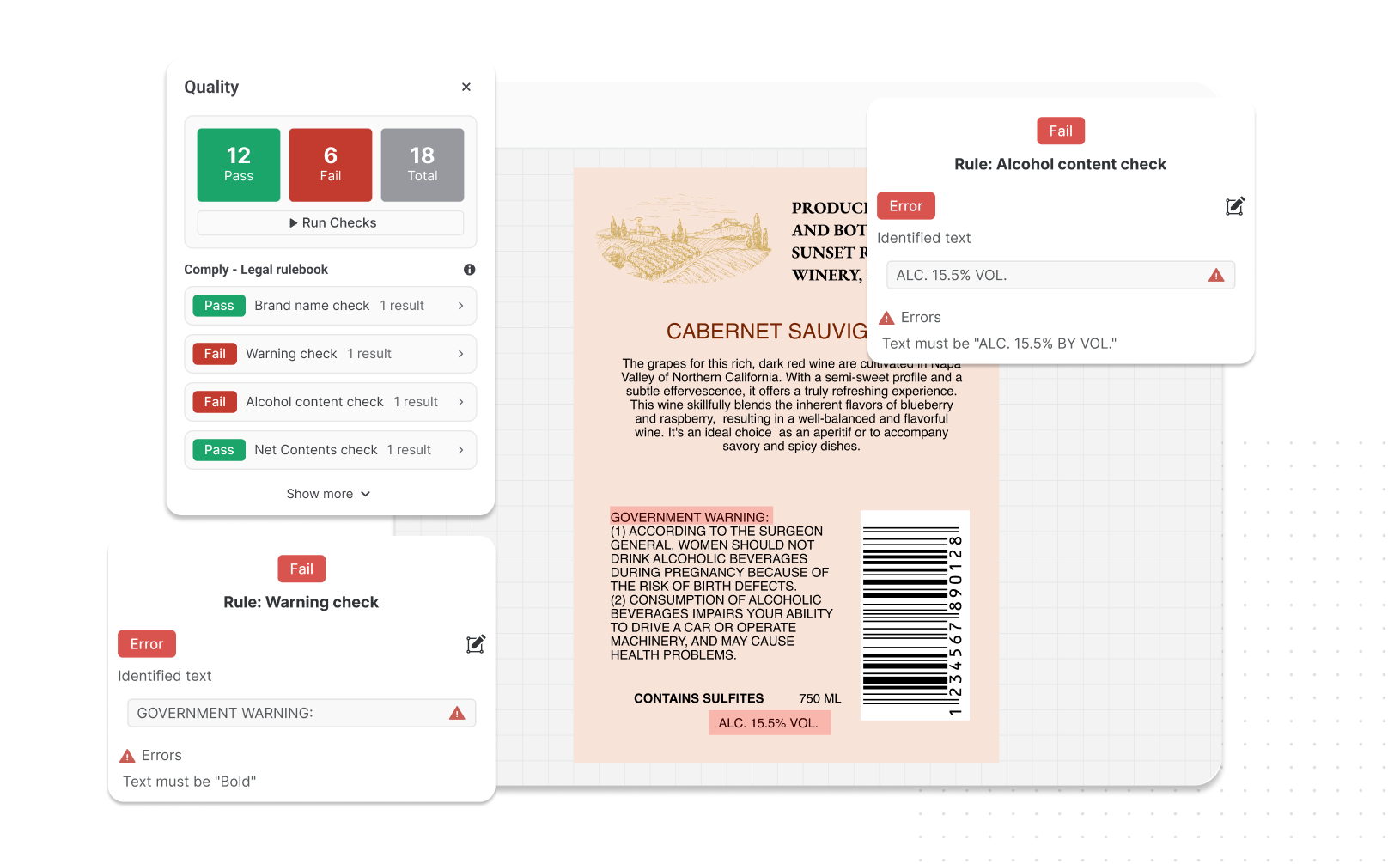
Comply detecting formatting and regulatory risks on a wine label
Flexible Workflows to Managing Large-Scale Label Revisions
In 2025, new trade framework deals implemented a 15% U.S. import duty on EU wines, necessitating rapid label changes.
A structured artwork management system turns what could be a disruptive overhaul into a controlled process. Instead of manually revising large numbers of files, teams can route updates through legal, marketing, and winemaking reviewers at the same time, with visibility into status and approvals.
Bulk-edit capabilities allow common elements, such as importer information, ABV statements, or required logos, to be updated across dozens of SKUs in a single cycle. Automated checks then verify that revised elements meet formatting and content rules before files are finalized. This reduces the likelihood of last-minute errors that often occur during time-sensitive changes.
The Cost of Getting it Wrong
When it comes to compliance, “almost right” is just as expensive as “completely wrong.” In the current 2026 landscape, the margin for error has evaporated.
Direct-to-Consumer (DTC) Shifts
The DTC shipping channel suffered its most challenging year on record in 2025, with national shipment volume plunging 15% and total value dropping 6%. With wholesale margins tightening, a single rejected label can eat up the remaining profit on a vintage.
Historically, DTC was a safe haven with high margins. Now that it’s shrinking, wineries are forced back into the high-volume wholesale market where margins are razor-thin.
The “Obscenity” Trap: Federal Approval vs. State Reality
The 1978 label featuring David Lance Goines’ reclining nude, once rejected as obscene, illustrates how the tension between creative expression and regulatory interpretation continues today.
Getting a federal COLA (Certificate of Label Approval) is only the first hurdle. Many producers forget that states have their own “decency” standards.
In a famous 2009 case, the wine Cycles Gladiator featured a classic 19th-century French art-nouveau poster of a nymph. The TTB approved it, but the Alabama ABC Board banned it, calling it immoral and sensuous.
While names like “Fat Bastard” have been approved, other labels like The Prisoner or Bad Frog Beer have faced state-level bans for being too aggressive, morbid, or indecent.
An artwork management solution lets you set specific workflows for hThe system can automatically flag a design for an extra legal review if it’s destined for a state with stricter obscenity or labeling laws.
You can also store multiple versions of a label (e.g., an “Original” version for California and a “Modified” version for Alabama) within the same project. Automation ensures that the correct, state-approved file is the only one sent to the printer for that specific distribution run.
Wrapping Up
The competition is fierce. The middle market is collapsing, forcing brands to either go premium or go high-volume. In both scenarios, you cannot afford a creative process that is all over the place.
Getting your labels right the first time means faster approvals, zero rework, and the confidence to launch a vintage while the buzz is still fresh. If you’re tired of being at the mercy of a manual checklist, it’s time to let automation take the wheel. Book a demo of Comply today.