Mitha Shameer is a content specialist who writes for various SaaS platforms across Esko, bringing nearly six years of experience in writing
Getting a plant-based label right sounds simple.
Until you have to launch the same product across multiple markets.
One team wants familiar wording. Another wants a vegan symbol on pack. Regulatory wants proof for every claim. Prepress has to version artwork for different regions without introducing errors. For teams still coordinating that through email chains and spreadsheets, WebCenter Go workflow automation is built to route reviews, approvals, and rework loops far more systematically.
That is where things get messy fast.
Plant-based products existed long before the category took off. But they only really became a mainstream retail fixture in the early 2010s, as alternative diets and health trends accelerated.
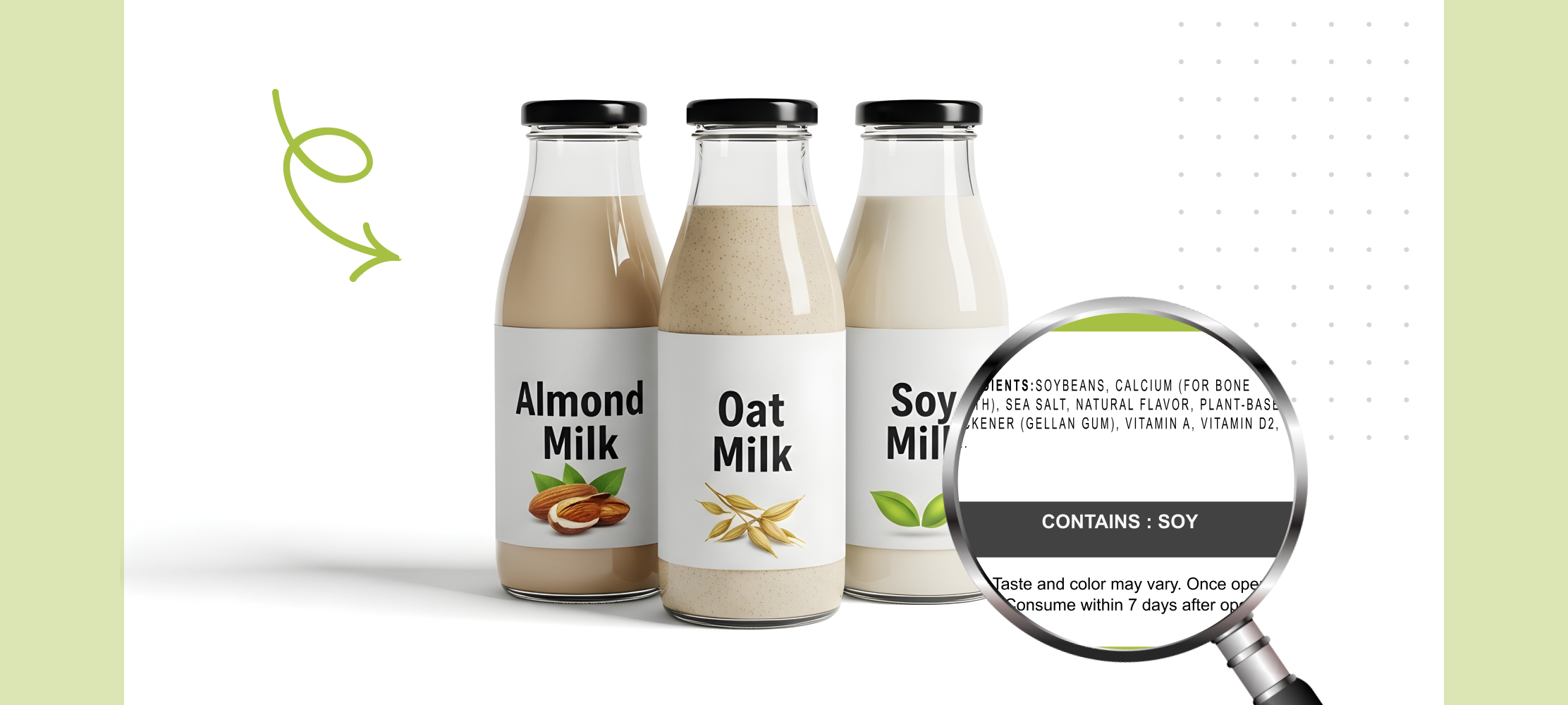
At first, many brands leaned on familiar dairy and meat language. You saw terms like soy milk, almond butter, vegan cheese, and plant burger.
Packaging often carried nothing more than a “vegan” or “plant-based” sticker, with no consistent legal framework behind it.
Then the market grew. Sales climbed. Regulators started paying closer attention to how these products were named and presented so consumers would not be misled.
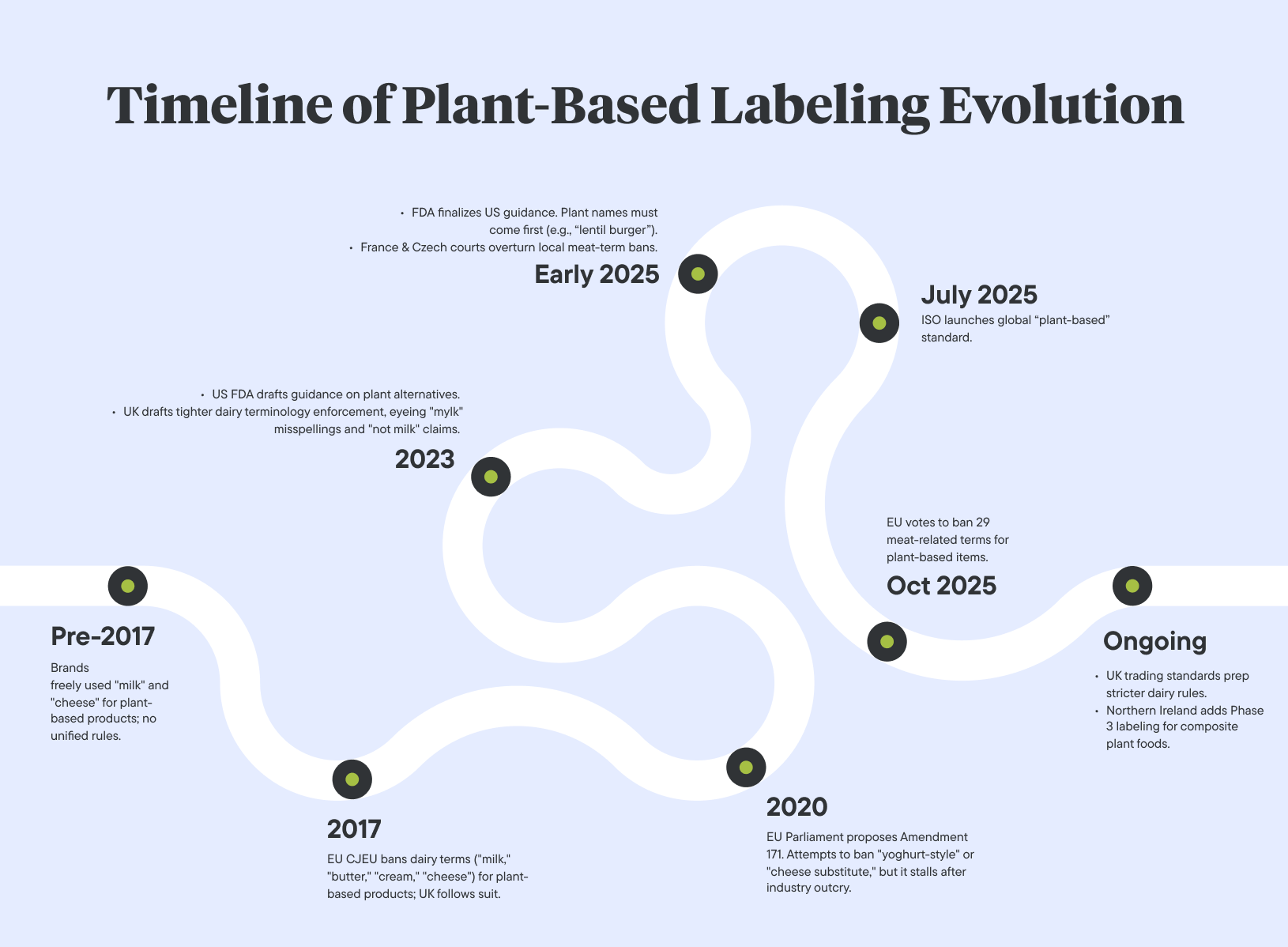
The big turning point came in 2017, when the EU Court of Justice ruled that terms such as milk, butter, and cream are reserved for animal products. That forced plant alternatives to use qualifiers like soya drink instead.
How Plant-Based Labeling Evolved Over the Years
Trying to keep up with plant-based rules across markets?
That is the real challenge.
Since 2017, labeling rules have split further across regions, creating a patchwork that is hard to manage if you sell across borders.
Packaging is nobody’s responsibility. It sits between departments, so everyone assumes someone else is handling it. That’s how errors fall through the cracks.
Jan De Roeck Director – Industry Relations & Strategy, Esko
Claims, ingredients, translations, and legal statements need to stay aligned in one controlled system, because when regulations change, teams need fast, coordinated on-pack revisions across markets.
Bart Tielemans, Senior Enablement Platform Specialist at Esko
Key recent shifts
In July 2025,ISO 8700:2025 introduced a stricter definition of “plant-based.” It distinguishes between products with zero animal-derived ingredients and products that include limited animal-origin inputs and therefore need qualifiers.
In January 2025, theU.S. FDA also issued draft guidance that treats plant-based alternatives to animal-derived foods as non-standardized foods. The agency did not ban familiar naming conventions outright, but it made clear that labels should identify plant sources clearly so consumers are not misled.
The EU story moved again after the original wave of 2025 headlines.
So this is no longer just a pending trilogue talking point. It is a more concrete step toward tighter EU naming controls.
At the same time, enforcement is still not perfectly uniform at country level.France and theCzech Republic, for example, have allowed terms like soy steak to be used again after court decisions.
Those rulings also align with theCourt of Justice’s view that member states cannot create stricter national bans beyond EU law.
If you are managing artwork for multiple markets, this is exactly the kind of moving target that breaks spreadsheet-based review. For organizations handling more complex global processes, WebCenter Enterprise provides a central system for artwork, approvals, and compliance across regions.
Then one non-compliant claim can hold up approvals, trigger rework, or force a relabeling exercise you did not budget for.
Here is what plant-based labeling rules currently permit or restrict in the EU, US, and UK as of April 2026.
2025 is shaping up to be a year of major regulatory shifts. These changes have already begun and will continue to challenge R&D teams in 2026 and beyond to innovate with alternative ingredients and labeling teams to adjust their nutritions facts and panels.
Kari Barnes, Regulatory Standards Manager at TraceGains
European Union (EU)
Selling into Europe?
This is where naming rules get strict quickly.
Dairy terms like milk, butter, and cheese have been off-limits for plant-based alternatives since the 2017 court ruling. That part is established.
The pressure point now is meat terminology.
Back in October 2025, the European Parliament approved restrictions on 29 commonly used meat-related words, such as burger, sausage, steak, and bacon, when used for plant-based items.
The post-October picture has since moved forward. On March 5, 2026, the Parliament and Council announced a provisional agreement that protects the term meat and a specified list of meat-related names for meat products only.
For packaging teams, that matters. A label that looked acceptable a few months ago may now need review before the next print run.
Still, EU-wide policy does not always translate into identical day-to-day enforcement. Member states continue to interpret and apply the rules differently.
France and the Czech Republic, for example, overturned local bans, which means terms like soy steak or vegetable sausage may still be used there in certain contexts.
The other important development is ISO 8700:2025. It gives you a clearer framework for how the term plant-based should be used:
Category 1 products are fully plant-based, with no animal-derived ingredients and a characterizing plant ingredient.
Category 2 products may allow limited conditional animal-origin inputs, but they need qualifiers.
That standard does not replace local law. But it does help brands create more consistent internal rules across regions.
Use our checklist to review claims, visuals, and mandatory information with confidence.
Loading...
United States (US)
Working in the U.S. and assuming the rules are looser?
They are more flexible than in the EU, but not loose enough to ignore.
The FDA generally treats plant-based alternatives as non-standardized foods, which gives brands more room to name products, as long as the label clearly tells consumers what the product is.
For meat or seafood alternatives, that usually means leading with the plant source, such as:
Soy burger
Black-bean patty
Lentil sausage
The FDA’s January 2025 draft guidance for plant-based alternatives to animal-derived foods does not ban terms like burger or sausage. But it does expect brands to use those terms in a way that does not imply the product is animal-derived.
A separate track for milk alternatives
Milk alternatives sit on a separate track.
The FDA’s February 2023 draft guidance for plant-based milk alternatives still recognizes names like soy milk and almond milk as common and acceptable. So in the U.S., dairy naming for milk alternatives is not handled the same way as in the EU or UK.
Where the FDA wants more care is nutrition communication. If a plant-based milk contains more or less of certain nutrients than dairy milk, the agency encourages voluntary comparison statements such as “contains lower protein than milk.”
That sounds manageable until marketing starts reaching for broad positioning.
Claims like “25% more calcium than cow’s milk” can be fine, but only if they are supported by reliable evidence. Unqualified messaging that suggests plant-based foods are automatically healthier creates risk.
That risk has increased.
The FDA’s wider nutrition-labeling agenda has tightened the policy environment around wellness language. Its updated “healthy” rule and its January 2025 front-of-pack nutrition labeling proposal both raise the bar for vague “better-for-you” messaging, even when the product category is plant-based.
There is another nuance worth calling out.
Nutritional equivalence is not automatic, especially in plant-based drinks. Fortified and unfortified products can differ significantly from cows’ milk on nutrients like calcium, iodine, vitamin A, and B12.
So if your pack implies “just like dairy” nutritionally, you need data, not assumptions.
United Kingdom (UK)
Selling in the UK and expecting a near-copy of U.S. rules?
That is where teams get caught out.
The UK broadly mirrors the EU’s long-standing position on dairy naming. Terms such as milk, yoghurt, cheese, and cheddar are off-limits for plant-based products, regardless of qualifiers.
Even phrases like yoghurt-style or cheddar-type have been flagged in draft guidance and may face tighter enforcement.
The UK is also taking a firmer position on workarounds. Homophones and creative spellings such as mylk are increasingly viewed as risky.
In other words, clever naming is not a reliable compliance strategy.
Great Britain and Northern Ireland
If you move products between Great Britain and Northern Ireland, there is a second layer to manage. Northern Ireland’s Phase 3 labeling expansion fully took effect on July 1, 2025.
Under Phase 3, a broader set of products, especially composite foods like pizzas, ready meals, and desserts, must now carry individual “Not for EU” labels when they contain a mix of plant-based components and any processed product of animal origin, and when they are not shelf-stable or already covered by sanitary or phytosanitary checks.
Fully plant-based items generally remain exempt unless they fall into niche official-control categories.
But if a product contains even a small amount of animal-derived ingredient, for example a lasagna with plant vegetables and a meat-based sauce, every single retail unit must be labeled.
Outer-box labeling is not enough. Blanket declarations are not enough.
There was a short grace period for goods already in Northern Ireland before July 1, 2025, allowing compliance until July 31, 2025. That window is closed.
So if your business operates across Great Britain and Northern Ireland, your artwork workflow needs tighter version control and faster review cycles.
If not, delays, fines, and shipment disruption become very real risks.
Symbols and Certifications: What They Really Mean
Think the symbol will do the compliance work for you?
It will not.
Plant-based shoppers rely heavily on symbols, so choosing the right certification matters. But each mark comes with its own standards, audit approach, and market recognition.
Use the wrong one, or overstate what it proves, and you create a different kind of risk.
As Bart Tielemans, Senior Enablement Platform Specialist at Esko, explains:
“On-pack text is never just copy. Claims, ingredients, translations, and legal statements all need to be created and validated together so every market version stays accurate.”
Some of the most recognized options include:
The Vegan Society Sunflower, one of the oldest and most widely recognized marks, which signals no animal ingredients and no animal testing
V-Label, especially prominent in Europe, with independent audits that many food and beverage brands value
ProVeg Plant-Based certification, a newer option that focuses on clear verification of plant-derived positioning for international markets
The newer ISO 8700:2025 standard adds more structure here too. It distinguishes between products that are entirely plant-derived and those that are primarily plant-based but still include limited animal-origin inputs.
If you want to use plant-based without qualification, you need to meet the strictest zero-animal-ingredient standard.
That is also why DIY symbols and self-invented vegan badges are a bad idea. They weaken trust, confuse consumers, and in some jurisdictions may be considered misleading.
But do not overread certification either.
A third-party mark is a trust signal, not a substitute for legal compliance review. It does not automatically prove your naming, allergens, nutrition claims, or market-specific presentation are compliant.
Plant-based, vegan, and free-from are not the same thing
This is one of the most common sources of confusion.
Plant-based usually describes the formulation or overall product positioning.
Vegan signals that the product does not contain animal-derived ingredients and typically aligns with stricter ingredient and processing expectations.
Free-from is different again. It speaks to allergen absence or safety expectations, not lifestyle positioning.
Those are not interchangeable messages.
A vegan claim does not mean allergen-free. A plant-based product does not automatically qualify for a vegan certification. And a free-from claim needs its own evidence and controls.
If your teams are managing claims, symbols, and reusable copy across multiple SKUs, centralized content management becomes critical.
Hidden formulation risks that can undermine a claim
Front-of-pack wording is only part of the story.
A product can look compliant at artwork stage and still create problems because of what sits behind the claim.
Common blind spots include:
Animal-derived minor ingredients hidden in flavorings, additives, or carriers
Processing aids that do not stand out on the label but still matter for vegan assessment
By-products or derivatives in colorants, coatings, or capsule materials
Supplier-level substitutions that change ingredient origin without being reflected in packaging copy
Versioning gaps where one market pack is updated but another still carries an outdated claim or symbol
This is where structured packaging content matters.
When ingredient-related text, claims, and symbols live in disconnected files, errors spread fast. WebCenter Enterprise content management helps teams govern and reuse that content more safely across markets.
And when approved changes need to cascade consistently across variants and outputs, WebCenter Automated Artwork helps remove manual copy-and-paste from the update process.
Risky Claims That Get Brands into Trouble
Seen a plant-based pack that looks fine at first glance?
That is exactly the danger.
Many of the highest-risk errors are subtle.
Naming, allergens, and nutrition pitfalls
One of the most common issues is still using traditional meat or dairy descriptors without proper qualifiers. In the EU and UK, calling something milk or cheese without the right plant context is an immediate red flag.
In the U.S., brands have more flexibility, but clarity is still essential.
Allergens are another frequent problem. Oat-based snacks labeled gluten-free, for example, may fail legal requirements because of cross-contact during milling or processing.
And here is a nuance teams often miss: a product can be vegan in formulation and still need a precautionary allergen statement such as “may contain milk” or “may contain egg” if a real cross-contact risk remains after assessment.
Vegan and allergen-free are not the same thing.
Nutrition and wellness language is another trouble spot.
Claims like:
better for you
clean protein
nutritionally superior
may sound harmless, but they often imply a comparison that needs evidence.
That scrutiny is increasing, especially in the U.S., where recent FDA nutrition policy developments make broad wellness positioning harder to defend.
It is also becoming harder to imply that plant-based drinks are nutritionally equivalent to dairy without a solid basis, because nutrient levels can vary widely between fortified and unfortified products.
Visual impression and enforcement risk
Then there is imagery.
Visuals that mimic dairy, eggs, or meat can still create risk even when the wording looks technically acceptable. Farm scenes. Raw-cut illustrations. Drips of “milk.” Butcher-style layouts.
All of these shape the overall net impression of the pack.
When those elements are inconsistent with the product’s true nature, the consequences are not theoretical.
Still trying to manage plant-based labeling with PDFs, spreadsheets, and memory?
That is where teams lose time and miss details.
Plant-based labeling rules shift by region, product type, and sometimes by quarter. Manually tracking naming restrictions, claim requirements, allergen expectations, ingredient-source disclosures, and visual presentation rules is hard enough.
Doing it at scale across artwork versions is harder.
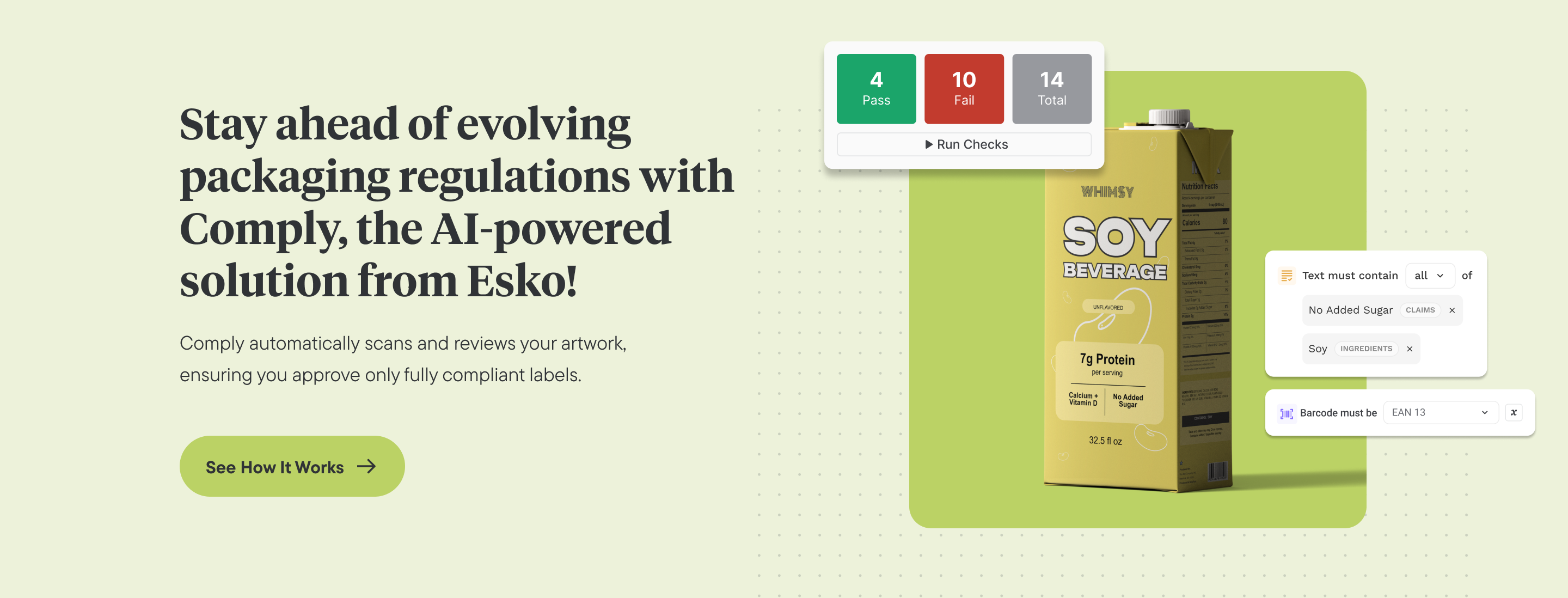
That is exactly why Comply exists. And when teams want those checks inside a broader packaging workflow rather than as a stand-alone activity, WebCenter Go brings proofing, routing, and AI-led compliance together in one environment.
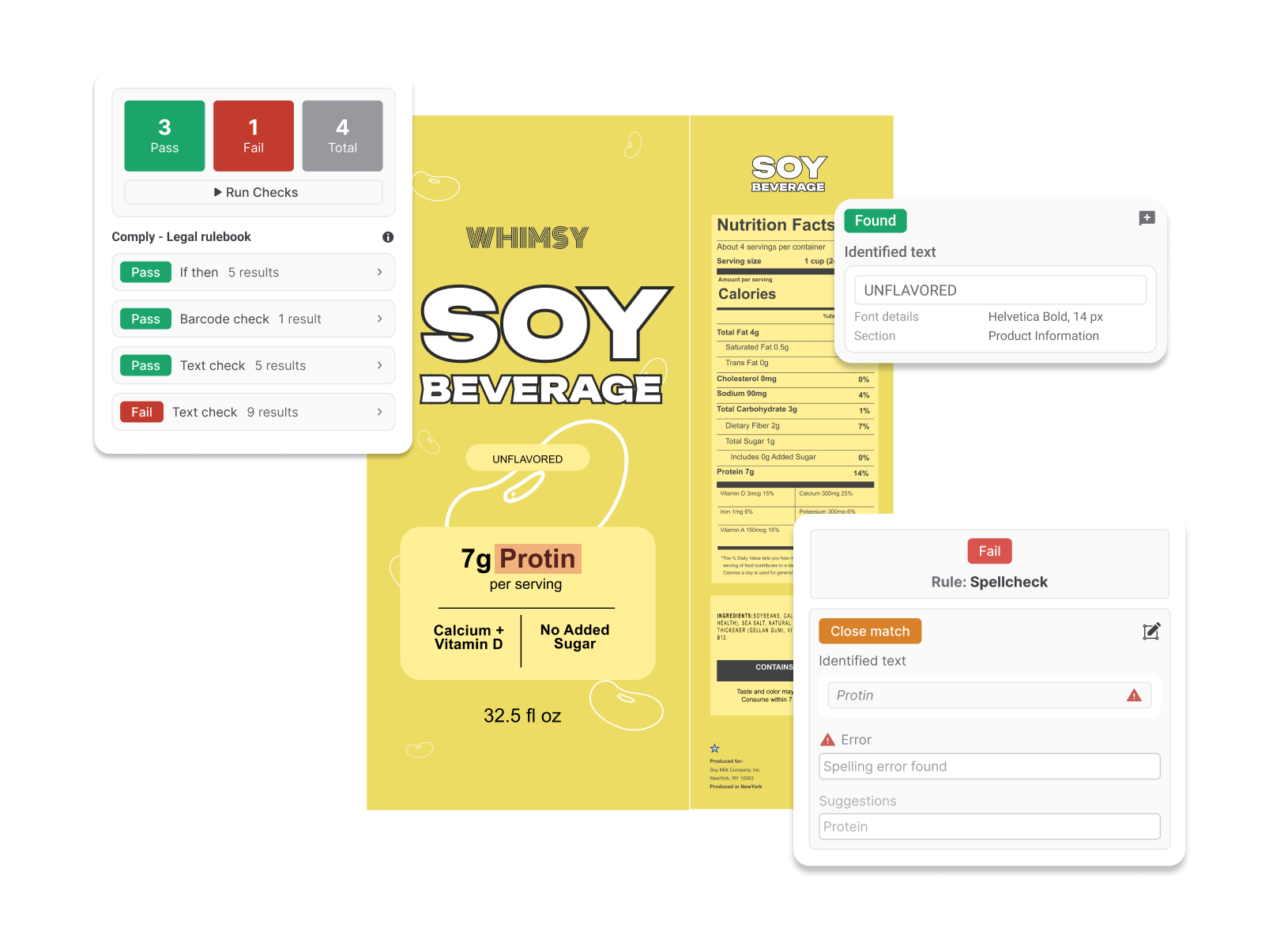
Comply is an AI-powered automated label compliance solution that helps keep your packaging artwork compliant and error-free. You can upload artwork and immediately see which elements may create issues in the US, UK, or EU.
The platform checks your label against custom rulebooks, including:
Region-specific naming rules
Claim guidelines
Allergen requirements
Ingredient-source disclosures
Symbols and logo usage
Other market-specific compliance rules
It then generates a detailed result card that shows:
What’s correct
What’s incorrect
Why it was flagged
Which rule or regulation it relates to
What your team needs to update
That changes the workflow in a very practical way.
Instead of jumping between regulatory PDFs, local guidance notes, email threads, and outdated spreadsheets, your team works from one controlled environment.
Comply also becomes a training layer. Designers, project managers, marketers, and reviewers learn the nuances by doing.
They see when almond beverage is the safer choice than almond milk. They see when a vegan burger claim works in one market but not another. They see what needs evidence and what needs rewording.
For global brands, that means tighter approvals, fewer revision rounds, lower risk, and faster time to market, without needing a regulatory specialist on every project.
Final Thoughts: Why Getting Labeling Right Matters
Plant-based products are booming.
But trust, compliance, and brand credibility still come down to one thing: clear, honest, region-appropriate labeling.
Compliance doesn’t have to be a burden; it can become a strategic advantage with the right tools in place.
Gwen Bultelle, CPG Category Specialist at Esko
A simple naming choice can create outsized risk. Call almond milk milk in the EU, and you may trigger a compliance issue.
Use vegan cheese without the right supporting naming or context, and you may invite the same kind of pushback.
The safest approach is not to wait for a market complaint or a regulator comment.
Build compliance into your packaging and artwork workflow from the start. Put guardrails around naming, claims, visuals, symbols, allergens, and version control early.
That is how you stay ahead of relabeling risk.
It is also how you scale globally without losing control of the details that matter most.
About the Author
Mitha Shameer is a content specialist who writes for various SaaS platforms across Esko, bringing nearly six years of experience in writing. She’s passionate about creating content that resonates deeply with audiences and drives performance. When she’s not working on her next piece, she’s probably binge-watching crime documentaries or overthinking something she said five days ago.