AI is a buzzword that has been used to exhaustion, and it has definitely lost some of its spark (at least on paper). Sure, we’ve beaten it to death. But when it comes to regulatory compliance, you simply can’t ignore it. So, what does it really mean to use AI in packaging compliance?
When intelligence and automation take the lead, your team’s job becomes much easier. You no longer have to rely on manual processes to catch errors and ensure label accuracy. As they say, the higher the stakes, the bigger the risks. And in regulatory compliance, even one slip-up can lead to recalls, reprints, or penalties.
AI is not the future.
It is the present. AI has already found its way into the packaging lifecycle, whether in risk management, project planning, quality control, supply chain optimization, or, most importantly, regulatory compliance. With AI, reviews get faster; you catch errors that are otherwise missed and get your products to market quicker.
It’s always daunting to embrace change when you’ve grown comfortable with familiar ways of working over decades. But if you’ve ever faced the following challenges, you know why the old-school approach can hold you back:
Complex and scattered review cycles
Missed errors during compliance checks
Delayed launches with all that back-and-forth
In packaging, regulatory teams have their work cut out for them. Packaging regulations keep changing, and every six months, you either get a new one or see an existing one updated.
This year alone, we have seen new labeling updates shaping up such as mandatory harmonized EU labels with clear material composition and recycling instructions, requirements for visible QR codes providing reuse and recycling info, and bans on ambiguous environmental claims to enhance consumer clarity and promote proper packaging disposal.
For packaging teams, this means updating all existing product labels to stay compliant — sometimes hundreds or even thousands of them — often within tight timelines. And that’s exactly when errors creep in: when large-scale reviews are handled manually.
Enter Comply.
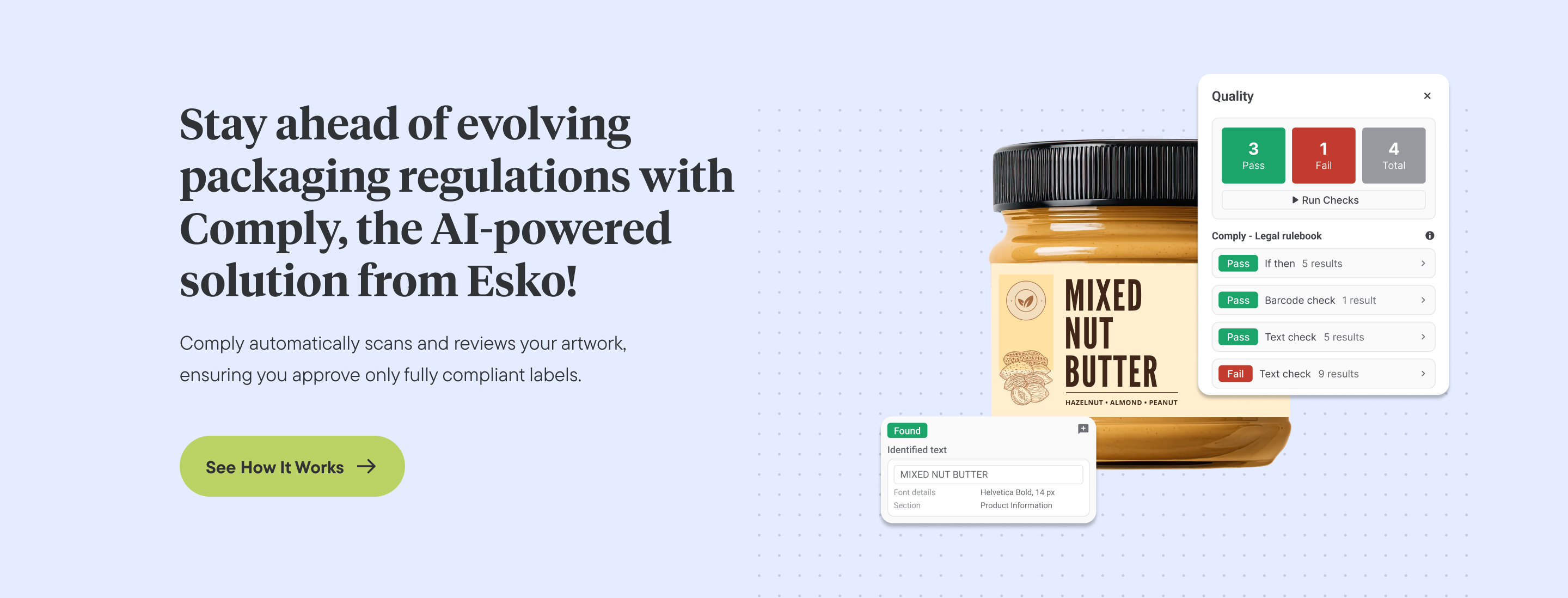
Comply is an AI-powered solution that automates label reviews and compliance checks, making the process faster, more accurate, and less prone to mistakes.
Can AI Really Simplify Label Compliance for Packaging Teams?
The obvious answer is yes! But the real question is how much can it actually simplify, and where does human expertise still matter?
Think about it: the biggest delays often happen during label reviews and regulatory approvals. Your team is juggling multiple SKUs, reviewing hundreds of labels, and ensuring every element of the artwork is both legally compliant and on-brand. This is where most teams struggle and where errors creep in.
AI helps change that by flagging issues when you feed the right data. For instance, with Comply, you can set up a rulebook that draws directly from your product specification data, covering details like ingredient lists, claims, and mandatory label copy. It then automatically validates your artwork against these predefined rules and flags any deviations or inconsistencies as compliance errors.
All this to say, instead of manually checking every file, all you have to do is click a button, and AI reviews them for you.
We built Comply to help organizations meet the endless complexities of regulatory affairs with simplicity and efficiency. It empowers teams to push the boundaries of innovation and bring products to market faster, without the usual risk of recalls.
Rakesh Edavalath, Director of Product Management, Esko
Now, let’s look at the different stages of a regulatory packaging review that automation and AI can help simplify:
Spelling
Spelling errors may seem minor, but they can hurt brand credibility and even lead to regulatory issues. In sectors like F&B, cosmetics, and pharma, a single misspelled ingredient, allergen, or claim can confuse consumers, trigger compliance flags, or force costly reprints.
The spellcheck tool scans your artwork for spelling errors and ensures accuracy in over 25 languages. You get precise suggestions along with a detailed report highlighting incorrect spellings and their corrected recommendations.
Critical Statements
This includes mandatory declarations like net quantity, ingredient lists, allergen warnings, storage instructions, MRP, and legal disclaimers.
Visual representation of nine major allergens.
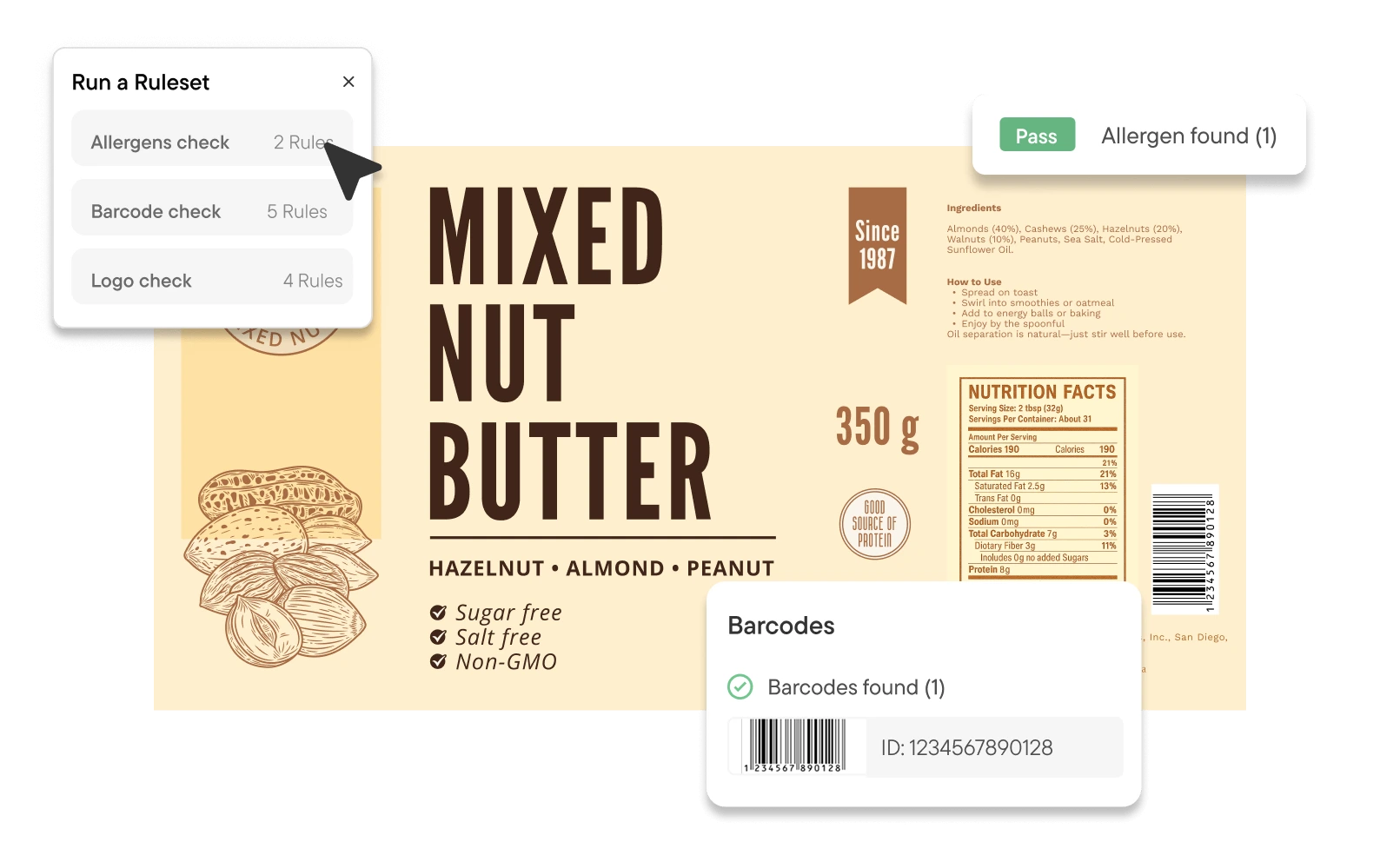
Comply automatically detects inaccurate, missing, or misplaced critical statements by comparing the artwork against your approved specification data.
Formatting
Packaging regulations often specify how certain information must appear — from the placement of nutritional declarations to exact panel sequencing for multi-panel labels. Formatting issues are one of the most common causes of compliance deviations, especially in fast-moving design cycles.
Comply scans layouts, panel order, indentation, alignment, and hierarchy to ensure everything matches regulatory and brand formatting rules. This prevents costly iterations and ensures packs consistently follow the right visual and compliance structure across SKUs.
Fonts and Sizes
Regulators define minimum font sizes (e.g., height of numerals in net content, mandatory text in food or cosmetic labels).
The AI checks every character’s font family, size, and weight against your rulebook. It flags undersized or incorrect fonts instantly, protecting brands from violations related to readability, legibility, and regulatory type-size rules.
Logos and Symbols
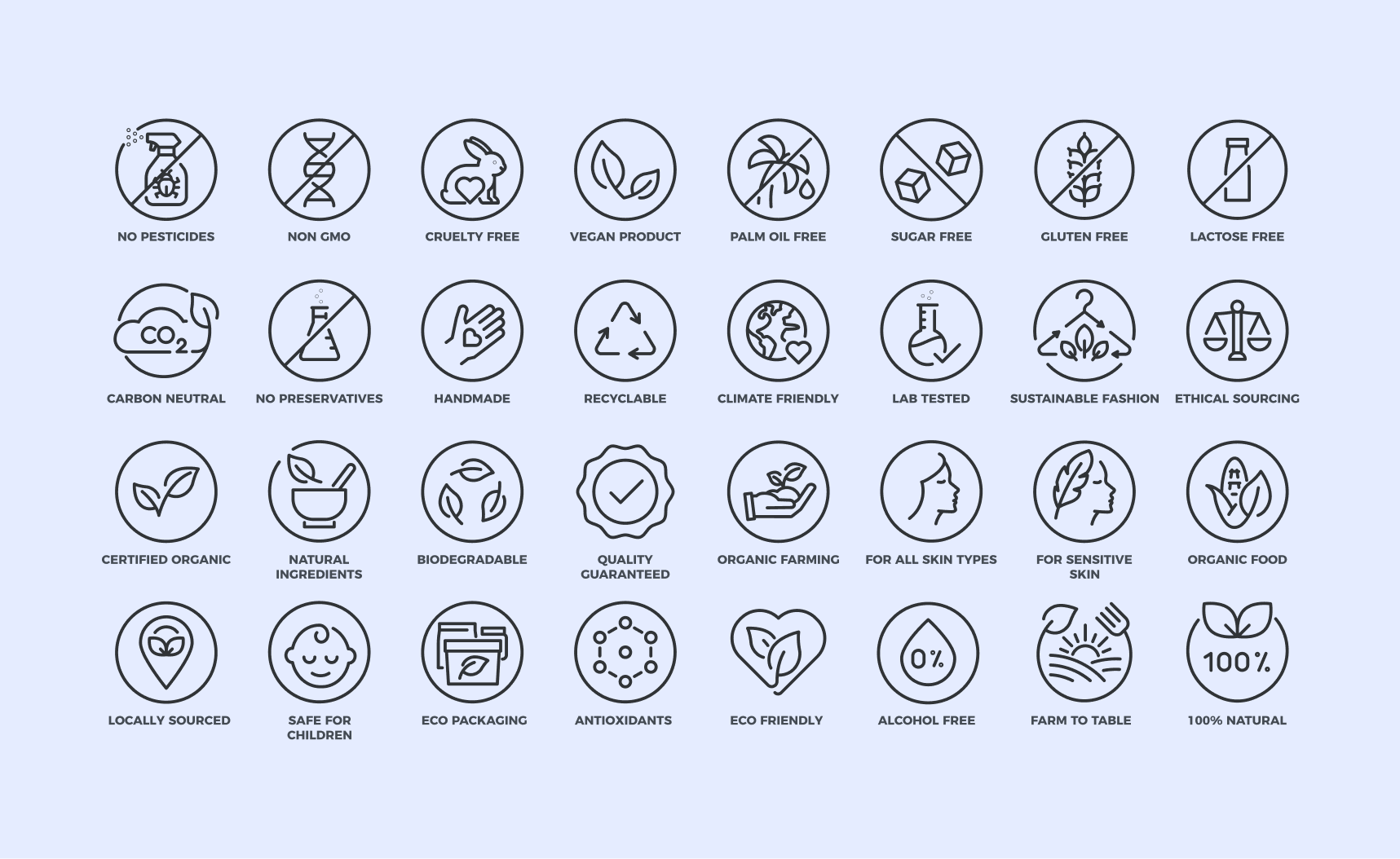
From your brand logo to recycling marks, cautionary symbols, flammability icons, cruelty-free marks, and regulatory approvals, packaging has several symbols that must be used exactly as specified.
Comply identifies whether correct and up-to-date logos or symbols are used, checks their proportions, contrasts, and placement, and ensures no distorted or outdated versions appear on the artwork.
Barcodes
Barcodes must meet strict standards such as GS1 compliance, correct encoding, proper quiet zones, contrast ratios, and scannability. Even small distortions or resolution issues can lead to scanning failures on shelves or at warehouses.
Comply scans barcodes for resolution, printability, quiet zone accuracy, contrast, and correct numerical sequence.
Nutrition Fact Tables
For food and beverage brands, nutrition tables are heavily regulated, from nutrient order and units to table structure and layout.
AI-led compliance checks verify nutrient values, units, formatting, table grids, and placement. It cross-checks these details with your predefined rulebooks to make sure your artwork has the most updated and accurate nutritional data.
Regulatory Check
How Comply Works
How Comply Automates Regulatory Compliance
For packaging teams, a streamlined solution that automates manual compliance checks means faster approvals and quicker time to market. Here’s how Comply can help your team.
Note: Comply is currently available for emerging brands in WebCenter Go and will soon be available for Enterprise customers in WebCenter Enterprise.
1. Review and Proof Artwork with Precision
An artwork contains many elements that need to be validated before final approval. Automating these intricate checks with intuitive proofing tools and annotations helps teams spot compliance risks early, before the file moves to the next stage.
2. Build Custom Rulebooks for Every Product Type or SKU
Regulatory and packaging teams can convert their specification sheets into custom rulebooks covering mandatory statements, font sizes, panel layouts, claims usage, barcodes, symbols, and more. These rulebooks become the foundation for consistent, repeatable compliance checks across all SKUs.
3. Run Automated Compliance Checks with Comply
You can run Comply directly during the review stage by integrating it into your packaging workflow. Comply scans each artwork against your rulebooks and instantly flags any deviations. It checks spelling, formatting, critical statements, logo accuracy, barcode standards, nutrition table structure, and other regulated elements. This ensures reviewers get an automated list of errors before the file is approved, reducing back-and-forth and preventing non-compliant designs from slipping through.
4. Approve Only Fully Compliant Artwork
By blending human review with AI-powered checks, Comply ensures every approved file is accurate, compliant, and audit-ready, helping packaging teams avoid reprints, regulatory observations, and costly packaging delays.
Final Thoughts
As a growing brand, it’s crucial to ask yourself where delays and errors are creeping in, and what you can do to eliminate them. More often than not, the answer lies in AI. With AI-led compliance checks, your team can focus on strategic planning while running smooth, accurate reviews and compliance processes.
Ready to see what Comply and AI can do for your team? Experience WebCenter Go with a free trial.
About the Author
Mitha Shameer is a content specialist who writes for various SaaS platforms across Esko, bringing nearly six years of experience in writing. She’s passionate about creating content that resonates deeply with audiences and drives performance. When she’s not working on her next piece, she’s probably binge-watching crime documentaries or overthinking something she said five days ago.