Skip to content
English
My AccountCart
Artwork Management

CPG Packaging Toolbox: Smarter Artwork Management & AI-Powered Compliance

Alexandra Blanck

Written by Alexandra Blanck

Content Manager, Esko

It would be an understatement to say consumer packaged goods (CPG) packaging is more than a box or a label.

Today, it also serves as a critical touchpoint for consumers. And for brand owners, it becomes a compliance minefield.

With regulations evolving rapidly and speed-to-market more essential than ever, brands need smarter ways to manage artwork and ensure compliance.

Building on Esko’s webinar AI & Automation in CPG Packaging Artwork, this article expands on how our product experts are helping brands balance speed, compliance, and collaboration across the packaging lifecycle.

Recently, Esko product experts, including Gwen Bultelle (CPG Category Specialist), Evelyn Hoogstoel (Product Manager), and Frank Woltering (Senior Product Manager), discussed these challenges and shared how Esko’s technology helps CPG companies navigate the balance between efficiency and compliance.

Their insights form the foundation of this article.

The Forces Shaping CPG

Each year, Esko surveys CPG professionals on the technologies influencing packaging. The feedback is consistent: automation, AI, and machine learning are the most disruptive forces driving change.

Rather than replacing human capabilities, AI is best positioned to augment them — helping teams work faster, reduce errors, and focus on higher-value tasks.

The Digital Maturity Model: Four Phases of Growth

To frame this journey, the speakers introduced the Digital Maturity Model for Artwork Management.

Let’s look at what each stage entails:

  1. Reactive – disconnected workflows, manual processes, no centralized system.
  2. Organized – artwork management system in place, but content still siloed and copy-pasted manually.
  3. Integrated – end-to-end content ecosystem, with e-commerce sync, translation management, and greater reuse of assets.
  4. Automated & AI-driven – AI-generated content, AI-powered compliance, and automated artwork changes.

Where Do CPG Brands Stand Today?

In recent internal discussions with CPG professionals, most organizations identified themselves in the early to mid-stages of the Digital Maturity Model:

52%

use a basic artwork management system.

10%

remain manual and reactive.

31%

are in the advanced artwork management

6%

only 6% are already leveraging AI-driven automation.

This snapshot shows that while progress is being made, most organizations still have significant opportunities to move up the curve — particularly when it comes to embracing automation and AI.

Smarter Artwork Management in Action

During the discussion, Evelyn described how Esko’s artwork management system supports collaboration across the entire packaging lifecycle:

  • Project creation with automatic timelines and task assignments.
  • Centralized libraries hold approved assets, metadata (e.g., barcodes, GTINs), and copy.
  • Stakeholder collaboration with annotations, approvals, and version control.
  • Process visibility through digital tracking, reporting, and KPIs.

The benefits? Faster turnaround times, fewer errors, and the ability to continuously improve workflows based on real data.

The Compliance Challenge

While managing artwork efficiently is a major step forward, compliance remains one of the biggest pain points in packaging. Regulations differ by market, change frequently, and carry steep consequences.

  • U.S. agencies issued ~3,200 final rules in 2024, published across ~106,000 Federal Register pages, underscoring the regulatory volume CPGs must track (Federal Register).
  • In 2024, U.S. agencies issued 3,248 final rules, published across 106,109 pages of the Federal Register— the highest page count ever recorded. Together, these numbers highlight the sheer volume of regulatory material that CPG companies must track (Forbes).
  • Multiple analyses suggest roughly one-third to nearly half of recent U.S. food recalls stem from labeling/packaging errors (MakroCare, New Food Magazine).
  • Esko experts noted that on average, fewer than 40% of artworks are right first time — often leading to multiple revisions and delays of up to six weeks.

Esko experts also shared internal findings consistent with these trends — highlighting that frequent regulatory changes, low right-first-time rates, and multiple artwork cycles continue to delay product launches across the CPG sector.

The Top Packaging & Labeling Challenges

These challenges are echoed by Esko’s ongoing conversations with CPG teams:

48%

cited approval bottlenecks as their biggest obstacle.

15%

struggle most with compliance errors.

23%

pointed to manual handoffs.

14%

face delays with external partners.

These results confirm what the industry already knows: delays and inefficiencies in review and approval cycles are the number one roadblock.

This highlights the need for smarter tools that streamline collaboration and automate compliance checks.

Comply: AI-Powered Artwork Compliance

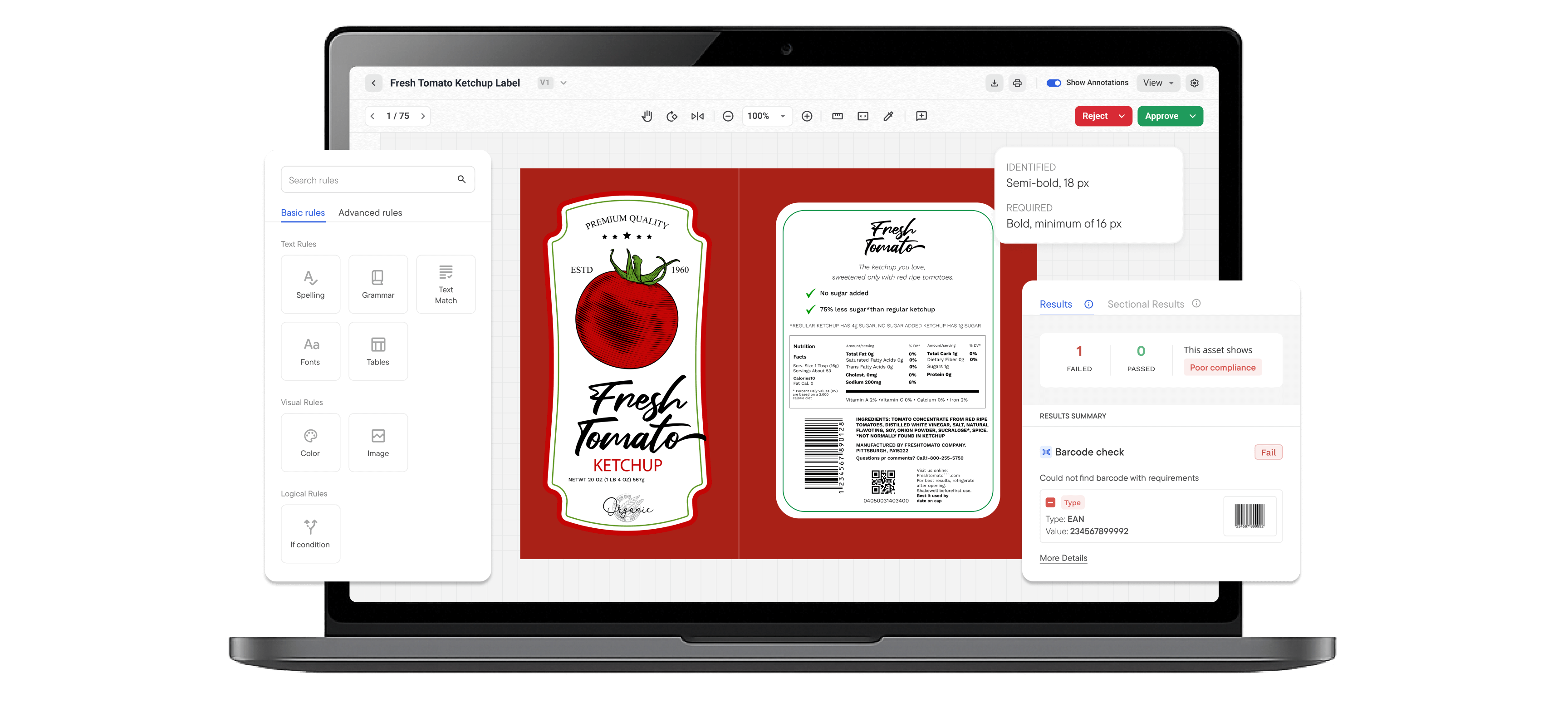
This is where Comply, Esko’s AI-driven compliance assistant, comes in. Integrated into WebCenter, Comply works seamlessly within existing workflows to catch issues early, identifying potential problems before they create costly delays or recalls.

The key capabilities of Comply include:

  • Text validation – ensuring mandatory copy (e.g., allergen statements) is present, correct, and readable.
  • Formatting checks – verifying styles like bolded allergen declarations.
  • Barcode & QR code inspection – analyzing readability, contrast, magnification, and quiet zones.
  • Logo verification – confirming required certifications (e.g., vegan, organic) are included for specific markets.
  • Regional flexibility – applying different rule sets automatically based on pack type, region, or SKU.

As the team explained, Comply can flag common errors — from “vegan” vs. “vegetarian” mislabeling to missing bold formatting and outdated logos.

These errors can easily slip through manual review.

Crucially, AI doesn’t replace human approvers. Instead, it acts as a partner, catching errors, reducing rework, and streamlining approvals so teams can focus on judgment and decision-making.

Barriers to AI Adoption

Across discussions with CPG professionals, common concerns about adopting automation and AI include:

29%

pointed to budget constraints.

20%

raised data security concerns.

10%

noted a lack of internal expertise.

28%

cited resistance to change.

14%

were unsure of ROI

These concerns underline why AI must be introduced thoughtfully, with clear value, strong security, and a roadmap for cultural change.

Key Takeaways

If you only remember one section from this article, make it this one.

Here are the key takeaways you can use to guide your packaging strategy.

Wrapping it Up

As packaging complexity grows, so do the risks and opportunities.

Brands that embrace smarter artwork management and AI-powered compliance are not just reducing errors, they’re also accelerating speed-to-market, strengthening collaboration, and enhancing their processes.

Want to explore how WebCenter and Comply can help your team move up the digital maturity curve? Request a discovery call with our experts to see these capabilities in action.

About the Author

Alexandra Blanck, a member of the Esko Corporate Marketing team, is known for her dedication to crafting engaging content that resonates with global audiences. As a Content Manager, she brings a strong editorial perspective and strategic insight to Esko’s communications, with a passion for turning complex topics into compelling narratives. Beyond her work at Esko, Alexandra is known for her creativity and storytelling expertise with a diverse writing portfolio that spans lifestyle features, fiction, and poetry.

Alexandra Blanck