Mitha Shameer is a content specialist who writes for various SaaS platforms across Esko, bringing nearly six years of experience in writing
Launching a cosmetic product in the U.S. is hard enough without label issues slowing you down.
One missing warning. One misleading claim. One unreadable ingredient list. That is all it takes for a product to be treated as misbranded.
FDA cosmetic labeling requirements are there to protect consumers and prevent deceptive packaging.
For your team, they also shape how artwork gets reviewed, approved, and released. If those checks happen too late, you end up with rework, launch delays, import holds, recalls, or worse.
This guide walks you through the core cosmetic labeling requirements in the United States, including what must appear on pack, where it needs to appear, how it should be formatted, and where teams usually trip up.
It also covers newer MoCRA-related considerations and practical ways to build compliance into your packaging workflow with Comply.
Disclaimer:
This post was last update June 25th 2026.
This blog post is based on information published by the U.S. Food and Drug Administration and related regulatory sources, with current developments incorporated through 2026. Always refer to the relevant regulatory authority for final and current requirements. Comply is a software module designed to help brands manage compliance workflows. It does not provide legal or regulatory advice.
Why FDA Labeling Rules Matter
Think labeling errors are just copy issues?
They are not.
Under the Federal Food, Drug, and Cosmetic Act and the Fair Packaging and Labeling Act, a cosmetic label can make a product illegal to sell if it is incomplete, misleading, or hard to read.
A label can be considered misbranded if:
Required information is missing or misleading
Statements imply FDA approval where none exists
Required warnings or directions are absent
Formatting, placement, or prominence rules are not met
That creates real commercial risk.
The stakes are also getting more operational.
In the post-MoCRA environment, cosmetic compliance is no longer just about static label text. FDA attention now extends further into complaint handling, safety substantiation, records access, and adverse event reporting.
FDA issued draft guidance on records access for cosmetic products on January 21, 2026, and it now maintains a public cosmetic adverse event dashboard. That makes label accuracy, responsible-person details, and traceability more important than ever for regulatory and packaging teams.
Getting the label right starts earlier than most teams think.
If the product is classified incorrectly, the whole label can go off track.
Cosmetic vs. soap vs. drug
Under U.S. rules, a cosmetic is generally intended to cleanse, beautify, promote attractiveness, or alter appearance.
A product marketed only as true soap is different. If the bulk of the nonvolatile matter consists of alkali salts of fatty acids and the product is marketed only for cleansing, it may fall outside the cosmetic category for FDA cosmetic labeling purposes.
A product can also become a drug based on its intended use. If your claims say or imply that the product treats disease, prevents disease, or affects the structure or function of the body, you may no longer be dealing with a cosmetic-only label.
That matters because classification is driven by intended use and claims, not just formula type.
Cosmetics that are also drugs
Some products sit in both categories.
If a cosmetic is also a drug, it does not just change the ingredient-ordering rules. It must also comply with the relevant drug labeling requirements in addition to cosmetic rules.
That means claim language needs extra scrutiny. A moisturization or beautifying claim may stay within cosmetic territory. A treatment, prevention, SPF, anti-dandruff, acne, or similar claim can move the product into drug territory.
This is one reason claim reviews cannot be left until the final artwork round.
While we are partnering on this initiative, we are holding the cross-functionals accountable to map out and write down what needs to happen to ensure accurate content, from their expertise, is provided for labels.
Jill Gundy, Graphics Process Owner at SC Johnson
Cosmetic Labeling Requirements by the FDA
Confused about what goes on the carton, what goes on the bottle, and what has to appear on both?
Start here.
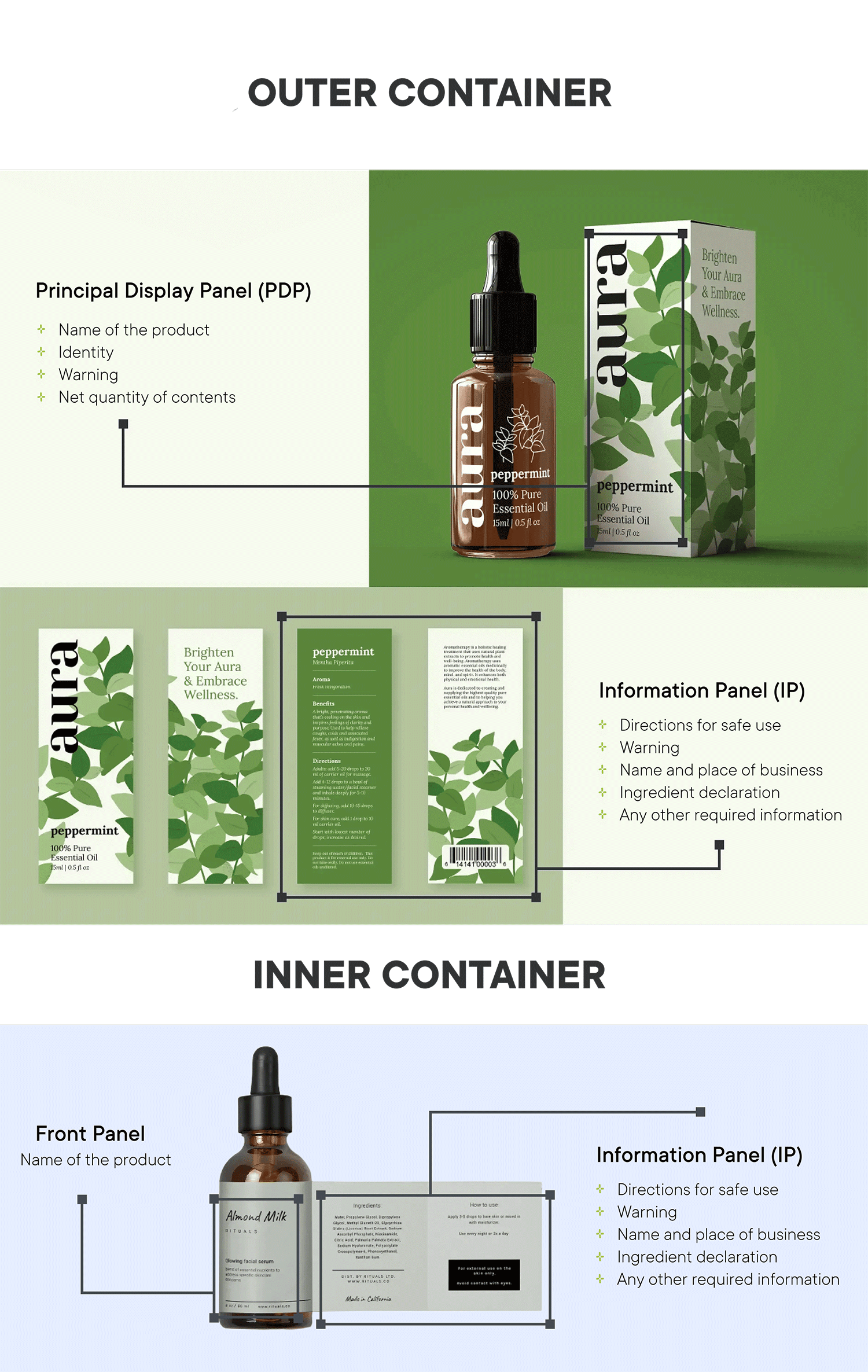
1. Information on the outer container
The outer container is the packaging that holds the product’s primary container.
Think cartons, boxes, sleeves, or wrapping.
This packaging must carry the required labeling information so consumers can identify the product and review essential details before purchase.
2. Information on the inner container
The inner container is the package that directly holds the cosmetic product itself.
That could be a bottle, jar, tube, compact, or pump.
This container must also include required labeling information, especially where the outer packaging may be discarded after purchase.
Note: If your product is sold without an outer package, the inner container is treated as the outer container for labeling purposes.
A deodorant bottle sold without a carton, for example, must carry all required outer-package labeling information on the bottle itself.
3. Ideal PDP size
Not sure why PDP size matters?
Because it drives the type size and placement rules for key label elements, especially the net quantity declaration.
The Principal Display Panel, or PDP, is the part of the label most likely to be shown, presented, displayed, or examined under normal retail conditions.
FDA uses standard methods to calculate PDP area:
Rectangular packages: generally one entire side considered the PDP
Cylindrical or nearly cylindrical containers: generally 40% of the product of the height and circumference
Other container shapes: generally 40% of total surface area, unless there is an obvious display panel
Once that PDP area is known, it helps determine minimum type-size requirements for net contents and related formatting expectations.
4. Products with more than one Principal Display Panel
If a product has multiple PDPs, the required PDP information must appear on each PDP.
This matters for packs designed to face consumers from different angles on shelf.
5. Products with very small package sizes
Running out of room?
Small cosmetics create some of the toughest compliance problems.
If the product contains less than 0.25 oz, a tear-away tag or attached tape may be used to provide the required Principal Display Panel information when there is not enough space on the container itself.
6. Professional-use-only cosmetic labeling
Selling only to salons or licensed professionals?
That does not remove your labeling obligations.
Products intended only for licensed professionals should carry a clear professional-use-only statement where applicable, and they still need to meet the relevant FPLA and cosmetic labeling requirements.
In short, restricted audience does not mean relaxed format rules. If MoCRA is on your radar, What You Need to Know About MoCRA gives useful background on how these obligations are expanding.
4 Things That Make a Cosmetic Label Readable
A compliant label still fails if people cannot read it.
FDA cares about prominence and conspicuousness, not just whether the words technically appear somewhere on the pack.
1. Panel placement
Required information must appear on the panels most likely to be seen by consumers at the time of purchase, unless the package is too small to accommodate all details.
That keeps essential information visible without forcing the shopper to hunt for it.
2. Panel size and type requirements
Labels must be large enough to present required information clearly and prominently.
A. Type size and style
Type size and style vary depending on the area of the PDP.
The bigger the PDP, the bigger the minimum type requirements for certain mandatory elements.
B. Ingredient declaration
If the label has enough available surface area, ingredient text must be at least 1/16 inch in height
If the available labeling area is less than 12 square inches, excluding raised or decorative surfaces, the ingredient text may be reduced, but not smaller than 1/32 inch
C. Net contents declaration
The PDP area determines the type size for the net quantity of contents declaration.
For certain small or decorative containers, such as cosmetic compacts, pencils, pillboxes, or products weighing less than 1/4 oz, type size must be based on the container’s dimensions.
3. Warning statements
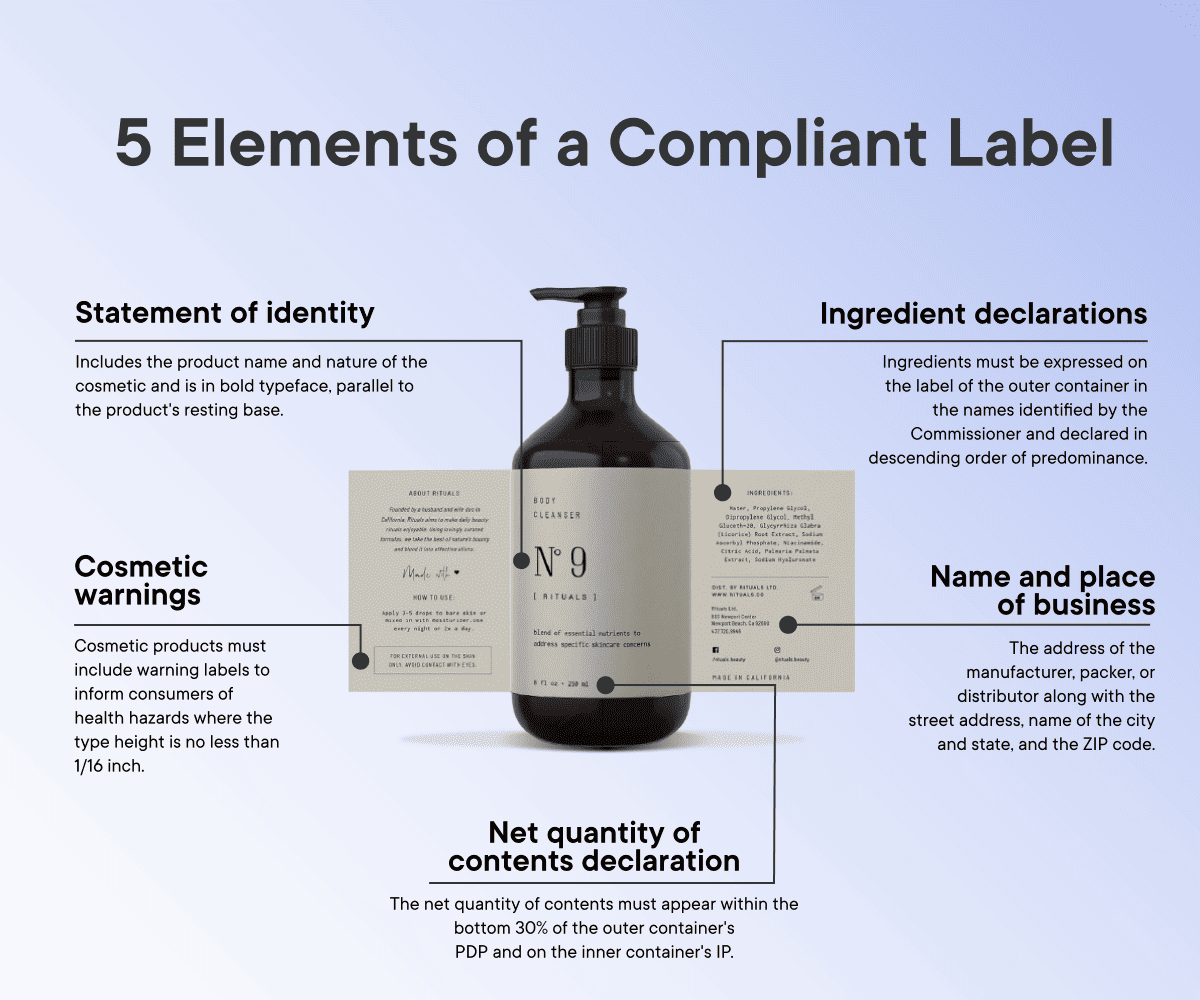
Warning statements must appear in a type size of at least 1/16 inch in height.
If the package is too small to accommodate the warning statement at this size, you may petition FDA’s Division of Docket Management. If approved, the Commissioner may allow an alternative method of compliance.
4. Background contrast
Busy artwork causes real compliance problems.
Required text must:
Have sufficient contrast against the background
Not be obscured by graphics, patterns, or design elements
Even when the right text is present, poor contrast can still leave you with a non-compliant label if the consumer cannot read it.
Teams trying to catch those issues earlier often use WebCenter Go proofing to compare versions, inspect text, and annotate problems before signoff.
Mandatory FDA Labeling Elements on Your Cosmetic Label
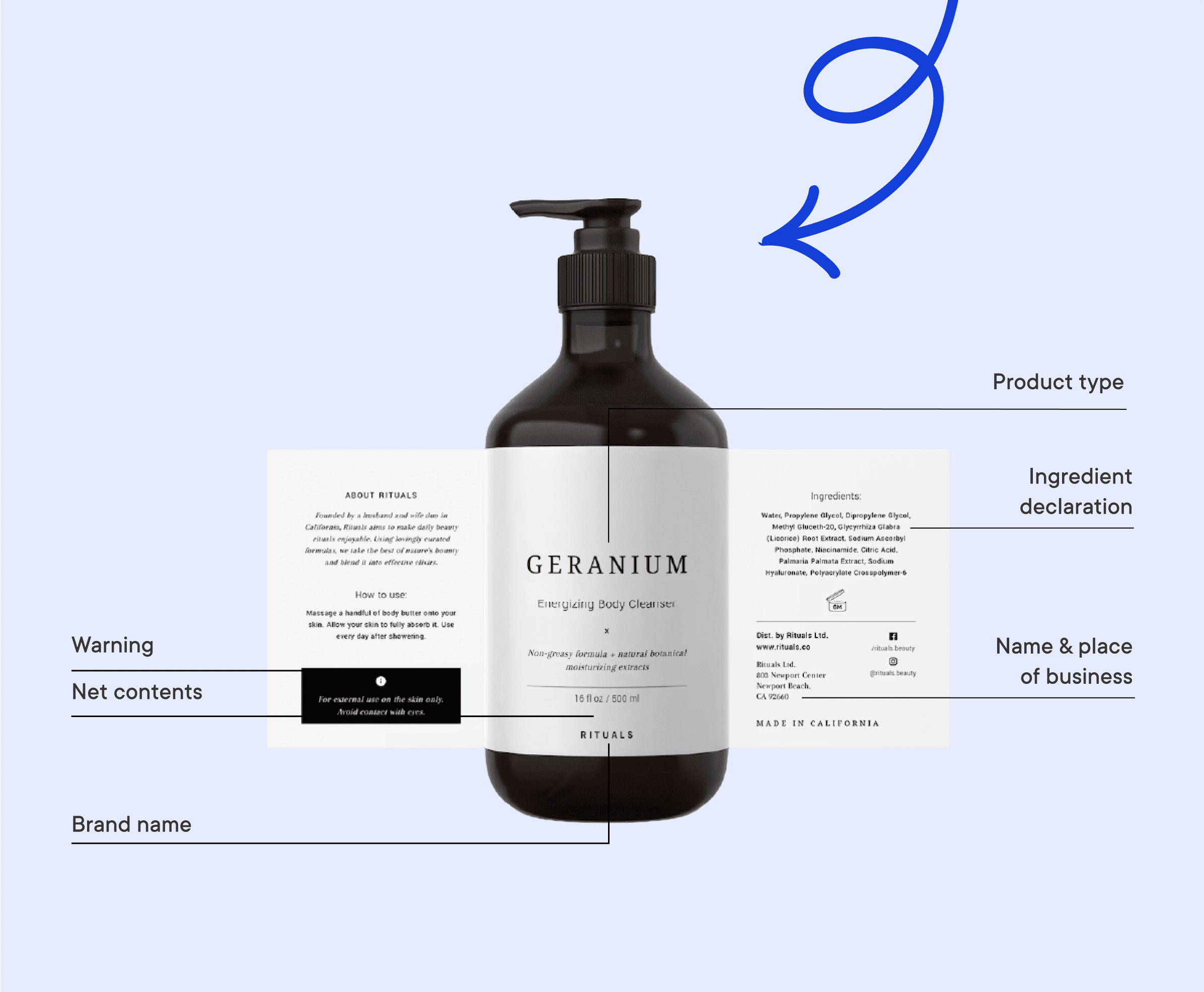
1. Statement of identity
The statement of identity includes:
The brand or product name
The nature of the cosmetic product
The nature of the cosmetic may be expressed in descriptive, fanciful, or illustrative terms, as long as the product’s purpose is still clear.
Example:
If your product is called GlowDew Body Lotion:
GlowDew = brand or product name
Body lotion = identity of the cosmetic
Formatting requirements:
The type must be bold and reasonably sized
The statement must be parallel to the base on which the package usually rests
2. Name and place of business
The label must include the name and principal place of business of the manufacturer, packer, or distributor.
The business address must include:
Street address
City and state
ZIP code
If the address shown is not the manufacturer’s, it must be preceded by wording such as:
Manufactured for…
Distributed by…
Address declaration guidelines
A practical format looks like this:
Manufactured by: Company Name, Street Address, City, State ZIP
Distributed by: Company Name, Street Address, City, State ZIP
Manufactured for: Company Name, Street Address, City, State ZIP
MoCRA contact information for adverse event reporting
This remains one of the most important MoCRA-related labeling requirements.
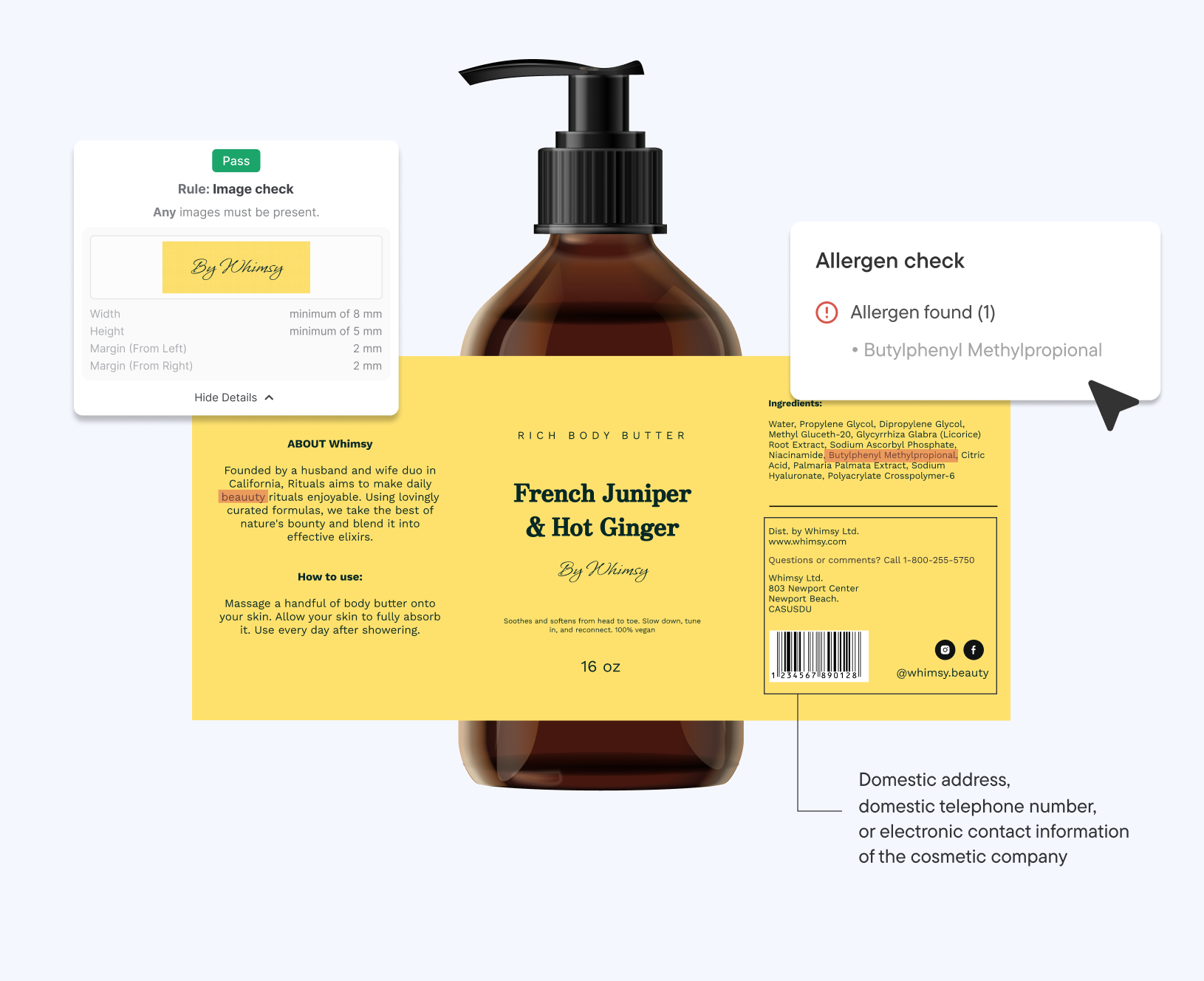
Under MoCRA, cosmetic labels must also provide a way for the responsible person to be contacted about adverse events.
That contact can take the form of:
A domestic address
A domestic phone number
Electronic contact information
This is separate from the broader business-identity requirement and should not be treated as an afterthought.
If a complaint comes in, the contact pathway needs to be clear, accessible, and tied to the right responsible person.
3. Net quantity of contents declaration
The net quantity of contents states how much product is in the package.
It must be expressed in U.S. customary units. Metric units may be added, but not used as the only declaration.
Weight declarations
Expressed in avoirdupois pounds and ounces
Must be preceded by Net weight or Net wt.
Fluid declarations
Expressed in U.S. gallons, quarts, pints, or fluid ounces
Prefixes such as Net contents or Net are optional, though often helpful
Common examples
Acceptable declarations include:
Net wt. 3 oz.
3 oz. Net wt.
Net 3 qt.
3 fl. oz.
Net contents 3 fl. oz.
A. Fractional declarations
Fractions between 1/2 and 1/32 may be expressed as common fractions or decimals with no more than two significant digits.
Examples:
Net wt. 24 oz. (1 1/2 lb.)
56 fl. oz. (1 qt. 1 1/2 pt.)
B. Supplemental statements
Supplemental quantity statements may appear on panels other than the PDP.
These statements must not exaggerate or misrepresent the amount of product.
Acceptable uses include:
Package size descriptions
Terms like economy size or large may be used only if:
The product is sold in more than one size
There is at least a 5% price difference between sizes
Descriptive quantity terms
Phrases such as giant pint or full quart may be used if they are not misleading.
Number of applications
You may supplement the numerical quantity declaration with the number of applications when the product is used according to instructions.
Example:
Net 10 fl. oz.
Ten Applications
Multi-item kits
If a kit contains multiple units, you may describe both the total quantity and the quantity of individual units.
For example, if a kit contains 6 facial serums with 1 fl. oz. each, the declaration may read:
Net 6 fl. oz.
6 Bottles of 1 fl. oz. each
C. Placement of net quantity declaration
It must appear within the bottom 30% of the PDP if the product has an outer container
It must appear on the information panel of the inner container
Exception: If the PDP area is less than 5 square inches, the net quantity declaration is not required on the inner container.
4. Cosmetic warning labels
Warnings are where teams often assume they are done too soon.
The warning statements below are important, but they are not exhaustive. Certain product categories have very specific required wording, and missing that language can create immediate misbranding risk.
Cosmetic ingredients must be substantiated for safety before marketing.
If they are not, the product is considered misbranded unless it carries this warning:
> “Warning: The safety of this product has not been determined.”
A warning is not required if:
Safety was established before new, inconclusive data emerged
New data does not indicate human health risk
Ongoing studies are assessing safety
B. Cosmetic aerosols
Aerosols are products in self-pressurized containers, such as hairsprays.
Because many are flammable or irritating, they require this warning:
> “Warning: Avoid spraying in eyes. Contents under pressure. Do not puncture or incinerate. Do not store at a temperature above 120°F. Keep out of reach of children.”
If the propellant contains hydrocarbon or halocarbon, add:
> “Warning: Use only as directed. Intentional misuse by deliberately concentrating and inhaling the contents can be harmful or fatal.”
Note:
If the product is not a spray, you may omit “Avoid spraying in eyes”
If the container is glass, replace “puncture” with “break”
Add “except under adult supervision” if the product is intended only for children
C. Feminine deodorant sprays
Federal regulation defines feminine deodorant sprays as any deodorant spray intended to be used in the female genital area or all over the body.
Their warning statement must read:
> “Caution: For external use only. Spray at least 8 inches from the skin. Do not apply to broken, irritated, or itching skin. Persistent, unusual odor or discharge may indicate conditions for which a physician should be consulted. Discontinue use immediately if rash, irritation, or discomfort develops.”
If the product does not use hydrocarbon propellants, you may omit “Spray at least 8 inches from the skin.”
Also, terms such as hygiene or hygienic should not be used in a way that implies medical benefit.
D. Tanning products without sunscreen
Tanning products that do not contain sunscreen must carry this warning:
> “Warning: This product does not contain sunscreen and does not protect against sunburn. Repeated exposure of unprotected skin while tanning may increase the risk of skin aging, skin cancer, and other harmful effects to the skin even if you do not burn.”
E. Other category-specific warnings to watch
The list above is not the full universe of FDA warning requirements.
Other regulated cosmetic categories include coal-tar hair dyes and foaming detergent bath products, each with their own warning considerations. If your portfolio includes edge-case products, do not assume general cosmetic rules are enough.
Review the category-specific requirements before artwork is finalized.
Cosmetic claims: what they mean, and where they go wrong
Claims are where cosmetic labels often cross the line.
FDA does not publish an approved list of cosmetic claims, but every claim must still be truthful, supportable, and not misleading.
A. Alcohol-free
This claim is permitted if the product contains no ethyl alcohol, even if other fatty or wax alcohols are present.
B. Organic
The USDA regulates the term organic.
It refers to produce grown on soil that had no prohibited substances for three years before harvesting. Products using the term must meet USDA organic standards in addition to FDA labeling rules.
C. Cosmeceutical
This term has no legal recognition under U.S. law.
Products cannot be marketed as cosmeceuticals in a way that suggests a recognized drug-cosmetic hybrid category.
D. Hypoallergenic
This is a high-risk term.
FDA does not pre-approve hypoallergenic claims for cosmetics, and the term has no simple safe-harbor meaning. If you use it, you need a solid basis for the claim and you should avoid presenting it as if it carries formal FDA endorsement.
E. Cruelty-free or not tested on animals
These claims also need careful substantiation.
FDA does not define them as an approval category for cosmetics. If you use them, they must be truthful, documented, and consistent with your supply chain and testing practices.
F. “FDA approved”
This is one of the clearest red flags in cosmetic labeling.
Most cosmetics labels are not FDA-approved before marketing. If your packaging implies FDA approval where none exists, you create immediate misbranding risk.
G. Claims that turn a cosmetic into a drug
A claim can change the legal category of the product.
If your label says or implies that the product treats acne, restores hair growth, changes body structure, relieves eczema, prevents disease, or produces another drug-like effect, cosmetic rules alone are no longer enough.
This is why claims review needs to sit alongside regulatory review, not behind it. For a broader look at how claims, symbols, and wording can create compliance risk, Plant-Based Labeling Rules, Claims, Symbols, Risks is worth reading.
Cosmetic ingredient labeling requirements
Ingredient lists are detail-heavy.
That is exactly why they cause so much rework.
Under the Fair Packaging and Labeling Act, ingredients must be declared on retail product labels and are generally listed in descending order of predominance.
Identifying ingredients
Ingredient names must follow standardized nomenclature.
If the Commissioner has established a name, that name must be used.
If no official name exists, refer to these sources in order:
CTFA Ingredient Dictionary
United States Pharmacopeia
National Formulary
Food Chemical Codex
USAN and USP Dictionary of Drug Names
If the ingredient is not listed in those sources, use its commonly recognized or technical name.
Order of ingredient declaration
Here is the order in which ingredients should be declared.
1. Cosmetics that are also drugs
If a cosmetic is also a drug, list the active ingredients first, followed by the cosmetic ingredients.
Again, that is not the only implication. Dual-status products must also satisfy the relevant drug-labeling rules.
2. Products with insignificant concentration
Ingredients present at less than 1% may be listed in any order after ingredients present at more than 1%, which should appear in descending order of predominance.
3. Color additives
Color additives may be listed in any order after active ingredients, if applicable, and the other cosmetic ingredients.
If the product line uses alternative shades or color-correction additives, you must declare them with the phrase “may contain.”
4. Incidental ingredients
FDA defines incidental ingredients as substances that are:
Used to prepare declared ingredients
Added during manufacturing but removed before packaging
Added for a technical effect during manufacturing but have no technical or functional effect in the finished product because of low concentration
Insignificant in concentration and do not affect the functioning or effectiveness of the product
5. Trade secrets
FDA allows certain trade-secret exceptions.
You may use the term “and other ingredients” to represent secret ingredients, but only if factual and legal grounds support the trade-secret claim and the authorities accept that basis for exemption.
If you need to go deeper on trade secrecy, refer to Title 21 of the Code of Federal Regulations.
Ingredient scrutiny is rising
Even where label wording has not yet changed, ingredient scrutiny is increasing.
FDA’s December 29, 2025 stated that available data were insufficient to determine PFAS safety in cosmetic products. Talc is another area to watch.
FDA withdrew a proposed asbestos testing rule in November 2025, which means expectations in that space are still evolving rather than fully settled.
For packaging teams, the lesson is simple. Ingredient transparency and documentation are becoming more visible, not less. Beauty Under Scrutiny: From Trends to Traceability looks at that shift in more detail.
Cosmetic labeling requirements in Canada
Ingredient lists are detail-heavy.
That is exactly why they cause so much rework.
Under the Fair Packaging and Labeling Act, ingredients must be declared on retail product labels and are generally listed in descending order of predominance.
Identifying ingredients
Ingredient names must follow standardized nomenclature.
If the Commissioner has established a name, that name must be used.
If no official name exists, refer to these sources in order:
CTFA Ingredient Dictionary
United States Pharmacopeia
National Formulary
Food Chemical Codex
USAN and USP Dictionary of Drug Names
If the ingredient is not listed in those sources, use its commonly recognized or technical name.
Order of ingredient declaration
Here is the order in which ingredients should be declared.
1. Cosmetics that are also drugs
If a cosmetic is also a drug, list the active ingredients first, followed by the cosmetic ingredients.
Again, that is not the only implication. Dual-status products must also satisfy the relevant drug-labeling rules.
2. Products with insignificant concentration
Ingredients present at less than 1% may be listed in any order after ingredients present at more than 1%, which should appear in descending order of predominance.
3. Color additives
Color additives may be listed in any order after active ingredients, if applicable, and the other cosmetic ingredients.
If the product line uses alternative shades or color-correction additives, you must declare them with the phrase “may contain.”
4. Incidental ingredients
FDA defines incidental ingredients as substances that are:
Used to prepare declared ingredients
Added during manufacturing but removed before packaging
Added for a technical effect during manufacturing but have no technical or functional effect in the finished product because of low concentration
Insignificant in concentration and do not affect the functioning or effectiveness of the product
5. Trade secrets
FDA allows certain trade-secret exceptions.
You may use the term “and other ingredients” to represent secret ingredients, but only if factual and legal grounds support the trade-secret claim and the authorities accept that basis for exemption.
If you need to go deeper on trade secrecy, refer to Title 21 of the Code of Federal Regulations.
Ingredient scrutiny is rising
Even where label wording has not yet changed, ingredient scrutiny is increasing.
FDA’s December 29, 2025 stated that available data were insufficient to determine PFAS safety in cosmetic products. Talc is another area to watch.
FDA withdrew a proposed asbestos testing rule in November 2025, which means expectations in that space are still evolving rather than fully settled.
For packaging teams, the lesson is simple. Ingredient transparency and documentation are becoming more visible, not less. Beauty Under Scrutiny: From Trends to Traceability looks at that shift in more detail.
Cosmetic labeling requirements in Canada
Selling in both the U.S. and Canada?
Do not treat them as one labeling job.
First, an important correction: cosmetic labeling in Canada is not governed by the FDA. It is governed by Health Canada and related Canadian laws and regulations.
Canadian cosmetic labels must include:
Ingredient list
Common name of the product
Net quantity
Name and address of the manufacturer or distributor
Warnings or cautions
Directions for use
Language requirements in Canada
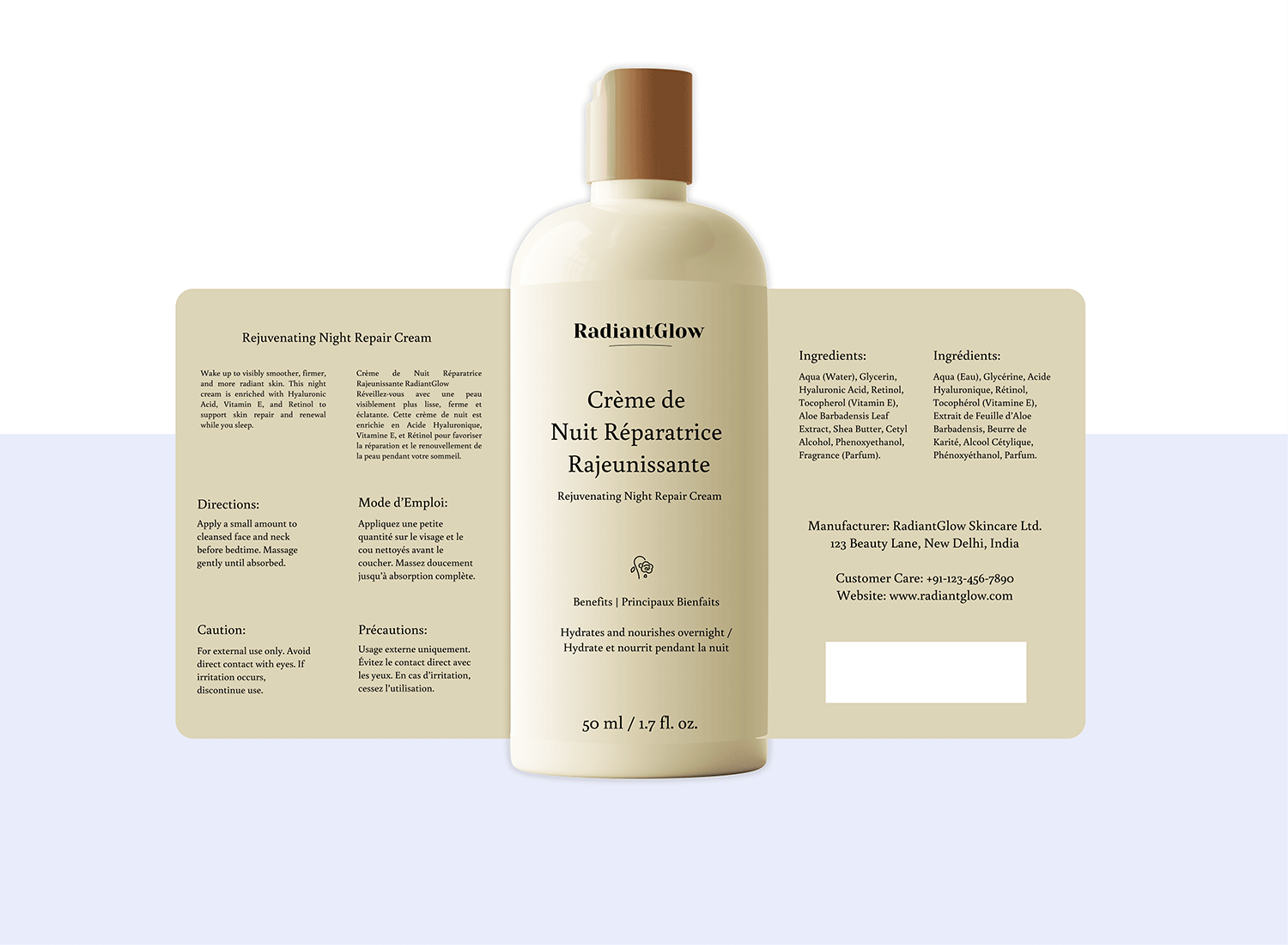
The required content is similar in many ways to the U.S., but Canada adds a major operational layer.
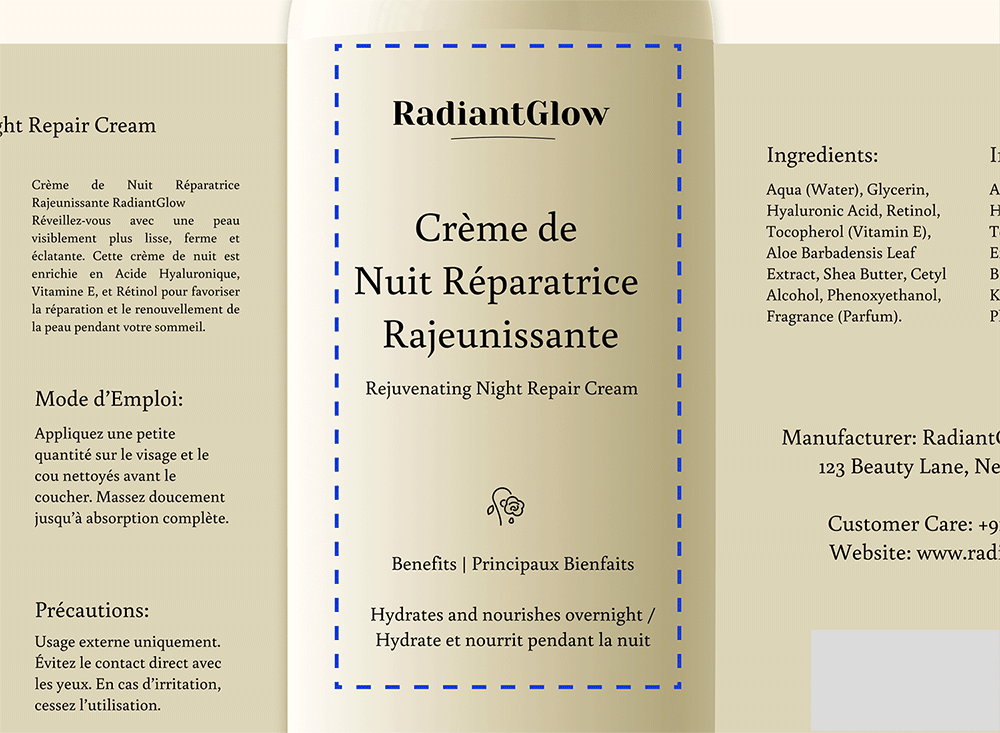
Canada is bilingual. Under the Consumer Packaging and Labelling Act and related regulations, the following parts of cosmetic labels must appear in both English and French:
Product identity
Net quantity declaration
Identity and place of business of the importer or manufacturer
U.S. language note
In the U.S., cosmetic labels generally must appear in English, unless the product is distributed solely in a territory such as Puerto Rico, where another language predominates.
If your label carries foreign-language representations, all required labeling statements must also appear in that foreign language. The same information should also appear in English for clarity and completeness.
Canada fragrance allergen rollout
This is the biggest freshness update for Canada in 2026.
Health Canada’s fragrance-allergen requirements are rolling out in phases:
April 12, 2026: 24 fragrance allergens must be listed above threshold levels
August 1, 2026: the list expands to 81 allergens for new cosmetics
August 1, 2028: the expanded 81-allergen requirements apply to existing products
If your artwork workflows cover both U.S. and Canadian SKUs, that difference matters.
The U.S. and Canada are moving on different timelines.
As Bart Tielemans, Senior Enablement Platform Specialist, puts it clearly:
“Claims, ingredients, translations, and legal statements need to be created and validated together, with marketing and regulatory teams working from a single source of truth to keep every market aligned.”
For teams managing multilingual and market-specific copy changes across SKUs, Dynamic Content can help separate packaging content from design so late-stage text updates are easier to manage without introducing manual copy-paste errors.
Ingredient declaration for multiple products
Multi-pack formats can get messy fast.
That is especially true when components separate during retail sale.
Multi-unit packages
These are packages made up of similar or dissimilar products.
For example, a gift set containing lotion, moisturizer, and sunscreen.
Multi-component packages
These contain two or more components used together as one complete kit.
For example, a hair dye kit with a dye solution and hydrogen peroxide.
Multi-unit and multi-component packages must have ingredient declarations on the outer and inner containers if the inner units are separated from the outer packaging during retail sale.
Because these packs often repeat ingredients, FDA allows certain provisions for consolidated ingredient listing.
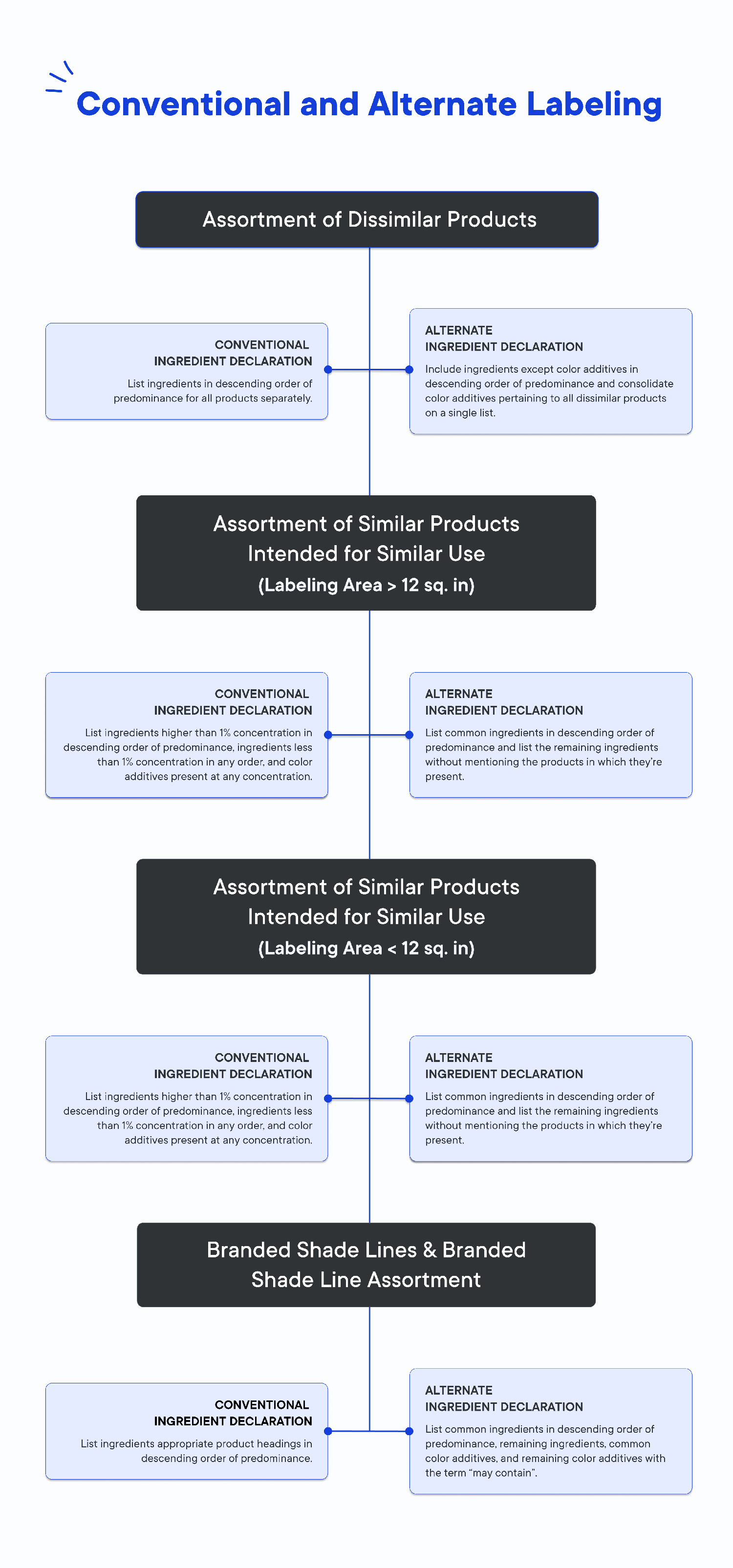
To apply the rules correctly, you need to distinguish between:
Assortments of dissimilar products
Assortments of similar products intended for similar use with area less than 12 square inches
Assortments of similar products intended for similar use
Assortments of similar products
Those distinctions affect whether conventional or alternate labeling approaches are permitted.
That is especially true when components separate during retail sale.
Multi-unit packages
These are packages made up of similar or dissimilar products.
For example, a gift set containing lotion, moisturizer, and sunscreen.
Multi-component packages
These contain two or more components used together as one complete kit.
For example, a hair dye kit with a dye solution and hydrogen peroxide.
Multi-unit and multi-component packages must have ingredient declarations on the outer and inner containers if the inner units are separated from the outer packaging during retail sale.
Because these packs often repeat ingredients, FDA allows certain provisions for consolidated ingredient listing.
To apply the rules correctly, you need to distinguish between:
Assortments of dissimilar products
Assortments of similar products intended for similar use with area less than 12 square inches
Assortments of similar products intended for similar use
Assortments of similar products
Those distinctions affect whether conventional or alternate labeling approaches are permitted.
FDA cosmetic labeling compliance acts
If you are trying to simplify U.S. cosmetic labeling requirements, it helps to separate the two laws teams most often work back to.
1. Fair Packaging and Labeling Act (FPLA)
The FPLA focuses heavily on the net quantity of contents and the fair presentation of consumer commodities.
Its purpose is to support value comparison and prevent unfair or deceptive packaging and labeling.
It requires label information such as:
Product identity
Net quantity of contents
Manufacturer or distributor information
2. Modernization of Cosmetics Regulation Act (MoCRA)
MoCRA, passed in 2022, gives FDA more authority over cosmetic products.
It introduced or strengthened expectations around:
Facility registration and product listing
Safety substantiation
Adverse event reporting
Label contact information for adverse event communication
Professional-use-only labeling in certain circumstances
One point needs careful wording.
MoCRA includes a requirement for FDA to establish fragrance allergen disclosure through rulemaking, but that should not be treated as a fully settled present-tense U.S. ingredient-list requirement across the board. FDA still needs to define the substances and thresholds through regulation.
So if your team is building automated checks, do not hard-code unfinished U.S. allergen assumptions as if they were final law.
Meet complex cosmetic labeling requirements with Comply
Manual cosmetic label review breaks down in the same places every time.
Too many SKUs. Too many reviewers. Too many country variants. Too many late-stage edits.
That is why FDA cosmetic labeling requirements are so hard to manage with spreadsheets, email chains, and disconnected artwork files.
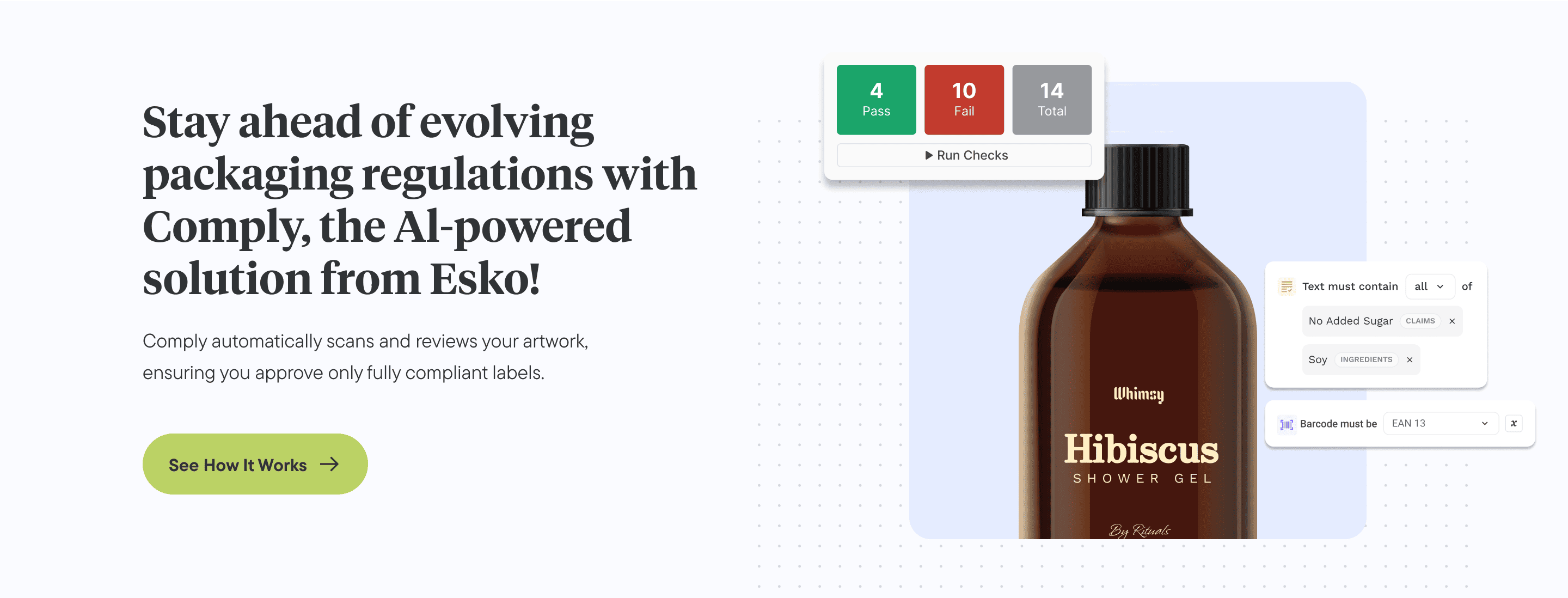
An AI-powered label compliance tool such as Comply helps you build structure into that process.
Automated FDA checks
With Comply, cosmetic brands can build regulation-specific rulesets aligned with FDA requirements and run automatic checks on artwork and copy.
That means the system can flag issues in real time, such as:
Missing required warnings
Incorrect net quantity declarations
Misleading claim language
Misbranding risks
Market-specific allergen disclosures where rules are defined
As Bart Tielemans explains:
“When approved graphics and content come together in artwork creation, centralized proofing, structured approvals, and AI-powered inspection help teams catch content and artwork discrepancies before production.”
Every cosmetic label touches multiple stakeholders.
Regulatory, packaging, marketing, legal, and external partners all need to review the same asset.
Comply gives them one place inside WebCenter to review the artwork, comment on flagged issues, and keep decisions tied to the live file instead of scattered across inboxes and markup PDFs.
Built into packaging workflows
The biggest gain is not just catching errors.
It is catching them earlier.
Compliance checks do not need to wait until the artwork is supposedly final. Teams can validate labels at multiple stages of development, with approval workflow software for packaging artwork helping route files, manage rework loops, and preserve a clear audit trail of changes and approvals.
That helps reduce review loops, keeps launches moving, and supports the traceability regulators increasingly expect.
Cosmetic labeling requirements are detailed for a reason.
They affect consumer safety, claim integrity, ingredient transparency, and how quickly you can get a product to market without rework.
For packaging and regulatory teams, the challenge is not just knowing the rules. It is applying them consistently across formats, product categories, countries, and claim variations.
That gets harder as MoCRA expands expectations around adverse events, records access, and inspection readiness.
With a tool like Comply, you can build those checks into the packaging workflow instead of chasing problems at the end. That gives your team a better way to catch label issues earlier, manage collaboration, document decisions, and keep cosmetic launches on track.
If you want to see how that works in practice, book a demo with us to learn more.