Gouri, a content specialist at Esko, loves adding a dash of creativity to everything she writes.
Key Takeaways
Nutraceutical labeling must cover required FDA statements such as the product name, net quantity, Supplement Facts, ingredient list, and manufacturer or distributor details in the correct label areas.
Nutraceuticals differ from dietary supplements and pharmaceuticals because they are food-based products associated with health benefits, while supplements add nutrients and pharmaceuticals are prescription drugs intended to treat or prevent disease.
Labels must accurately handle regulated content such as serving size, Daily Value percentages, allergens including sesame, nutrient content claims, and structure/function claims with the required DSHEA disclaimer.
Multi-market packaging creates added complexity because claim rules, health authority expectations, and approval requirements can differ across FDA, EFSA, FSSAI, SFDA, BPOM, and other frameworks.
Common labeling failures include disease claims, missing disclaimers, incorrect Supplement Facts formatting, outdated artwork, and barcode or QR code errors that can trigger rework, launch delays, warning letters, or recalls.
Did you know that the nutraceuticals industry is expected to hit USD 417.66 billion by 2026?
In the last decade, the industry has boomed as more individuals prioritize their health and better understand the significance of consuming nutritious food and supplements. This proves how nutraceuticals play a vital role, especially among adults.
However, behind the promises of improved health, better energy, and overall well-being, lies a world of complex regulations governing the labeling of these products.
Here, along with understanding the important labeling aspects of nutraceuticals, let’s learn how they differ from your regular dietary supplements and whether they only come in the form of capsules.
Disclaimer: This blog post derives information from the U.S. Food and Drug Administration (FDA) website and is updated as of September 1st, 2025. Do refer to the FDA website for final and updated information regarding regulations. Comply is a software designed to streamline compliance for brands, not a service providing legal or regulatory advice.
What are Nutraceuticals?
Nutraceuticals are a combined form of nutrition and pharmaceuticals.
They are food or parts of food sources that have been scientifically shown to provide health benefits and prevent various diseases.
Nutraceuticals are nutritionally rich whole foods that contain vitamins, minerals, probiotics, amino acids, and herbs.
Some examples include soy protein, garlic, beetroot, and spinach.
Nutraceuticals vs. Dietary Supplements vs. Pharmaceuticals
People often get confused with the jargon they use at drug stores or pharmacies.
While these terms are often used interchangeably, there are distinct differences between nutraceuticals, dietary supplements, and pharmaceuticals.
Nutraceuticals: As we have already defined what nutraceuticals are, they offer specific health benefits beyond the standard nutritional value of food, such as antioxidant properties, immune support, or disease prevention.
Dietary supplements: Dietary supplements are foods that complement your diet and contain one or more ingredients. They provide additional nutrients that may be lacking in a person’s diet. You can ingest them as liquids, capsules, tablets, powders, soft gels, or gel caps.
Pharmaceuticals: These are the drugs that are intended to treat or prevent diseases and require a prescription from a health professional. Pharmaceuticals undergo extensive testing and approval processes to ensure safety and efficacy.
Feature
Nutraceuticals
Dietary Supplements
Pharmaceuticals
Importance of Nutraceutical Labeling
Along with the demand for nutraceutical products, there is an increase in the need for accurate and compliant labeling.
Nutraceutical labeling is not merely a regulatory requirement; it plays a key role in ensuring consumer safety, building trust, and sustaining the industry’s integrity.
Manufacturers don’t need FDA approvals to distribute their nutraceutical products, but they must ensure they aren’t spreading the wrong information.
1. Ensuring Regulatory Compliance
One reason nutraceutical labeling is crucial is to ensure compliance with local and international regulations.
Regulatory bodies such as the U.S. Food and Drug Administration (FDA), the European Food Safety Authority (EFSA), and other national agencies have stringent guidelines governing the labeling of nutraceutical products.
Following these regulations helps manufacturers avoid legal troubles, including fines, product recalls, and worse, bans.
Not only does compliance protect your brand’s reputation, but it also ensures that products can be legally marketed and sold in targeted regions.
If you’re selling into more than one market, your label rules may change by region.
In the EU, EFSA plays a key role in evaluating health claims, while brands selling in India must account for FSSAI requirements for health supplements, nutraceuticals, foods for special dietary use, foods for special medical purposes, prebiotic food, and probiotic food.
Multi-market labeling can quickly become difficult to manage if your artwork, claims, and approval rules are not tied to the right market from the start. For larger teams managing complex approval paths, WebCenter Enterprise helps connect configurable workflows, automated quality checks, and a single source of truth for enterprise artwork and label creation.
The FDA’s Human Foods Program also adds important context for nutraceutical brands.
For your packaging team, that means labeling accuracy, claim control, and traceability need to be treated as daily workflow requirements, not just final checks before print.
Ensuring artwork compliance has traditionally been a time-consuming and error-prone process, involving multiple rounds of manual reviews and approvals.
Jan De Roeck, Director Industry Relations & Strategy at Esko
Current Good Manufacturing Practices also affect what appears on your nutraceutical label.
Under 21 CFR Part 111, dietary supplement manufacturers must control identity, purity, strength, and composition.
If the product specification changes but the Supplement Facts panel. ingredient list, or claim text does not, the label can become inaccurate fast.
That is why GMP, quality control, and artwork control need to work together.
Labels provide essential information about a product’s ingredients, usage, and nutritional value.
Accurate labeling helps consumers make informed decisions about the products they use, especially for those with dietary restrictions, allergies, or specific health concerns.
By listing allergens or possible side effects, nutraceutical labels protect consumers from potential health risks.
3. Building Trust and Credibility
Transparent and informative labeling helps establish brand trust and credibility.
Consumers are more likely to purchase from brands that clearly communicate what’s in their products and how they benefit their health.
This confidence turns to brand loyalty, as consumers can make informed choices.
4. Differentiating Products in a Competitive Market
In a saturated market, clear and effective labeling can serve as key differentiators.
A well-designed label that highlights unique selling points, such as organic ingredients, non-GMO certifications, or specific health benefits, can set a product apart from its competitors.
Eye-catching and informative labels can attract attention on crowded shelves, making it easier for consumers to identify and choose your product over others.
Nutraceutical Labeling Requirements
To ensure consumer safety and provide accurate information, nutraceuticals must adhere to specific labeling requirements.
These requirements vary slightly depending on the regulatory framework of different countries, but some elements are required in general.
Five Commonly Required Label Statements
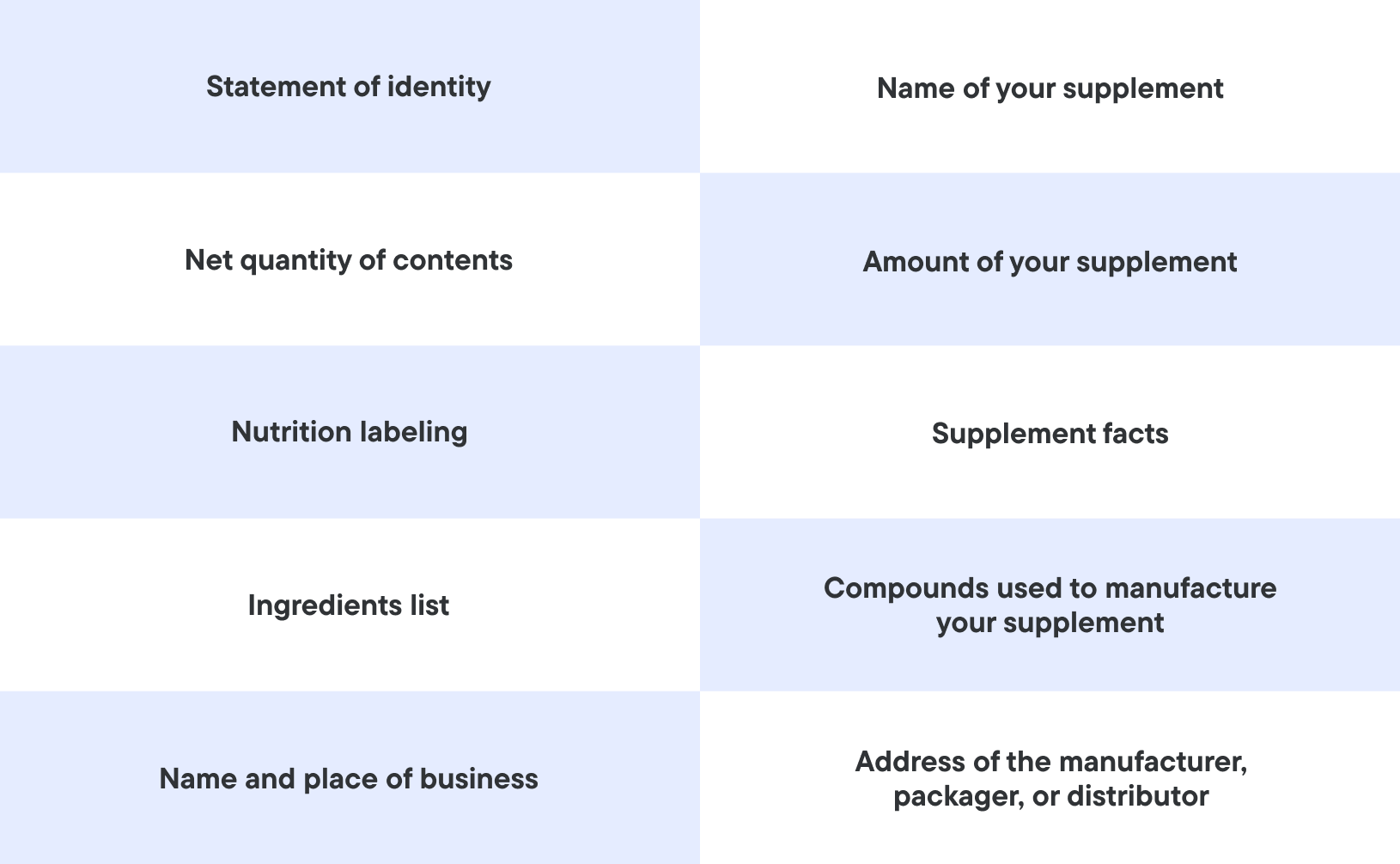
The FDA states the following five statements are required on dietary supplement labels.
Name of the supplement: The label must clearly state the product’s name, ensuring it speaks to the product’s contents and function.
Amount of supplement: This includes the net quantity weight or volume of the nutraceutical product, depending on its form.
Nutrition labeling: This section provides information about the serving size, amount per serving, and daily percent value for various nutrients.
Ingredient list: All ingredients must be listed in descending order by weight. Any potential allergens should be highlighted according to local regulations.
Name and place of business of the manufacturer or distributor: Include the contact information of the responsible party. This information is essential for traceability and consumer inquiries.
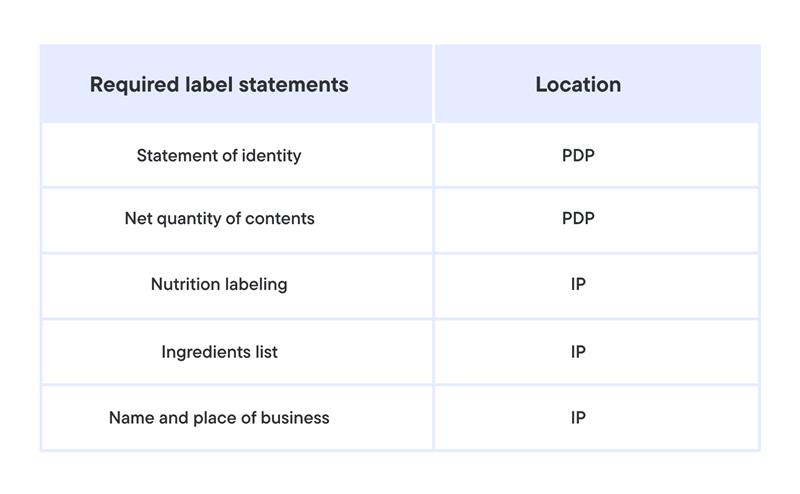
The FDA requires that these statements be visible and placed in specific areas on the label.
All statements must be located either on the front Principal Display Panel (PDP) or the Information Panel (IP).
Note:
You must place the required label statements on the label’s front panel, PDP, or IP in type sizes no less than 1/16″ with a height-to-width ratio of 3:1.
If your packaging isn’t large enough to accommodate a type size of 1/16″, you must file a petition to request an alternate labeling regulation.
But if you’re short on label space, you must be aware of adding QR codes and 2D codes to your pack that help you connect consumers, retailers, or auditors to extended information such as sourcing details, usage instructions, certificates, or market-specific content.
The code itself becomes part of the packaging workflow. It needs to scan correctly, route to the right content, and stay controlled when artwork changes.
Our guide on 2D traceability in packaging explains how connected codes can support audit-ready packaging workflows.
Statement of Identity
The statement of identity is the common name of the product and must be prominently displayed on the front label.
It differs from the brand name.
E.g., Super Omega-3 is the general name of food under the law that you have to display and not the company name.
It should accurately describe the nature of the product, helping consumers understand what they are purchasing.
Net Quantity of Contents
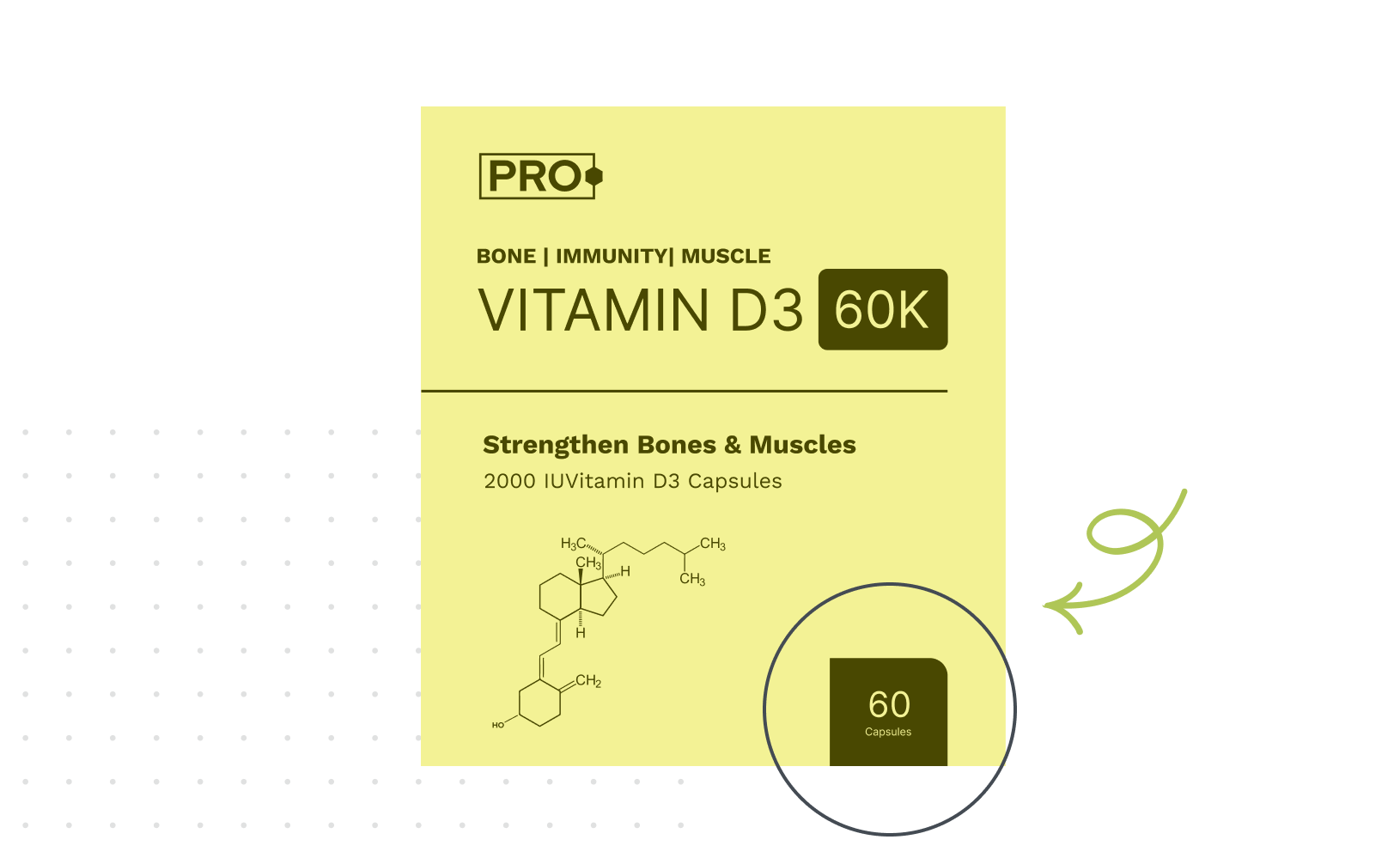
This statement displays the amount of product in your nutraceutical product container, typically expressed in the metric system and the US Customary system. You must specify the quantity in both metric and imperial terms if using volume or weight measurements. E.g., “Net Weight: 60 Capsules”.
It must always be placed on the bottom 30 percent of the front of the package and be easily visible to consumers. The net quantity of contents doesn’t include the weight of the wrappers and other packing materials included with the supplement.
Nutrition Labeling
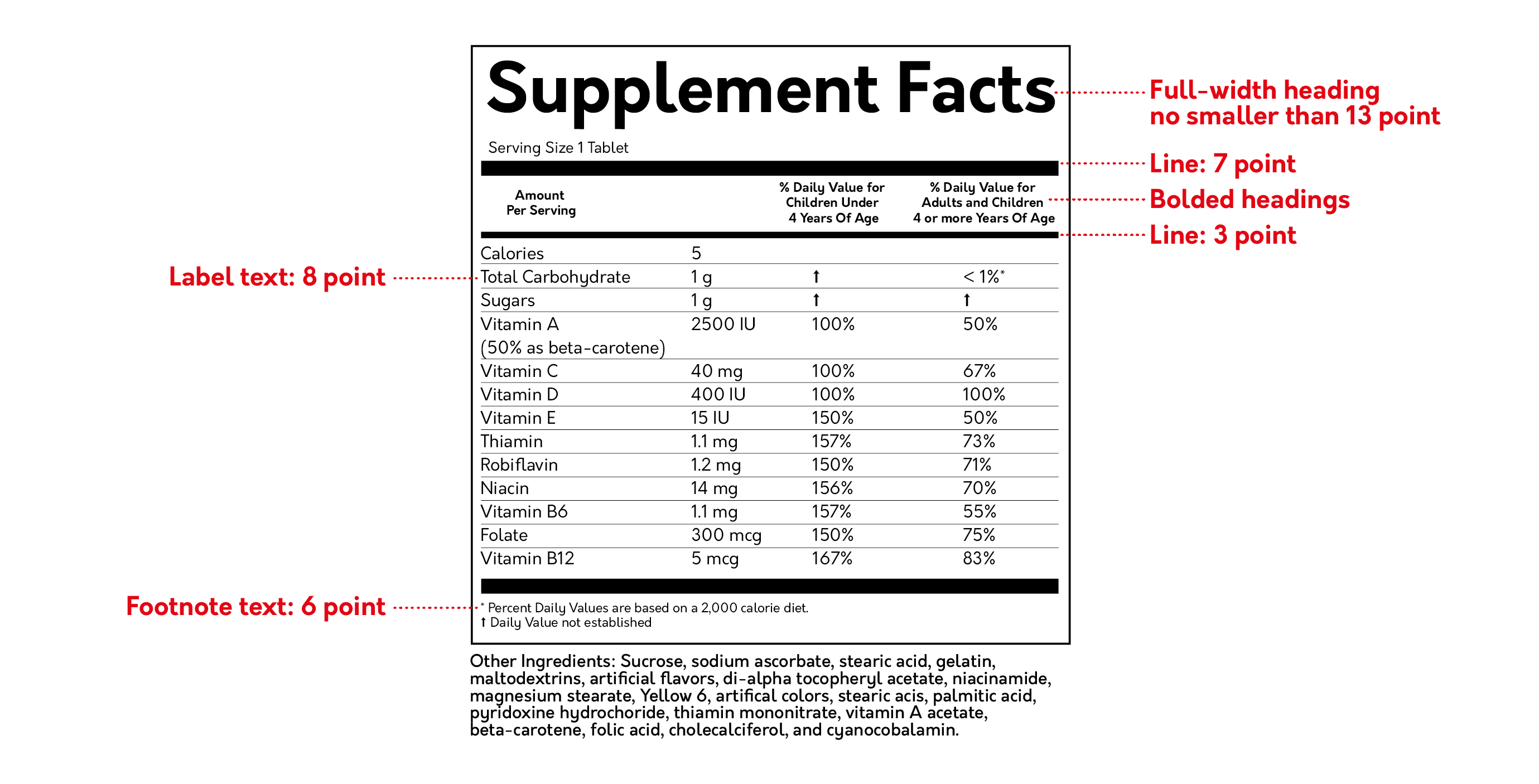
The supplement facts panel provides a detailed breakdown of the product’s nutritional content. This includes information for:
Serving size: The maximum amount of the product one typically can consume in one sitting. If there’s no recommended amount, the serving size is 1 unit (pill, teaspoon, etc.)
Calories: The total energy content.
Nutrients: The amount per serving of various nutrients, such as total fat, saturated fat, trans fat, cholesterol, sodium, total carbohydrates, dietary fiber, sugars, protein, vitamin A, vitamin C, calcium, and iron.
Daily percent value: Daily Values or DV is the amount of nutrients you must consume in a day. The percentage of Daily Values (% DV) is the percent of the recommended nutrient amount your supplement provides daily. You must list the% DV for all dietary ingredients that have DVs except protein.
The layout and content of this panel must adhere to specific regulations set by authorities like the FDA.
Do you want to add the correct serving size to your nutraceutical label? What if you notice the font size differs between the ingredients before the launch? Oh, and the nutritional values definitely can’t go wrong overall!
Here’s where an AI-powered label compliance tool like Comply figures.
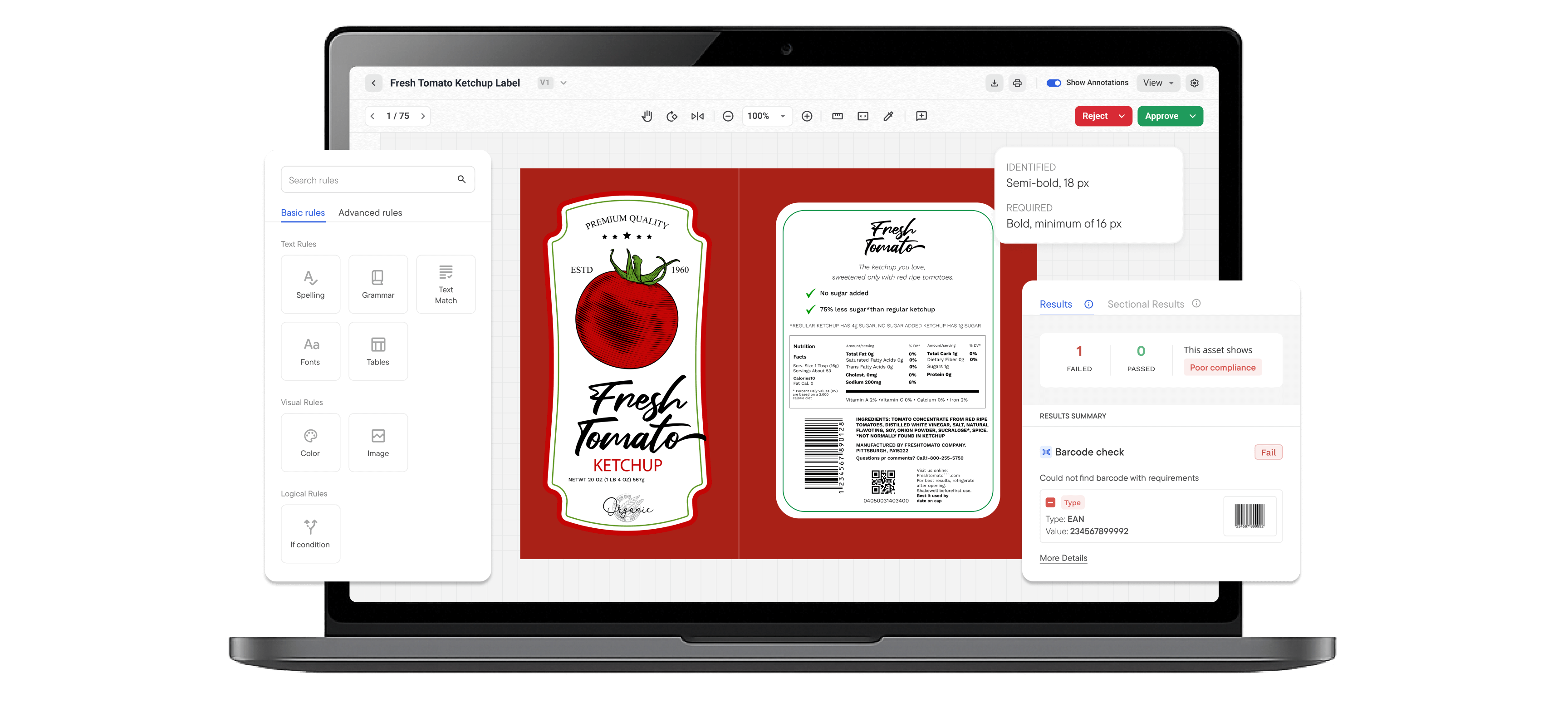
It helps you smoothly set up your regulatory framework online and check every label against it using automated proofing.
Ingredient labeling
Ingredients must be listed in descending order by weight.
This list helps consumers identify what is in the product and assess its suitability, particularly for those with dietary restrictions or allergies.
Special attention should be paid to allergen labeling, as certain ingredients must be accurately identified to protect consumers with allergies.
In the U.S., packaging teams should account for nine major food allergens: milk, eggs, fish, crustacean shellfish, tree nuts, peanuts, wheat, soybeans, and sesame.
If your nutraceutical uses sesame oil, sesame flour, tahini, or another sesame-derived ingredient, your allergen review needs to catch it before the label reaches print.
From food allergens to fragrance allergens, there are allergen ingredients that you must declare on your label.
But sometimes you might miss out on adding them or end up adding the wrong one.
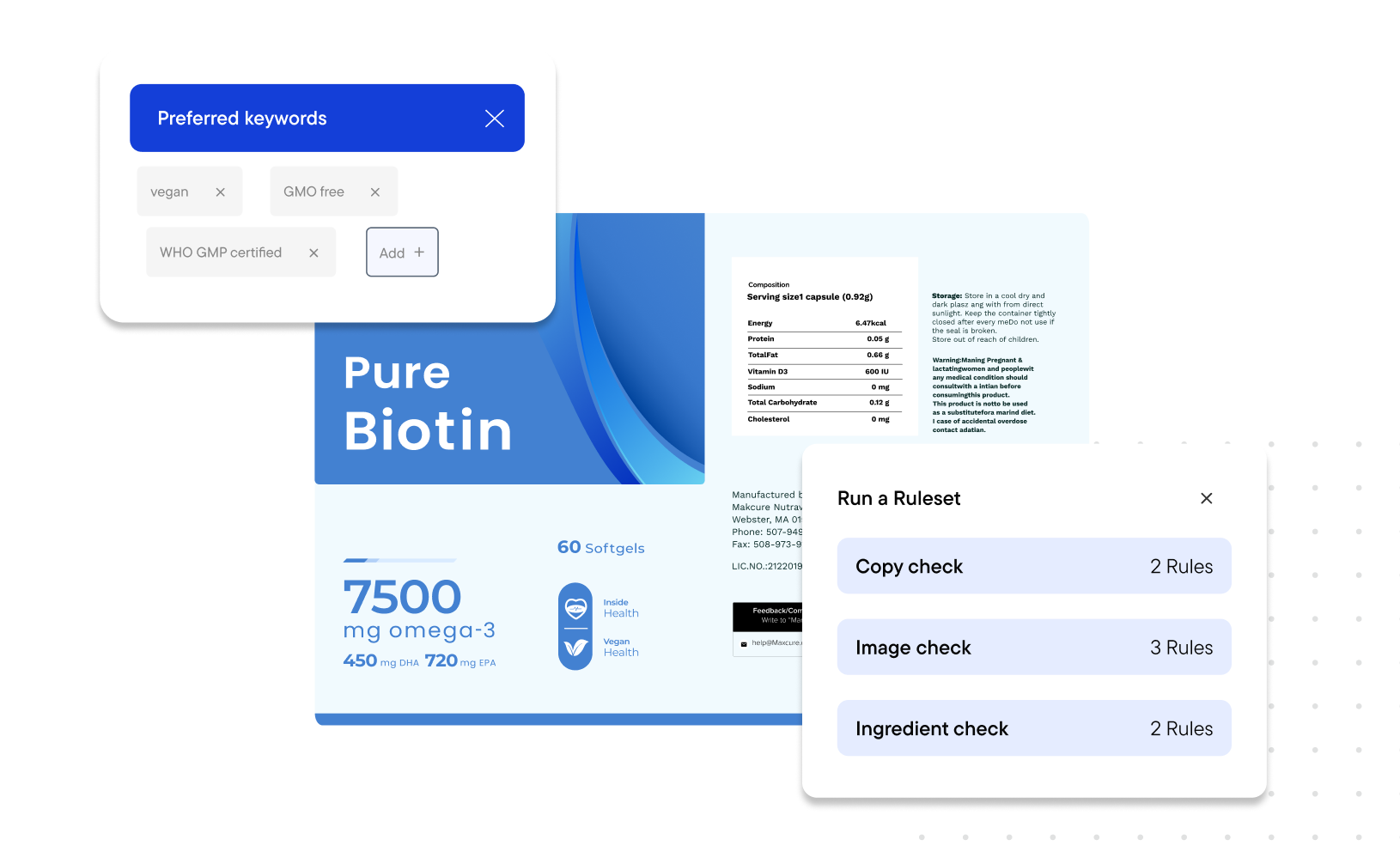
You can run information panel reviews with ease on Comply by customizing rules for each of the key elements on your information panel.
From heavy ingredient information to the name and place of business, Comply scans every detail within seconds. When approved ingredients, claims, symbols, or barcodes need to be reused across multiple packs, WebCenter Content Management helps structure and manage packaging content so updates can be made consistently across labels and related materials.
Nutrient Content Claims
These are claims about the level of a nutrient in the product, such as “low fat,” “high in fiber,” or “sugar-free.”
Nutrient content claims must meet specific criteria defined by regulatory authorities.
A good source claim may be made when your product contains between 10 and 19% DV of an ingredient, while a high source claim can be made if the % DV exceeds 20%.
The word “healthy” also needs extra care.
The FDA finalized an updated definition of the “healthy” nutrient content claim at the end of 2024, and the change can affect food and supplement products that want to use that claim.
If your artwork includes “healthy,” “low sodium,” or “low saturated fat,” treat those words as regulated claims, not marketing copy.
Structure/Function Claims and the DSHEA Disclaimer
Claims can be risky when one word changes the meaning.
Structure/function claims describe how a nutrient or dietary ingredient affects the normal structure or function of the body.
These are different from disease claims, which suggest a product can diagnose, treat, cure, or prevent a disease.
If your nutraceutical label makes a structure/function claim, the DSHEA disclaimer is a core requirement.
The required disclaimer states: “This statement has not been evaluated by the Food and Drug Administration. This product is not intended to diagnose, treat, cure or prevent any disease.”
Your review process needs to check the claim, the disclaimer, and where that disclaimer appears on the package.
To make it smoother and faster, find out how AI can flag non-compliant text before it reaches print in our article, which explains how automated checks can catch claim and disclaimer issues earlier in the artwork process.
There is also a fresh layout development to watch.
In December 2025, the FDA signaled that it is considering a change to the placement rules for the DSHEA disclaimer, which could reduce the need to repeat the disclaimer across multiple panels.
That matters for small bottles, sachets, and crowded cartons where every millimeter of label space is already under pressure.
Other Labeling Requirements
Additional labeling elements may include,
Warnings or cautions: Any potential risks or side effects to the usage of the nutraceutical product.
Suggested use: Recommended dosage and frequency of the nutraceutical supplements.
Expiration date: The date by which your nutraceutical product is used.
Storage instructions: Guidelines for proper storage, such as in a cool, dry place.
Manufacturer/distributor information: Contact details for the company responsible for the product.
Common Labeling Pitfalls
What usually goes wrong right before approval?
Often, it is not one big failure.
It is a small mismatch between regulatory text, artwork, product data, and market rules.
These are common issues to watch for:
Disease claims that should not appear on a nutraceutical or dietary supplement label.
Structure/function claims without the required DSHEA disclaimer.
Supplement Facts panels with incorrect serving size, % DV, formatting, or nutrient order.
Allergens that are missing, incomplete, or not updated for sesame
Claims such as “healthy,” “low sodium,” or “high source” used without the right criteria.
Barcode or QR code errors that connect the package to the wrong product or content.
Old artwork reused after a formulation, supplier, or market requirement changes.
These mistakes can lead to rework, launch delays, warning letters, or recalls.
Nutraceutical Labeling Done Right With Comply
By sticking to the labeling requirements outlined above, you can build consumer trust, avoid regulatory ambushes, and contribute to the growing market of health-focused products.
Proper labeling not only fulfills legal obligations but also encourages your customers to make informed decisions about the products they choose for their health and well-being.
If you are looking to simplify the labeling process for your nutraceutical brand, smart compliance software like Comply can be the game changer.
But how?
Build your customizable document: If you have hundreds of label creatives lying around to review with different rules, you can feed them into the AI label compliance software and let it screen the creatives accurately for you. With Comply, you can set the required values for the nutritional value, including the font style and size, along with allergens, warnings, disclaimers, and more.
Detect wrong barcodes: With our barcode scanner, review barcode information accurately on your nutraceutical packaging to verify product identity and ensure that the correct label is used.
Identify misclaims, missing allergens, and incorrect logos: With the specs you feed into the software, the AI engine flags the wrong or missing information, allowing you to send out error-free and safe nutraceutical products.
Just like ChatGPT needs a prompt to understand what you’re asking, Comply needs a rulebook to understand what ‘right’ looks like
Tabrez Sheikh, Director of Sales and Customer Success at Esko
To launch error-free nutraceutical labels faster, on time, learn how Comply can help you with a guided demo.
About the Author
Gouri, a content specialist at Esko, loves adding a dash of creativity to everything she writes. She dedicates her craft to creating and optimizing content for clarity and impact. On weekends, you can probably spot her exploring new cafés or at movies.