
Written by Shruti Ramanujam
Content Marketing Manager, Esko
Defining the Trend
Packaging has always been more than a wrapper. In the past, it served as protection. It then evolved into a printed surface to catch the consumer’s eye. Now, it is evolving again into . Instead of stopping at the point of sale, packs are now starting to carry persistent digital identities that link to live data. This shift is what’s broadly known as smart packaging.
Esko’s 2026 Packaging Trends survey reinforces that this is no longer a distant idea: 20% of industry professionals ranked smart packaging among the top technologies set to impact packaging by 2026—behind only automation and artificial intelligence.
At its core, smart packaging uses embedded identifiers or sensing technologies to connect each physical pack to digital information. The technologies themselves are not futuristic anymore and are being quietly adopted across categories and regions.
- 2D barcodes and QR codes (often built on GS1 Digital Link) can direct different users like regulators, retailers, and consumers to dynamic web-based product data. As the link lives in the cloud, the content can be updated without changing the printed code.
- NFC and RFID tags support authentication, item-level tracking, and reuse logistics, particularly in high-value goods, pharma, and food safety.
- Digital watermarks, as tested in the HolyGrail 2.0 project, allow mixed post-consumer packaging waste to be automatically sorted with far greater accuracy.
- AR layers and embedded sensors can trigger interactive consumer experiences and monitor freshness, temperature, or shock during transport.
Several brands have started piloting such tech-enabled packs.
Coca-Cola, for instance, has brought back its famous ‘Share a Coke’ campaign with a twist—on-pack QR codes that give consumers the ability to customize their Coke packaging.
Quite a few companies, including Nestlé and Diageo have implemented Accessible QR codes using Zappar technology to improve accessibility for visually impaired customers. These QR codes relay essential product information such as allergens and usage instructions via apps compatible with screen readers.
Henkel, Korozo, and R-Cycle have collaborated on a Digital Product Passport pilot for flexible packaging to transmit recyclability data through the value chain. And HolyGrail 2.0 as mentioned above proved that watermarked packs can be sorted at industrial speeds, showing how packaging can carry value long after it leaves the shelf.
As Jan De Roeck, Director of Industry Relations at Esko, notes, “smart packaging creates a natural bridge between product specification and packaging specification, tying together ingredients, materials, and labeling in one data layer.”
In short, smart packaging gives each pack a digital life beyond the warehouse. It can carry traceability data, surface product information, and trigger real-time interactions for regulators, retailers, and consumers.
Crucially, this information sharing can also be context sensitive. The data revealed can differ by geolocation, the role or credentials of the person scanning, or the device used. This is what makes packaging not just connected, but truly “smart.”
Why 2026 is the Inflection Point
Smart packaging has been on the horizon for years. What makes 2026 different is that the enabling technology has matured and regulation is now forcing its adoption. The industry has reached a point where both tracks are converging.
The Tech is Ready to Scale
Until recently, connected packaging was held back by fragmented standards and unproven economics. Those barriers are disappearing fast.
One example is how retailers are aligning on GS1’s Sunrise 2027 to accept 2D barcodes at the point of sale. This means that brands need to have 2D-enabled packs and supporting systems ready by late 2026. A single GS1 Digital Link symbol can now route different sets of users to live product data without changing the on-pack code.
But this digital shift isn’t limited to what’s printed on a pack. The same connectivity that links a product to the cloud is also reshaping how those packs are made.
IoT in Packaging Production
While smart packaging connects individual packs to the cloud, a parallel transformation is happening upstream: production equipment itself is becoming connected. This is part of the broader Internet of Things (IoT) movement, where “things” can be either physical packages or the machines that make them, both generating valuable data streams.
Connected flexo plate making devices like Esko CDI and XPS, for example, already collect productivity and maintenance data in the form of uptime and error logs. These insights don’t change what’s on the pack, but they do improve converter efficiency, uptime, and service response.
As Mariam Khalfey, Global Product Manager – IoT/Equipment Services at Esko, points out, the value of this connectivity is immediate: “the low-hanging fruit with IoT is around efficiency gains and increasing uptime and throughput for our customers.”
Prepress and operations teams will increasingly become the data capture backbone of this transformation. Khalfey envisions a near future where “connected flexo hardware allows one to monitor, in real time, what is happening on CDI and XPS systems.” She expects tradeshops and converters to begin with uptime and throughput dashboards (a fast ROI path) and later incorporate print quality KPIs once definitions are standardized across customers.
These dashboards will serve multiple personas across a converter’s organization—from senior management tracking uptime and waste, to production managers monitoring device health and predictive maintenance alerts, to operators who rely on live job status to minimize downtime.
Over time, this data-driven approach to production can support predictive maintenance, quality tracking, and waste reduction. These benefits complement but are distinct from the consumer- and regulator-facing use cases of smart packaging.
Regulation Will Make It Non-Negotiable
If technology makes smart packaging feasible, regulation is what makes it unavoidable.
The Ecodesign for Sustainable Products Regulation (ESPR) entered into force in July 2024, creating the framework for Digital Product Passports (DPPs). The ESPR represents a structural shift toward greater sustainability, transparency, and circularity in how products are designed and documented across the EU.
The DPP will require brands to disclose structured, shareable product data such as material composition, recyclability, and carbon footprint via delegated acts. Geert De Proost, Director, Software Product Offering at Esko, even predicts that the DPP will be “the biggest digital transformation driver for the entire packaging supply chain. Brands, converters, premedia, or any other stakeholders are all facing the biggest operational and data management changes in order to comply.”
Additionally, the new Packaging and Packaging Waste Regulation (PPWR), adopted as Regulation (EU) 2025/40, entered into force in February 2025 and applies from August 2026. Some of its provisions are phased to 2030 or later, especially regarding stricter eco-design, reuse, and waste reduction requirements.
The PPWR harmonizes EU packaging design, reuse, and information rules, dovetailing with the DPP’s data model, which will mature and expand throughout the latter part of the decade.
Together, the ESPR and PPWR form a two-part regulatory spine: the ESPR sets sustainability requirements for all products and creates the DPP to carry product data, while the PPWR sets packaging-specific design, labeling, and waste reduction rules.
For brand teams, the 2026 deadline is the first operational checkpoint where compliance measures must start being implemented, making it a near-term regulatory milestone, and not a distant target.
The scale of the data transformation is far larger than most teams expect.
And even well-prepared organizations are still defining ownership and data models.
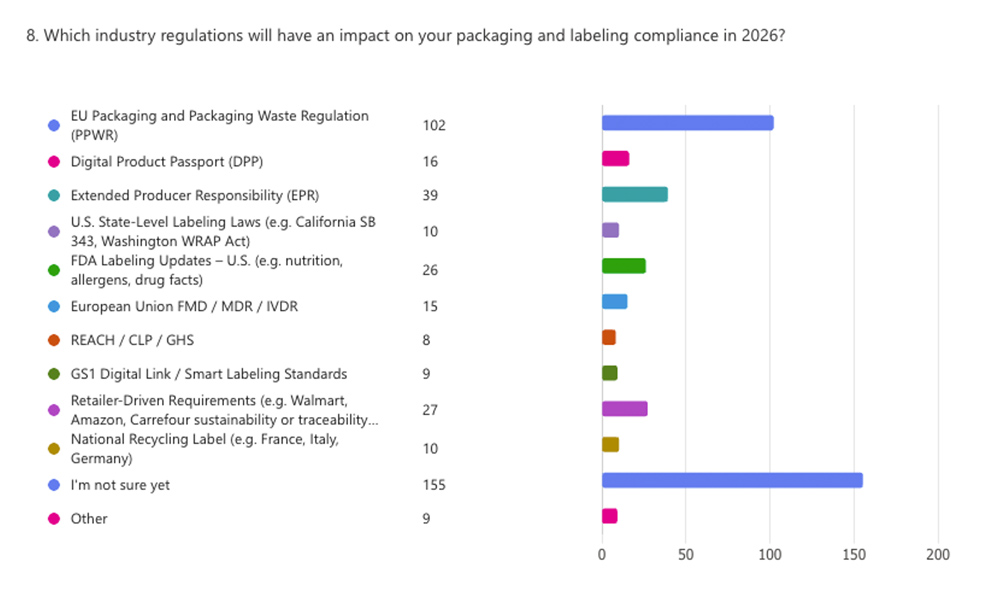
In fact, in Esko’s 2026 Packaging Trends Survey, when asked which regulations will most impact their packaging compliance by 2026, survey respondents pointed to the PPWR and DPP most often. However, the largest single group (36% of respondents) admitted they aren’t sure yet, underscoring just how unprepared the industry still is.
Converters and brands will need to centralize specifications that have never been managed in one place before: from substrates, inks, and adhesives to production conditions like curing times.
De Proost warns that “none of this data management is part of the DNA of a converter today. Most don’t collect or structure data at all, and when they do, it’s often scattered in Excel sheets and emails.” This is why brands will increasingly expect converters to operate like data companies, not just print suppliers.
Moving toward DPP means building an entirely new layer of structured systems and processes from the ground up. The accuracy and trustworthiness of this data will determine recyclability, recycled content, origin, chemical safety, and even the fees payable under PPWR and Extended Producer Responsibility (EPR) schemes.
Teams that move early will gain a rare edge.
Impact on Packaging Teams
Smart packaging and its associated regulations will trigger a cultural and operational reset in the day-to-day work of packaging teams in 2026.
As De Roeck notes, “A package is usually a combination of the primary container, which could be in various materials, mostly with one or multiple labels, combined with secondary and tertiary packaging. A real collection of assets—bottles, labels, boxes, and wraps—yet most brands don’t centrally manage this information, and data is typically scattered across many disconnected platforms. The biggest learning from this chapter of the eBook is that the Smart Packaging trend will force brands to consolidate and curate all packaging data.”
Brand-side packaging teams will become the orchestrators of product data. They will need to build and own the core data model: sourcing accurate specifications from suppliers, storing them, mapping them to GS1 identifiers, and maintaining them as living records.
They will also need to create governance frameworks:
- Who approves updates?
- Who owns the master record?
- How will these changes be audited?
This level of discipline will be unfamiliar but essential.
The payoff will be significant. Once packaging content becomes digital-first, brands can update it without triggering reprints. As this study commissioned by Amazon shows, 30-35% of packaging is updated annually. This is a churn cost that can be substantially reduced by DPP-enabled digital content.
Converters will have to overhaul their information systems to participate in this ecosystem. To remain viable partners to brands, converters will need to adopt specification and data management platforms, collaborative workflow systems, and integration with DPP-compliant third-party clouds while also embedding privacy and data security controls.
How Packaging Teams Can Prepare
Start with Data
Begin building a DPP-compliant data model now. Track packaging materials, origins, recyclability, and chain-of-custody details, and link each attribute to a unique digital ID. Audit where this data currently lives (in PLM, ERP, supplier PDFs, or spreadsheets) and start consolidating.
As De Roeck previously explained, most brands don’t centrally manage packaging information and specifications often sit fragmented across suppliers, premedia agencies, or converters.
Smart packaging collapses this divide. To make DPPs work, packaging teams will need to merge these two streams into a single, governed data model that links every product’s composition to the packaging it comes in.
De Proost adds that while this shift is daunting, it also creates an opportunity. Converters that get their data in order won’t just meet compliance requirements, but also gain a business edge by better understanding their own operations and using that data to drive continuous improvement.
Upgrade Production Capabilities
Invest in converting and printing lines capable of handling high-resolution variable 2D codes and, where relevant, serialized QR and RFID/NFC inlays. Ensure your workflow systems can manage variable data at scale and link correctly to packaging artwork and identifiers.
Build the Right Partnerships
Work with tech providers or platforms offering DPP-ready solutions for automated data capture, digital labelling, and secure passport data sharing. Integration between your systems and theirs will be critical.
Train Your Team
Educate packaging, regulatory, procurement, and supplier teams on DPP requirements and how the data ecosystem will function. Cross-functional understanding is essential, considering the DPP will cut across departmental boundaries that were previously isolated.
Smart packaging and DPP readiness are fast becoming baseline expectations for operating in the EU and other advanced markets.
As De Proost notes, “the road to implementation is an investment for the long term in a phased approach.” He outlines a maturity curve that teams can use to plan their transformation: