
Written by Alexandra Blanck
Content Manager, Esko
Defining the Trend
Sustainability has long been a headline in the packaging industry. In 2026, it will mean something different from just a few years ago. Where once a recycling logo and a bold commitment were enough, today’s consumers and regulatory bodies demand proof—measurable, auditable data integrated directly into packaging design and production.
This shift reflects how far the conversation has matured. In 2024 and 2025, many of the world’s biggest brands admitted they would miss their net-zero targets. The reasons varied, but most pointed to Scope 3 emissions—the indirect impacts across their value chains—as the hardest to control. Packaging is not immune. And while packaging represents 5-10% of a product’s overall footprint, it is the most visible signal of sustainability to consumers. That visibility has brought packaging from a peripheral issue into a frontline test of credibility.
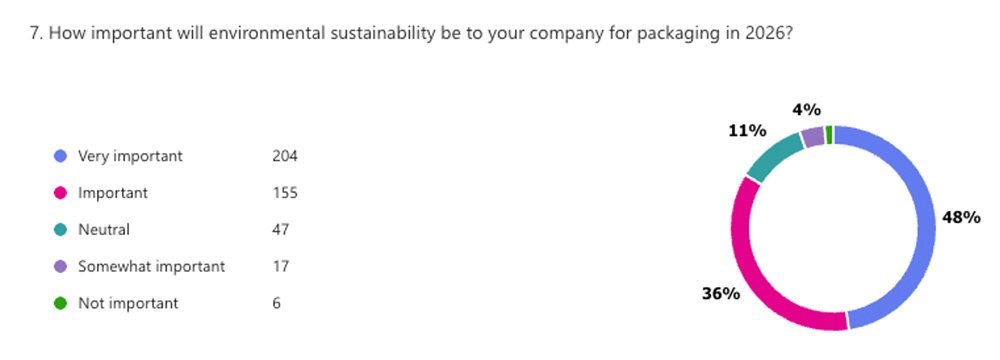
In Esko’s 2026 Packaging Trends Survey, 84% of respondents said sustainability would be important or very important for their company’s packaging in 2026. That figure has risen steadily from 77% in 2024 to 80% in 2025, showing a clear upward trend in priority year over year.
The industry’s answer has been to move from vague claims towards carbon intelligence. Life cycle assessment (LCA) has become the universal measurement, calculating the impact of raw materials, production, transport, and end-of-life.
You can only reduce what you measure, therefore measurement is everything in the packaging industry.
The difference today is that advances in automation and data science have made this measurement faster, cheaper, and available at the design stage.
The conversation has also broadened. Sustainability is no longer just about the recyclability of materials. It is about responsibility, measurability, and visibility across the entire packaging lifecycle—from source to shelf to consumer and back again. Companies now talk not only about their footprint—the impact of their own operations—but also their handprint: how the tools and solutions they provide help others reduce their environmental impact.
Why It Matters Now
Regulation as a Catalyst
The regulatory environment has undergone significant changes. For example, in Europe, the Packaging and Packaging Waste Regulation (PPWR) is introducing mandatory recycled content and eco-design standards. Extended Producer Responsibility (EPR) fees are creating new financial pressures: choose a higher-impact substrate, and you pay more.
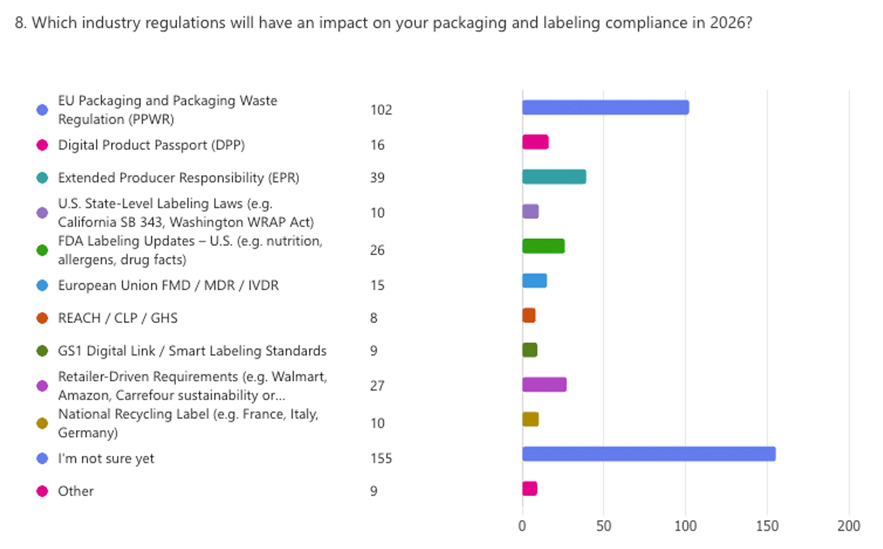
The loudest message from the survey isn’t about any single regulation — it’s uncertainty. Of 429 respondents, over 150 admitted they don’t know what will shape compliance in 2026, with PPWR and EPR emerging as the most cited among those who did take a position.
“The overriding driver is legislation—and the complexity of legislation per country or even per region is forcing companies to get data,” explained Geert De Proost, Director, Software Product Offering at Esko. That complexity has made sustainability officers indispensable. It has also shifted their reporting lines. “Sustainability officers increasingly report into procurement now, because there are millions of dollars involved,” he added.
Momentum is also building in North America. For example, New York’s proposed Packaging Reduction and Recycling Infrastructure Act is designed to reduce plastic packaging over the next decade by 30%. This is not pocket change. The projected savings are staggering: $1.3 billion, including $568 million for local governments and $696 million for private waste firms. With packaging expected to make up 3.8 million tons of the state’s waste in 2025, the political and financial ramifications cannot be ignored. As Paulina Vélez, Global Sustainability and EHS Senior Manager at Esko, observed: “Regulations drive innovation.” They do so by pushing companies to rethink production methods, adopt new technologies, and explore alternative raw materials to stay compliant and competitive.
Broadly speaking, sustainability regulations fall into two categories:
- Disclosure-Based Regulations, which focus on transparency, requiring companies to report on sustainability-related risks, governance, metrics, and impacts. For example, the CSRD (EU) and the SEC Climate Rule (US) ask for detailed reporting on Scope 1–3 emissions, climate risks, governance structures, and double materiality.
- Performance-Based Regulations, on the other hand, go beyond reporting. They require companies to meet specific thresholds or targets, often tied to product design, sourcing, or operations. Examples include the EU Green Deal, ESPR, PPWR, and EPR. Key requirements include meeting targets for recycled content percentages, emissions reductions, energy efficiency standards, and circularity metrics.
However, regulations also create new challenges. As Christian Knobloch, Co-founder and CEO of Recyda, noted, “Regulations like PPWR and EPR aren’t just compliance hurdles—they’re becoming the real market transformers. They’re pushing companies to think about recyclability and data at the very beginning of packaging design.”
Consumers as Enforcers
Stricter regulatory schemes are being bolstered by growing consumer pressure. The Wall Street Journal reports that 37% of North American shoppers, and 42% of Europeans, have already refused to buy a product because of unsustainable packaging. Additionally, eight in ten say brands use too much packaging. Susie Stitzel, Director of Product Management at Esko, further emphasized this point, stating, “For many products, packaging may only account for about 10% of the total carbon footprint, but the packaging is by far the most visible to consumers.”
This visibility explains why brands are scrambling to respond. Sustainability Magazine reports that many packaging pledges have failed to deliver measurable results. The Science Based Targets initiative (SBTi) has recently delisted more than 200 major companies for falling behind on climate commitments. For packaging leaders, this is both a warning and an opportunity: voluntary, good-faith sustainability promises are no longer enough—credible, data-backed action is now the expectation.
Additionally, according to McKinsey’s report “Investors want to hear from companies about the value of sustainability”, the majority of S&P 500 companies (95%) now issue sustainability reports. However, few include ESG factors in their core business strategies and reporting frameworks. The challenge is no longer whether companies disclose, but rather how deeply sustainability is embedded into their decision-making.
Smithers’s 5 Key Trends Shaping the Packaging Industry report shows that CPG companies are no longer treating sustainability as a standalone value proposition but as part of a plural strategy— “sustainability and,” not “sustainability or.” Brands are juggling multiple approaches simultaneously, from recyclability and renewable sourcing to carbon footprint reduction.
Technology and Early Movers
Technology is helping bridge the gap between ambition and action. One of the most powerful developments is the integration of carbon data directly into packaging workflows.
For example, CarbonQuota’s science-based footprinting is now embedded in design tools, enabling packaging teams to evaluate CO₂e impacts in real time. Dominic Harris explained, “If you make all the wrong design choices, you can almost double the carbon footprint of just the label.” By recognizing these impacts at the design stage, brands can make smarter trade-offs before production.
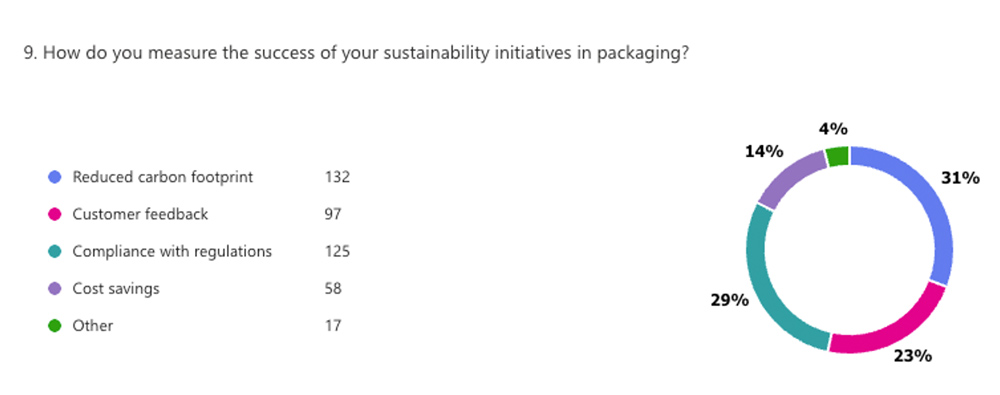
Among the 429 survey respondents, companies are already measuring sustainability success in multiple ways: 132 cited reduced carbon footprint, 125 compliance with regulations, 97 customer feedback, and 58 cost savings.
Regulatory intelligence platforms are also reshaping workflows. For example, “Recyda acts as the translation layer between regulators and packaging companies,” said Christian Knobloch. “Regulators are demanding increasingly complex data on topics such as eco-modulated fees and packaging conformity. Meanwhile, producers often manage only limited and fragmented information about their packaging. We help bridge that gap.”
Recyclability itself is becoming more complex. In its 5 Key Trends report referred to above, Smithers observes the real question is no longer “is it recyclable?” but “is it recyclable at scale?” Practical recyclability depends on variables like inks, adhesives, and contamination, which can undermine otherwise recyclable formats.
Hardware innovation plays a role, too. Flexo technology has proven especially impactful in reducing plastic consumption. According to Veralto’s 2025 Sustainability Report, Esko’s packaging solutions reduce global plastic use by 1.3 million tons every year. It’s a reminder that sustainability isn’t only a software or data story—it is also about smarter production technologies that prevent waste at scale.
The industry’s move toward circularity is also gathering pace. The demand for post-consumer recycled (PCR) content is growing faster than supply. As Smithers notes, this shortage is forcing brands, converters, and recyclers into new collaborations, making supply chain resilience as important as the environmental benefit.
Impact on Packaging Teams
The focus on sustainability intelligence is reshaping daily work across the packaging value chain.
For designers, decisions about size, substrate, and inks carry enormous weight. With real-time carbon feedback available inside tools like Cape Pack, designers can make better trade-offs without slowing creativity.
For prepress and production teams, sustainability is embedded in process optimization. Stitzel explained, “Quick wins already exist—AI-based planning, expanded gamut printing, and digital print can cut waste today without major investments.” Platemaking technology like the XPS Crystal further reduces plastic use. Together, these changes contribute substantial measurable reductions to Scope 3 emissions.
For managers and procurement leaders, sustainability is now a financial discipline. As De Proost emphasized, procurement is taking a lead role “because these choices influence costs at a massive scale.” Dashboards track emissions and recyclability metrics across projects, while finance teams are increasingly developing “sustainability finance” functions to manage eco-fees alongside design decisions.
Looking Forward
The future appears to be heading towards deeper integration of AI into sustainability intelligence. The potential is enormous: AI can model design trade-offs at scale, optimize transport, and even predict regulatory risks. But experts caution that AI is only as good as the data it is fed. “AI will clearly play a large part here,” Harris acknowledged, “but there’s a cautionary word that AI decision making needs to come from the right data sources to give intelligent answers.”
The industry will also become more granular. Not only will companies need to know what their packaging is made of, but where and how it was produced. This will drive a move toward simpler, cleaner designs that are easier to recycle, even in markets with less developed infrastructure.
Finally, collaboration will intensify. Vélez highlighted the importance of embedding sustainability into every part of the business: “The reality is that sustainability isn’t optional anymore—it’s become part of how companies compete.”
From Compliance Burden to Competitive Advantage
For years, sustainability was framed as a compliance burden—something brands had to do to avoid reputational or financial risk. The narrative will be different in 2026. Sustainability intelligence, powered by data and embedded into workflows, will become a source of competitive advantage.
Companies that measure at the design stage can reduce fees, cut costs, and win consumer trust. Converters that adopt the right tools and processes can reduce waste while improving efficiency. Brands that align regulatory compliance with consumer transparency can differentiate themselves in crowded markets.
As Harris reminded us, “Measurement is everything.” But measurement is only the beginning. What matters now is how companies act on that data—translating sustainability from an external obligation into a driver of trust, resilience, and innovation.
Explore the Full 2026 Packaging Trends Report
Sustainability intelligence is only one of the major packaging trends today.
The 2026 Packaging Trends Report explores the three major shifts with insights from industry experts and global survey data.
Download the full report to explore all three trends.