
Table of Contents
The Saudi Food and Drug Authority (SFDA) has laid down strict regulations regarding pharmaceutical labeling. This article covers the key requirements for primary and secondary packaging and Patient Information Leaflets (PIL), along with how to comply with Saudi Arabia drug laws.
Disclaimer: This blog post derives information from the SFDA website and is updated as of August 22, 2026. Please refer to official Government sources for updated information regarding pharmaceutical labeling requirements in Saudi Arabia. This is a label compliance resource and cannot provide legal advice or services regarding labeling.
What information must appear on secondary packaging?
Secondary packaging is the outer container of a drug. It protects the primary packaging and conveys important information to patients, including dosage, usage instructions, and warnings.
Here is what the Saudi FDA mandates for secondary packaging.
Product name
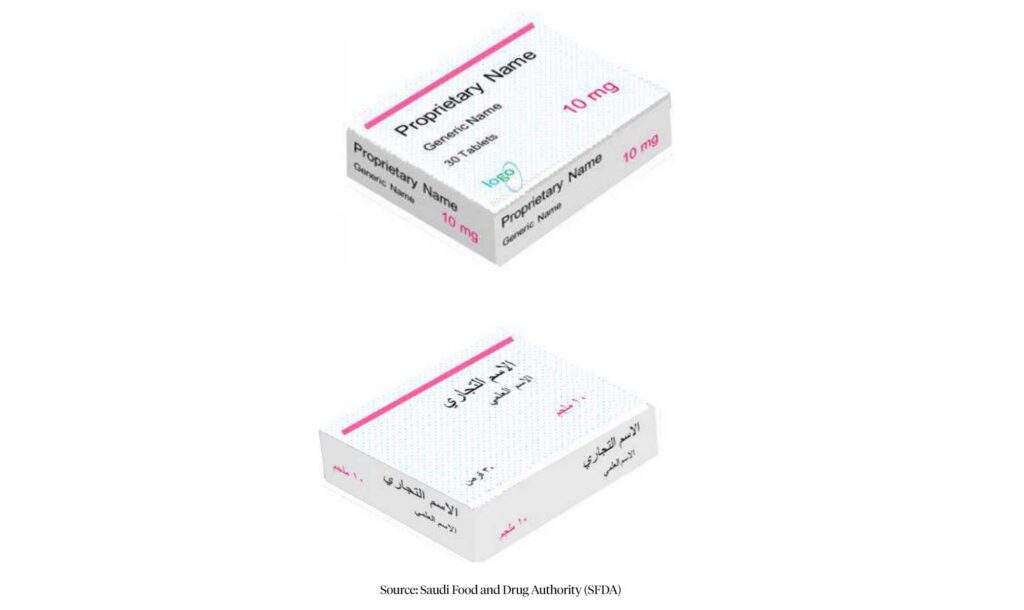
Display the generic and trade names of the medicine on the secondary packaging. Any critical information, including trade and generic names and dosage, should be visible on at least 3 non-opposing faces of the box.
Note: Ensure the generic name is at least 50% the size of the trade name. This helps patients stay aware of dosage limits when taking multiple medicines with the same active ingredients.
SFDA also published dedicated naming guidance in December 2024 that explicitly links medicinal product naming to the prevention of confusion and medication errors. The way you present trade and generic names on-pack is not just a formatting decision. It is a patient-safety one. Names that look or sound too similar to other products on the market are a compliance risk in their own right.
Dosage form
Specify the dosage form of the drug clearly. Common dosage forms include tablets, capsules, syrups, and more.
Strength or concentration
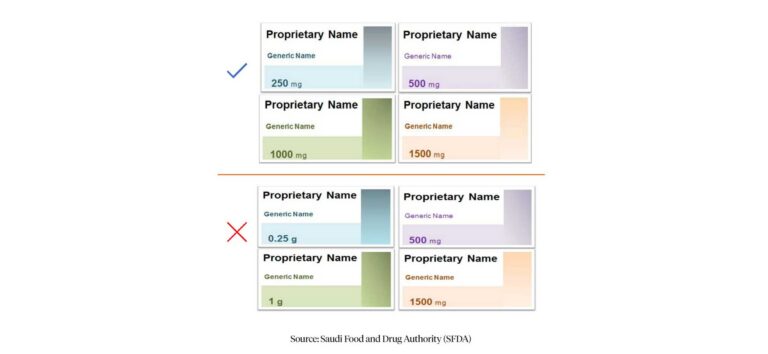
Show the amount of active ingredient present in a specific dosage form so consumers take the correct dose. If the same product comes in different strengths, use the same measurement unit throughout and visually differentiate each strength’s packaging through color and typography.
Note: Avoid trailing zeros when denoting strength. For example, 2.0g could be misread as 20g.
List of excipients
Mention any inactive ingredients (excipients) that have a known effect when consumed. If the medication is parenteral, topical, inhalable, or for the eyes, list every single excipient on the packaging.
Route and method of administration
Specify the method and technique by which the medication is to be taken or applied.
For example: “Shake well before use. For oral administration only.”
Net quantity
Display the total volume of the drug in grams, milligrams, milliliters, or units, depending on the dosage form.
Manufacturing and expiry dates
Represent dates with a three-letter abbreviation of the month, or a two-digit month followed by a four-digit year. For example, a product expiring in October 2026 would appear as OCT 2026 or 10/2026.
Marketing authorization holder (MAH)
Mention the name and address of the marketing authorization holder on the label.
Warning statements
Add warning statements where required to inform consumers about potential risks or precautions.
Examples:
- “Keep out of reach of children”
- “May cause drowsiness or dizziness”
Indications for use
Clearly state the intended indication of the product. This can appear on the outer or inner packaging, or on the Patient Information Leaflet (PIL).
Storage conditions
Add instructions for proper storage to ensure the potency and safety of the drug.
Typography recommendations for secondary packaging
- Use the largest font size possible for each packaging format to ensure readability.
- Use both upper and lower case letters throughout to maintain visual hierarchy.
- Do not italicize letters unless no other form of emphasis is available.
- Use bold or semi-bold formatting and legible typefaces such as Arial, Helvetica, or Univers.
- Ensure strong contrast between type and background color.
These typographic rules serve a purpose beyond legibility. SFDA has separate graphic-design guidance for medication packaging specifically aimed at reducing medication errors. Readability is a patient-safety issue, and SFDA’s 2026 annual plan includes a further update to that graphic-design guidance, signaling that packaging clarity remains an active regulatory focus area.
Treat your typography decisions as part of a broader safety framework, not a finishing step.
Braille on secondary packaging
Accessibility is part of the compliance picture. SFDA has issued dedicated Braille guidance for human medicinal products, covering when Braille is required and the scope of its application.
Check the current SFDA Braille guideline to confirm whether your product falls within scope and what information must be rendered in Braille on the outer carton.
What information must appear on primary packaging?
Primary packaging includes blisters or strips in direct contact with the medicine. It needs to protect the medication and inform the customer about what they are consuming.
Here are the SFDA’s requirements for blister packs and other primary packaging.
Product name
The product name and strength must appear over every single blister pocket, in both English and Arabic. If the pockets are too small to carry this information, repeat it in a pattern across the entire strip.
Marketing authorization holder
Add the brand name to the packaging.
Manufacturing and expiry dates
Add manufacturing and expiration dates using either a three-letter abbreviation of the month or a two-digit month followed by a four-digit year.
Batch number
Add the batch number and expiry date to each end of the blister strip.
Days of the week (optional)
For medication taken every day, you have the option to add calendar days on the back of blister pockets when packaged in strips in multiples of 7.
Typography recommendations for blister pockets
Ensure the following to maintain legibility:
- Type should be bold or semi-bold.
- Font size should be large enough to be readable on the blister pack.
- Type color should contrast strongly against the background.
On immediate packaging, design clarity does more than help patients read a name. It reduces the risk of picking up the wrong strip or misidentifying a dose. SFDA’s graphic-design guidance for medication packaging applies here too. The same medication-safety lens that governs outer carton design should inform how you approach blister text layout and contrast.
Child-resistant packaging
Physical packaging safety sits alongside on-pack text as part of compliance. SFDA has issued specific child-resistant packaging requirements for certain orally administered medicines supplied in reclosable packs.
If your product falls within scope, the pack itself must meet those requirements, not just carry the appropriate warning statement. Check the current SFDA child-resistant packaging guidance to confirm whether your product is affected.
Tamper-evident packaging
SFDA has also issued separate guidance on tamper-evident packaging. This affects how pack integrity is treated as part of overall compliance and is not covered by label content alone.
Review the SFDA tamper-evident packaging guidance alongside your labeling checklist to make sure both dimensions are addressed.
2D barcodes and track-and-trace (DTTS)
Serialization is now a real part of the compliance environment around drug packs in Saudi Arabia. SFDA’s Drug Track and Trace System (DTTS) requires each pack to carry a GS1 DataMatrix barcode encoding the GTIN, serial number, batch number, and expiry date.
This is separate from the human-readable information requirements covered above, but it belongs on your compliance checklist alongside them. For a broader view of how 2D traceability requirements are evolving across markets, Esko’s guide to 2D traceability in packaging covers the compliance drivers in detail.
Patient Information Leaflet (PIL)
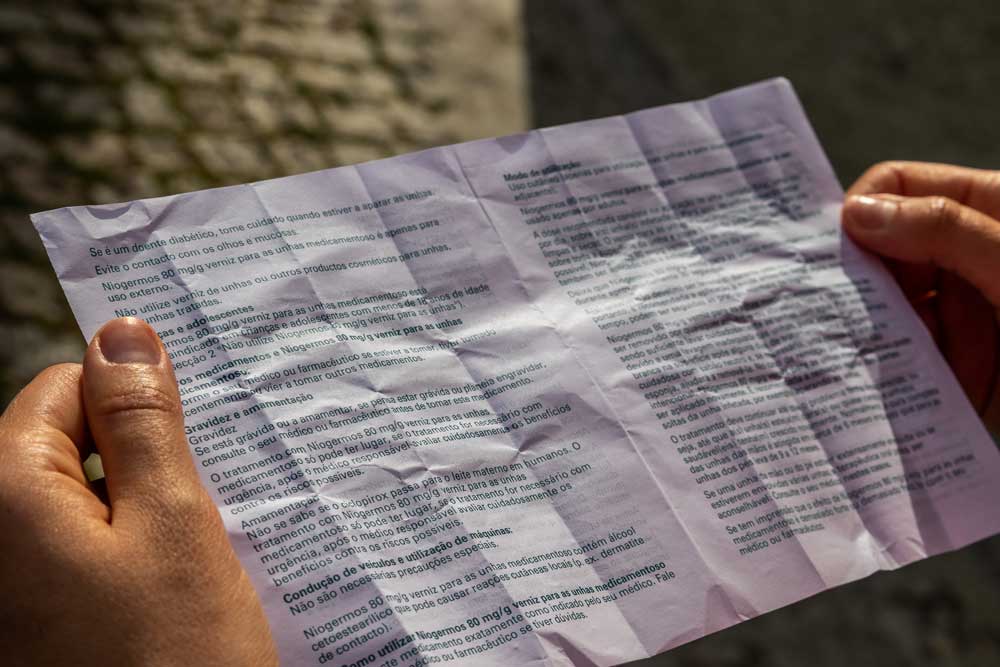
A PIL is the leaflet that comes with a medicine. It informs patients about their medication, side effects, directions of use, and more.
The PIL is part of the approved product information package. It must be consistent with the approved Summary of Product Characteristics (SPC) and is submitted to SFDA in both Arabic and English as part of the marketing authorization dossier.
For teams managing multilingual leaflet content and generating submission-ready documents from approved packaging content, our content management capabilities for leaflets and IFUs are worth checking out.
Here are the SFDA’s labeling requirements for PILs.
The product and its usage
List the product name, active substances, and pharmacotherapeutic group in simple language that patients can understand. Also include the therapeutic indications and the benefit of using the medicine.
What the consumer needs to know before using the medicine
This is where you elaborate on things the consumer needs to know before starting a new medication. Here are the points you need to include:
- Contraindications
- Warnings and precautions
- Interactions with other medicines and herbal or dietary supplements
- Interactions with certain foods and drinks
- Use during pregnancy and breastfeeding
- Driving and operating machinery
- Excipient warnings
Usage instructions
Add details about how to take or use the medicine, including:
- Dosage
- Method of administration
- Frequency of administration
- Instructions for proper use
- Treatment duration
Also include information on overdosage, irregular use, and interrupted treatments.
Possible side effects
List the most serious side effects first, along with clear instructions on what actions to take. For example: “If you experience any of the following serious side effects, stop taking [product name] and seek medical attention immediately.”
Side effects outside of the more serious ones should be arranged by frequency.
Storage information
Add directions on how to store the product. For example: “Keep out of reach of children.”
Further information
Remember to mention the following:
- Active substances and other ingredients
- Pharmaceutical form, shape, color, and other physical properties
- Marketing authorization holder (MAH)
- Leaflet approved date
- Address of the National Pharmacovigilance Centre (NPC) for reporting side effects
E-labeling and digital leaflets
Printed PILs are not the whole picture anymore. SFDA requires a digital leaflet in addition to the printed version, accessible through the Saudi Drugs Information (SDI) system and SFDA channels.
This means your PIL content needs to be managed in a way that supports both print and digital publication: the same approved text, consistently maintained across both formats.
If your team is still managing leaflet versions manually, that dual-format requirement adds real risk. Esko’s work on leaflet management in life sciences explains how automation is helping teams handle the transition to digital leaflets without losing control of approved content.
Artwork, Mock-ups, and Submission Requirements
Label compliance does not end with getting the content right. SFDA’s human drug submission requirements make clear that the approved labeling package is a formal part of the marketing authorization dossier.
Your submission is expected to include:
- Arabic and English versions of the PIL, consistent with the approved SPC.
- Artwork mock-ups for primary and secondary packaging.
- Representative samples of the final marketed pack.
- Labeling information formatted in line with the August 7, 2024 SFDA templates for labeling information, SPC and PIL.
Artwork teams and regulatory affairs need to work from the same approved content, in a controlled workflow, with a clear audit trail.
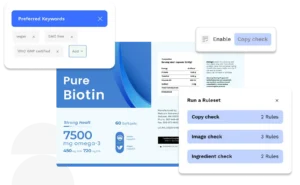
A checklist approach to label content is only part of the process. Artwork teams also need to make sure the final files reflect the approved requirements before submission and production. Comply can help here by automatically checking artwork against defined documents for elements such as copy, barcodes, and required symbols.
Achieve 100% SFDA compliance
Managing SFDA labeling requirements across primary packaging, secondary packaging, and PILs demands a controlled, auditable workflow — not a manual checklist. WebCenter gives packaging and regulatory teams a structured environment to manage artwork, approvals, and label content in one place, with the speed and affordability that t brands need.