Gouri, a content specialist at Esko, loves adding a dash of creativity to everything she writes.
Disclaimer: This post draws on information published by the U.S. Food and Drug Administration (FDA) and reflects requirements current as of 2025. Some items noted below, particularly front-of-package nutrition labeling, are proposed rules, not yet final.
Always refer to the FDA website for the most current binding requirements. WebCenter Go is software designed to help brands manage label compliance workflows; it is not a source of legal or regulatory advice.
FDA labeling rules for non-alcoholic beverages are scattered across multiple regulations, guidance documents, and CFR sections. Finding the right information takes time you probably don’t have.
The cost of getting it wrong is much higher. Mislabeling a product, whether by misclassifying it as a dietary supplement, omitting a required statement, or using a restricted claim, can trigger product recalls, FDA warning letters, and class action lawsuits.
Ensuring artwork compliance has traditionally been a time-consuming and error-prone process, involving multiple rounds of manual reviews and approvals.
Jan De Roeck, Director Industry Relations & Strategy
This guide covers everything you need to label a non-alcoholic beverage correctly: how to distinguish your product from a liquid dietary supplement, what mandatory statements belong on the label, and what regulatory changes are worth watching right now.
7 Key Differences Between Liquid Dietary Supplements and Beverages
Calling a conventional beverage a dietary supplement for marketing reasons instead of as a legal classification can have real consequences. Misbranding carries penalties, and the FDA takes the distinction seriously.
A beverage is a conventional food. Its primary purpose is to quench thirst, provide fluids, deliver nutritional value, or offer taste and aroma.
A dietary supplement, by contrast, is a product that cannot be consumed as a sole item of a meal or a diet. It supplements the diet rather than replaces a drink.
The FDA does not evaluate any single factor in isolation. It looks at the total picture — labeling, advertising, packaging, serving size, and marketing together. And an ingredient that is lawful in a supplement is not automatically lawful in a conventional beverage unless it is otherwise permitted for food use.
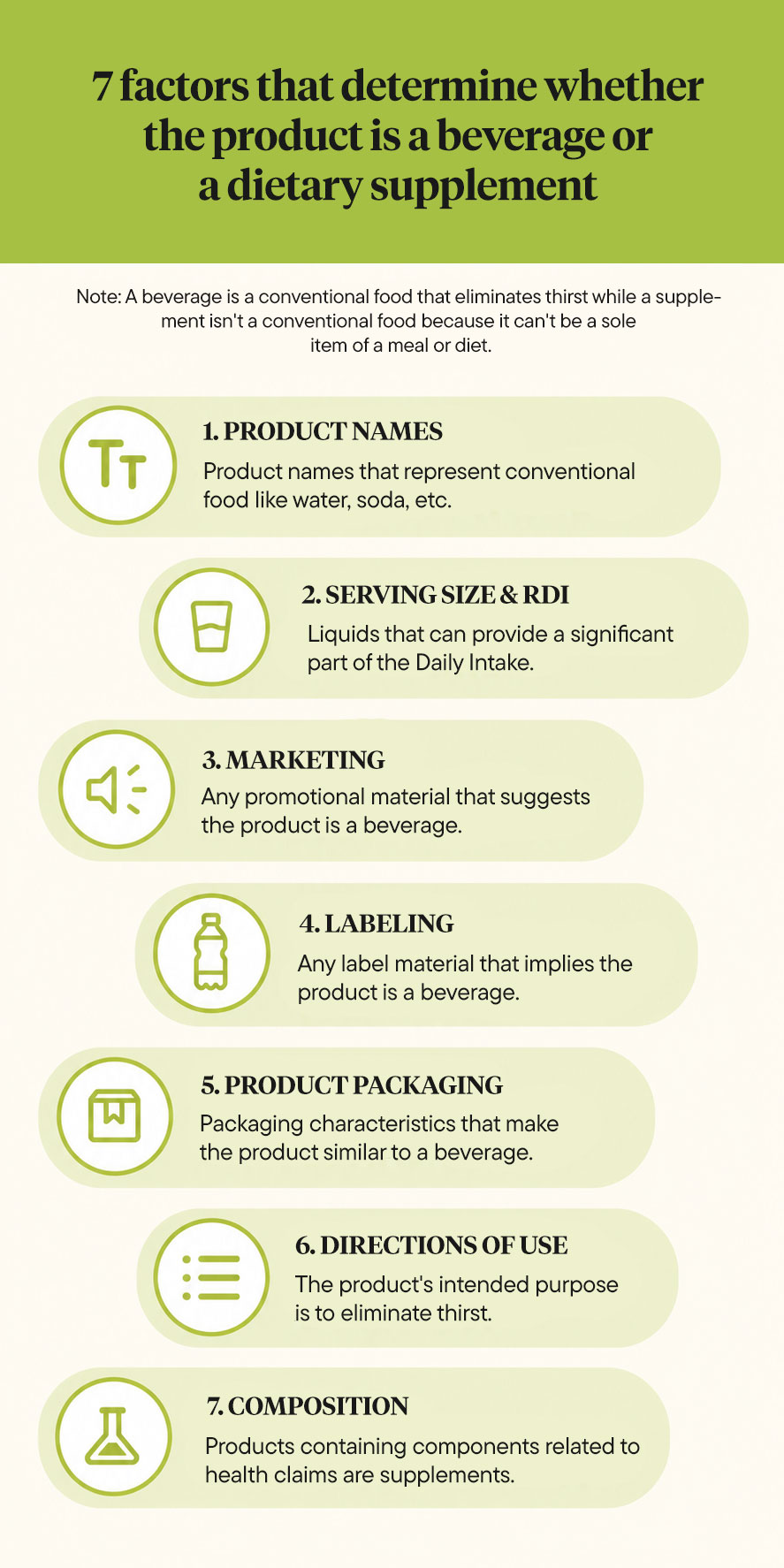
Here are the seven factors the FDA uses to make that determination.
1. Labeling
The FDA reviews statements and graphics across product labels, websites, and social media when evaluating a product’s intended use.
A product with a Supplement Facts panel is still a conventional food if its primary purpose is to “rehydrate” or “refresh” the drinker. Graphics matter too. Vignettes showing someone quenching their thirst, or pictorial serving suggestions that imply refreshment, push a product toward the beverage classification. Regardless of what the label says in text.
2. Product Names
Product names that correspond to conventional food terms under the Code of Federal Regulations (CFR) cannot be classified as dietary supplements. Names like “beverage,” “drink,” “water,” “soda,” “iced tea,” and “apple cider” all signal conventional food.
For ambiguous names, tea is a common example, the FDA evaluates the name in its broader context rather than treating it as definitive on its own.
3. Product Packaging
Shape, size, color, and design all communicate whether a product is a beverage or a supplement. A liquid in a pop-top aluminum can labeled “cola supplement” reads as a soft drink designed for a single serving, regardless of the supplement claim.
That said, packaging alone does not determine classification. A product in beverage-style packaging may still qualify as a dietary supplement if other factors, labeled serving size, Recommended Daily Intake (RDI), support that classification.
The Recommended Daily Intake (RDI), also called the Reference Daily Intake, is the amount of a nutrient required to meet 97–98% of daily nutrient requirements.
4. Serving Size and Recommended Daily Intake
According to the 2005–2006 National Health and Nutrition Examination Survey, an individual needs approximately 1.2 liters of fluid per day. If your product must be consumed in quantities that provide a significant portion of that daily fluid intake, it is a conventional food, even if the label says otherwise.
5. Directions for Use
Packaging that states or implies the product provides hydration points to a beverage. Directions that mirror supplement use, “take one teaspoon twice daily”, point the other way.
The way you tell consumers to use the product is one of the clearest signals the FDA reads.
6. Marketing
Advertising and marketing materials that compare the product to a beverage, or position it as a thirst-quenching option, will be treated as evidence that it is a beverage.
Note the nuance here: recommending that a product be taken with a meal does not make it a beverage, since dietary supplements are also commonly taken with food. And positioning a product as a substitute for a beverage does not automatically make it one.
A Vitamin C drink presented as an alternative to orange juice, for example, would likely be classified as a supplement. It is a convenient source of a vitamin, not a thirst-quencher.
7. Composition
Beverages and liquid dietary supplements share many ingredients. That overlap does not give you permission to label a beverage as a dietary supplement simply because it contains certain dietary ingredients.
To qualify as a supplement, the product must contain food components that support its health claims and must not be a copy of a common beverage with dietary ingredients added. You cannot label a product a “ginkgo supplement” just because it contains a botanical ingredient in a base that is essentially Kool-Aid or non-alcoholic eggnog.
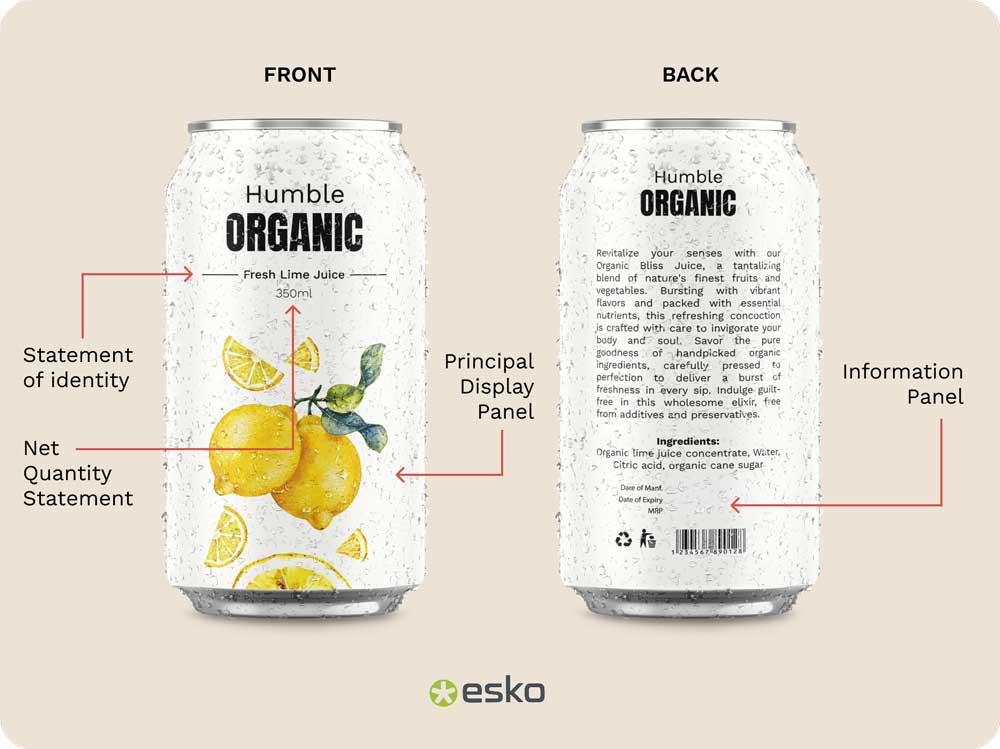
Every non-alcoholic beverage label has two primary zones where mandatory information lives: the Principal Display Panel and the Information Panel.
1. Principal Display Panel (PDP)
The PDP is the most prominent part of the label. It’s the part a consumer sees first when looking at the product. For most products, this is the front of the label. Some containers have alternate PDPs because of their shape.
Calculating PDP area: The PDP area determines the minimum type size for the net quantity of contents. The calculation method varies by container shape (rectangular, cylindrical, irregular). If your package has more than one PDP, all required label statements must appear on every PDP.
2. Information Panel (IP)
The IP is the panel immediately to the right of the PDP, as seen by someone facing the product. If that panel is unusable, for example, because of folded flaps, use the next most prominent panel to its right.
Two additional notes:
If your PDP is at the top of the container, use the adjacent panel as the IP (unless alternate PDPs exist).
If your product has alternate PDPs, the IP is always to the right of the PDP.
3. Required Label Statements: Placement and Legibility
All required label statements must appear on the front panel, PDP, or IP. Minimum type size is 1/16″ with an aspect ratio (width to height) of no more than 3:1.
The label background must contrast sufficiently with the type color. No obscuring vignette or graphic can cover the required text.
Two important notes:
If your packaging is too small to accommodate 1/16″ type, you must file a petition requesting an alternate labeling regulation.
You cannot place intervening material, including UPC codes, between required label statements on the IP.
Required Label Statements for Non-Alcoholic Beverages
1. Statement of Identity
The statement of identity is the common or usual name of the food. It describes the fundamental nature and purpose of the product as defined by law. It appears on the PDP, parallel to the container’s resting base.
Beverages containing fruit and vegetable juices
If your beverage contains juice at less than 100% concentration and uses the word “juice” on the label, you must add a qualifying term: “beverage,” “drink,” or “cocktail.” A grape drink with less than 100% grape juice must be called “Grape juice drink” or “Diluted grape juice drink.”
Mixed fruit and vegetable beverages
When a beverage is a diluted blend of multiple juices, the product name must list all juices in descending order of predominance, unless the product highlights a specific flavor. If your beverage contains raspberries, peaches, and apples, and it is raspberry-flavored, the name is “raspberry-flavored peach and apple drink,” regardless of the actual concentration of raspberry.
If the label represents some juices but not all, you must indicate that additional juices are present. A blend of apple juice and two other fruits becomes “apple juice blend” or “apple juice in a blend of two other fruits.”
Dietary supplements
“Dietary supplement” is a valid statement of identity on its own. You may add descriptive terms (“Vitamin C supplement”) or substitute “dietary” with another appropriate term (“Vitamin supplement”).
Imitation foods
The FDA defines imitation food as a product that contains less nutrition than the food it resembles. A fruit-flavored drink is an imitation of natural fruit juice. Your label must say so clearly.
Brand names are not part of the statement of identity. They must not be more prominent than the statement of identity.
A Note on Water-Based Beverages
If your product highlights “water” on the front of the pack — flavored water, nutrient-added water, sparkling water. FDA bottled water standards and ingredient disclosure rules can affect both your statement of identity and your ingredient list.
The FDA regulates the safety and labeling of bottled water, flavored water, and nutrient-added water beverages separately from other conventional beverages. If “water” is the primary characterizing ingredient, check whether bottled water identity standards apply to your product before finalizing the label.
2. Name and Place of Business
Consumers need a way to contact you. Your label must include the name and place of business of the manufacturer, packer, or distributor — including the firm name and principal place of business.
If your products are manufactured at a different location than your principal address, precede the address with “manufactured by” or “distributed by.”
All addresses must follow this format: street address, city name, state name, zip code. You may also include a phone number, QR code, or other contact method.
3. Net Quantity of Contents
The net quantity of contents is the volume of beverage in the package. It must be expressed accurately using the US Customary system. You may optionally precede the declaration with “Net Contents” or “Net.”
What to include and exclude:
You may add the number of servings if the net quantity alone does not adequately convey the amount.
Do not include the weight of wrappers or packing materials.
You may also express the volume in metric units alongside US Customary units.
Do not use exaggerating terms like “giant quart.”
Type regulations:
The declaration must stand alone, separated from surrounding text by spacing equal to the letter height used.
Type must be legible and contrast with the background.
Minimum spacing to the left and right of the declaration: at least twice the width of the letter “N” in your typestyle.
Aspect ratio of letters: no more than 3:1.
Type size: Minimum type size is determined by PDP area. Fractions must be set at one-half the minimum height of the surrounding text.
Location: The net quantity must appear within the bottom 30% of the PDP, parallel to the container’s resting base.
Declaration for packages less than 1 gallon: Express volume in the largest whole unit (quart), with the remainder in the next largest whole unit (pints).
Declaration for multi-unit packages: The outer package must declare the number of units, the volume per unit, and the total content in parentheses.
Only common fractions, ¾, ½, ¼, ⅛, 1/16, 1/32, may be used in a declaration.
4. % Juice Declaration
If your beverage label explicitly states or implicitly suggests (through vignettes or graphics) that it contains juice, a % juice declaration is required. This applies to all beverages: carbonated and non-carbonated, full-strength juices, and diluted juices.
Calculation: Divide the juice weight by the total weight of the fruits and multiply by 100.
Location: The % juice declaration appears on the IP, near the top. It may be placed above the product name, brand name, and UPC code.
Type requirements: The type size must be no smaller than the largest type size used elsewhere on the IP. The type must be bold and clearly visible. If the package has no IP, the declaration must appear on the PDP in type no smaller than the net contents declaration.
Acceptable declarations:
“Contains ____% Juice”
“Contains % of ____ Juice”
Exceptions: If the beverage contains only negligible amounts of juice used purely for flavoring, no % juice declaration is required, provided:
The product uses the terms “flavor” or “flavored” and does not use the word “juice” anywhere on the label outside the ingredient list.
The label contains no vignettes or graphics implying juice content.
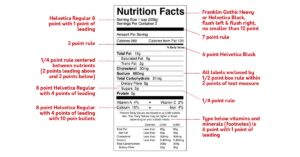
5. Nutrition Labeling
All conventional foods, including beverages, must carry a Nutrition Facts panel unless specifically exempt.
What the current Nutrition Facts label requires:
The current FDA format, mandatory since 2020 for most manufacturers, differs meaningfully from older versions. Here is what is required now:
Required nutrients: Total calories, total fat, saturated fat, trans fat, cholesterol, sodium, total carbohydrate, dietary fiber, added sugars (now mandatory), total sugars, protein, vitamin D (now mandatory), calcium, iron, potassium (now mandatory)
Removed: Calories from fat is no longer required
Removed from mandatory list: Vitamins A and C are now voluntary (though still permitted)
Beverage-specific serving size note: For beverages packaged in containers between one and two servings, where a person is likely to consume the entire container in one sitting, the label must reflect the whole container as a single serving. Some larger beverage packages may require dual-column labeling showing both per-serving and per-container values. Check FDA’s serving-size guidance for your specific container format.
Location: Nutrient information must appear on the IP, before or after the ingredient listing, alongside the name and place of business. It is typically set parallel to the container’s base but may be perpendicular if legibility is not compromised at point of purchase.
Type requirements:
Any typeface may be used, not just Helvetica.
Heading size: no smaller than 8 points, no larger than 13 points.
The heading must extend the full width of the nutrition labeling box.
Nutrient labeling must always appear in a rectangular box, regardless of container shape.
If space is limited: You may declare nutrients separately on a tape card or pamphlet attached to the packaging.
Rounding caloric values: FDA specifies rounding rules for calories and other nutrients. Caloric values under 5 calories may be expressed as 0.
Does your label say “healthy”? Does it claim to be “low sodium” or “a good source of vitamin D”? These are regulated claims, and not just marketing choices.
The FDA distinguishes between three types of claims on food and beverage labels:
Nutrient content claims: Statements that characterize the level of a nutrient (e.g., “low fat,” “high fiber,” “reduced sodium”). Each claim has a specific regulatory definition and threshold.
Health claims: Statements linking a nutrient or food to a reduced risk of disease. These require FDA authorization.
Implied claims: Language or imagery that implies a nutrient or health benefit without stating it directly. The FDA treats these as regulated claims too.
The “healthy” claim deserves specific attention. FDA finalized an updated definition for the voluntary “healthy” claim in late 2024, with an effective date of April 28, 2025. To qualify for the updated claim, a food product must:
Include a minimum amount of at least one recommended food group or subgroups (such as fruits, vegetables, grains, low-fat dairy, or protein foods).
Stay within specified limits for added sugars, saturated fat, and sodium.
If your beverage label uses “healthy”, or language that implies it, verify that your product meets the abovecriteria.
Using a claim your product does not qualify for is a misbranding violation. If you are unsure whether a phrase on your label triggers a regulated claim, treat it as if it does and verify before printing.
7. Ingredient Labeling
Ingredients are all compounds used to manufacture your beverage, including binders, colors, fillers, flavors, and excipients. They must be listed in descending order of predominance, preceded by the word “Ingredients.”
If your beverage is classified as a dietary supplement, you must also list the source of each dietary ingredient alongside the ingredient itself.
Placement: The ingredient list must appear immediately below the Supplement Facts or Nutrition Facts panel. If space does not allow this, it may appear to the right of the nutrition panel.
Type size: Minimum 1/16″, roughly equivalent to a lowercase “o.”
Declaring specific ingredient types:
Spices and flavors: You may use the terms “spices,” “artificial flavor,” or “natural flavor,” or use specific common names. If an ingredient serves both as a flavor and a colorant, turmeric and paprika are common examples, use the term “spice and coloring.”
Artificial colors: Use specific or abbreviated names for certified colors: “FD&C Red No. 40” or “Red 40.” For non-certified colors, use “Artificial Color,” “Artificial Color Added,” or “Color Added.”
Chemical preservatives: List the common or usual name of the preservative followed by its function. Example: “Sodium benzoate to help protect flavor.”
8. Major Food Allergen Labeling
Ingredient lists are where allergen disclosures live, but allergen labeling has its own specific requirements that go beyond the standard ingredient declaration.
The FDA requires disclosure of the nine major food allergens: milk, eggs, fish, shellfish, tree nuts, peanuts, wheat, soybeans, and sesame. Sesame became the ninth major allergen effective January 1, 2023. The U.S. regulatory body issued updated allergen-labeling guidance in January 2025 (Edition 5), covering sesame, tree nuts, multiunit packages, and other labeling scenarios.
You have two options for disclosing allergens:
Within the ingredient list, use the allergen’s common name in parentheses after the ingredient name. Example: “albumin (egg)”
A “Contains” statement: a separate statement immediately after or adjacent to the ingredient list. Example: “Contains: Milk, Wheat, Sesame”
Both methods are acceptable. If you use a “Contains” statement, it must include all major allergens present in the product, you cannot use it selectively for some allergens while relying on the ingredient list for others.
This is especially relevant for dairy-based beverages, plant-based drinks, protein beverages, and flavored drinks with complex ingredient systems. If your formulation changes, allergen disclosures must be updated before the new label goes to print.
“When compliance is tied directly to the artwork review process, teams stop asking whether anyone checked the pack and start seeing compliance happen in real time.”
Tabrez Sheikh, Director of Sales and Customer Success at Esko
The California Bottle Bill requires CRV (California Redemption Value) messaging on labels for specific beverage containers. Covered products include 100% fruit juice in containers of 46 ounces or larger, and 100% vegetable juice in containers greater than 16 ounces, among other categories.
Updated timeline: Expanded beverage categories entered the California Redemption Value program beginning January 1, 2024. Under AB 720, CRV labeling on non-exempt beverage containers is now required beginning July 1, 2026. If you are reformulating or relaunching any beverage in California, factor this deadline into your label update schedule now.
Eligible containers must display one of the following messages:
California Redemption Value
CA Redemption Value
California Cash Refund
CA CRV
CA Cash Refund
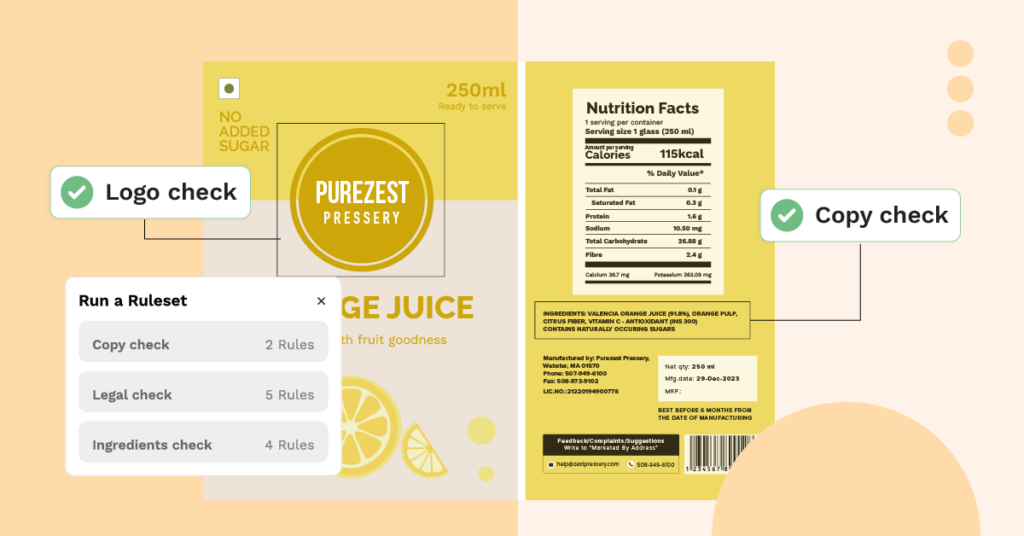
Esko Comply lets you build customizable rulesets for requirements like CRV messaging. If a required message is missing from a label design, the software flags it immediately before it reaches print.
You can define the exact preferred wording for your brand and market, making it straightforward to catch discrepancies across multiple SKUs or label versions. It is designed for mid-market brands that need enterprise-grade compliance capability without the complexity or cost of a full enterprise deployment.
What to Watch: Upcoming FDA Changes
Not everything in this guide is final. Two developments are worth tracking as you plan label updates for 2026 and beyond.
Front-of-package nutrition labeling
In January 2025, the FDA proposed a “Nutrition Info box” that would appear on the front of most packaged foods, displaying at-a-glance information for saturated fat, sodium, and added sugars. This is a proposed rule, not yet final, but the FDA still lists it as a regulation under development. If it is finalized, it will require significant label redesign for most food and beverage manufacturers. Start monitoring it now so you are not caught off-guard.
Updated “healthy” claim
FDA finalized an updated definition of the “healthy” nutrient content claim in late 2024, effective April 28, 2025. If your beverage uses this term, or language that implies it, verify compliance with the updated criteria before your next print run.
Mislabeling a non-alcoholic beverage or omitting required label statements creates real legal exposure. Product recalls, FDA warning letters, and class action suits are not hypothetical risks. They happen to brands that treat labeling as an afterthought.
This guide covers the classification factors, mandatory statements, and new developments you need to get your labels right. But knowing the rules is only part of the challenge. Applying them consistently across multiple SKUs, markets, and label versions is where most teams run into trouble.
Comply helps brands maintain brand consistency and meet regulatory requirements without slowing down your design process. Book a demo to see how it works in practice.