

Skip to content
English
My AccountCart
Artwork Management

EU PPWR: What Packaging Teams Need to Do

Banner for blog titled, "Beyond Basic Compliance: Navigating the New Era of Packaging Sustainability"
Alexandra Blanck

Written by Alexandra Blanck

Content Manager, Esko

Alexandra Blanck, a member of the Esko Corporate Marketing team, is known for her dedication to crafting engaging content

Jan De Roeck

Reviewed by Jan De Roeck

Director Industry Relations and Strategy, Esko

Jan De Roeck, member of the Esko Corporate Marketing team, is highly respected and trusted for his insight in the graphic arts industry.

Key Takeaways

  • Regulation (EU) 2025/40 replaces a patchwork of national packaging rules with one directly applicable EU framework that affects any company placing packaging on the EU market.
  • The PPWR sets concrete deadlines for recyclability, recycled content, reuse, harmonized labeling, and technical documentation, starting with application from August 12, 2026.
  • Packaging teams will need evidence-based decisions on pack size, materials, artwork, inks, coatings, adhesives, and supplier data because compliance now depends on documented performance, not broad sustainability claims.
  • EPR fee modulation, digital labelling requirements, and stricter reporting expectations are turning packaging data management from a back-office task into a cross-functional operational requirement.
  • Companies that connect design, production, logistics, and compliance can reduce empty space, support recycling outcomes, control future costs, and respond faster to changing regulations.

The PPWR changes packaging sustainability from a broad ambition into a set of enforceable design, data, labeling, and material requirements. To comply, packaging teams need one EU-ready approach that covers recyclability, recycled content, reuse, technical documentation, and connected supplier data across the full packaging workflow.


Packaging regulation in the European Union is entering a new phase.


Imagine the current landscape of packaging regulations across the European Union as a network of roads. Each country’s roads have their own rules, speed limits, and signage, which creates confusion and can lead to multiple fender benders.

In this case, regulations, especially changes in regulations, create traffic jams and impede the efficient flow of goods and materials.

For example, the Packaging and Packaging Waste Regulation (PPWR) is like the opening of a new, comprehensive European highway system for packaging.

It isn’t about patching up a few potholes. It is a fundamental redesign that will lay down rules for everyone involved, from raw material suppliers to final distributors.

The PPWR represents a significant shift toward a harmonized and more sustainable approach to packaging across the EU.

The Packaging and Packaging Waste Regulation has now been officially published as Regulation (EU) 2025/40. It was published in the EU Official Journal on January 22, 2025, entered into force on February 11, 2025, and applies from August 12, 2026.

This matters because PPWR packaging rules are not another flexible directive. Unlike the previous Packaging and Packaging Waste Directive, the PPWR is directly applicable across all 27 EU Member States. That means packaging teams can no longer plan around 27 different national interpretations. You need one reliable compliance approach that can travel across EU markets.

And if your company is outside the EU? You are still in scope if you place packaging on the EU market. For global brand owners, importers, and non-EU packaging manufacturers, PPWR packaging compliance is not optional.


This article is based on the recent Esko webinar, “Redefining Packaging: Sustainability Beyond Compliance,” which featured expert insights from Esko’s Geert De Proost, Jenny Walther-Thoss of BP Consultancy GmbH, and Dominic Harris of CarbonQuota. The experts provided an in-depth overview of the upcoming EU Packaging and Packaging Waste Regulation (PPWR), its implications across the value chain, and the urgent need for data-driven compliance.

Banner for Sustainability blog

WEBINAR

Redefining Packaging Sustainability Beyond Compliance

In this blog, we highlight key takeaways from the webinar and expand on how packaging professionals can respond proactively to these evolving requirements.

Understanding the Shifting Global Regulatory Landscape

The surge in sustainability regulations reflects a global push to tackle the growing problem of waste and to foster a more circular economy.

In fact, global municipal solid waste volumes are projected to increase by around 50% by 2050.

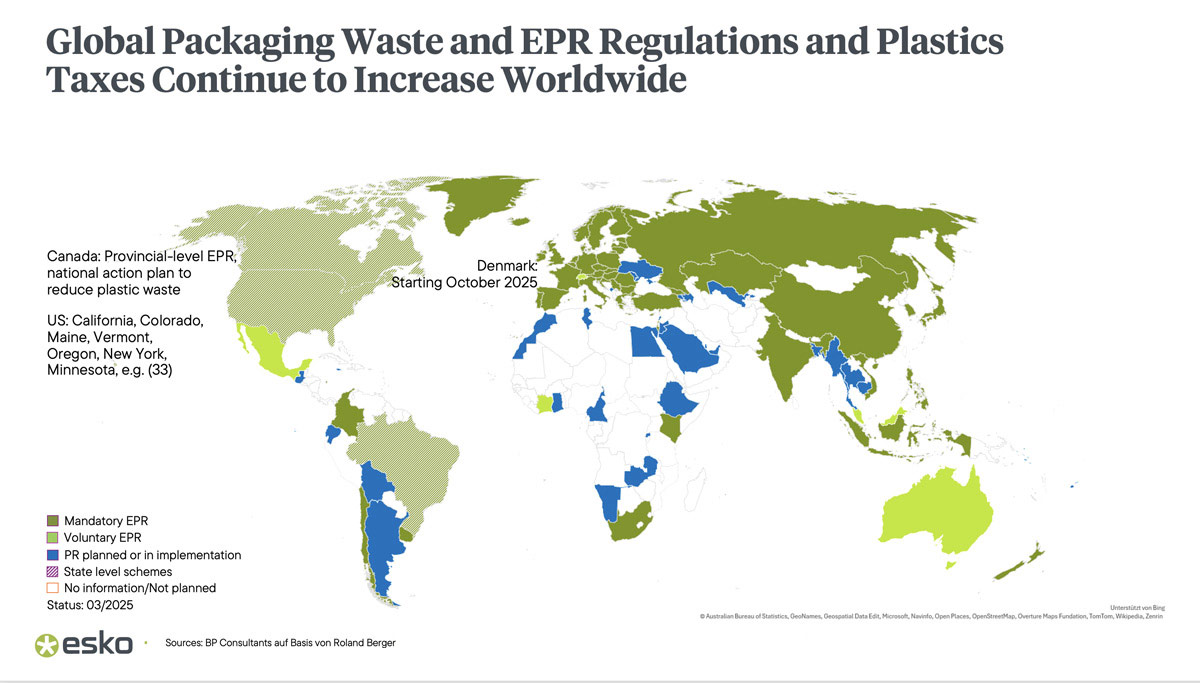
This has led to a significant increase in packaging-related legislation globally, including the rise of Extended Producer Responsibility (EPR) systems and plastic taxes.

Health and safety are also paramount, with bans and limitations on single-use plastics and substances of concern (SoC) like PFAS becoming increasingly common.

The focus of these laws is clear: reduce waste and over-packaging, and foster a circular economy by emphasizing recyclability and the use of recycled content, especially in plastic packaging.

While compliance is necessary, aligning with these regulations also presents a strategic business opportunity. It can help meet growing consumer demand for eco-friendly products, improve brand reputation, and achieve cost efficiencies through material and energy savings.

Regulatory Landscape by Region

It would be an understatement to say the regulatory landscape varies across different regions. For instance:

North America (US & Canada)

While there isn’t mandatory federal packaging legislation in the U.S., states like California, Oregon, and Maine have implemented their own Extended Producer Responsibility (EPR) laws.

Canada has a national action plan to reduce plastic waste, with provinces like Ontario and British Columbia implementing their own EPR programs.

This fragmentation presents a challenge for companies operating across different jurisdictions.

Asia/Pacific

Regulatory momentum is growing, with a focus on health and safety. China has introduced recycling targets and banned non-degradable packaging. Japan maintains a sophisticated system, while South Korea, Australia, and India are advancing laws around waste management, recycling targets, and mandatory recycled content.

Europe

The PPWR regulation will be effective on August 12, 2026. It aims to reduce overpackaging and empty space, promote recyclability through design for recycling and restrictions on SoCs, and harmonize labeling and EPR systems.

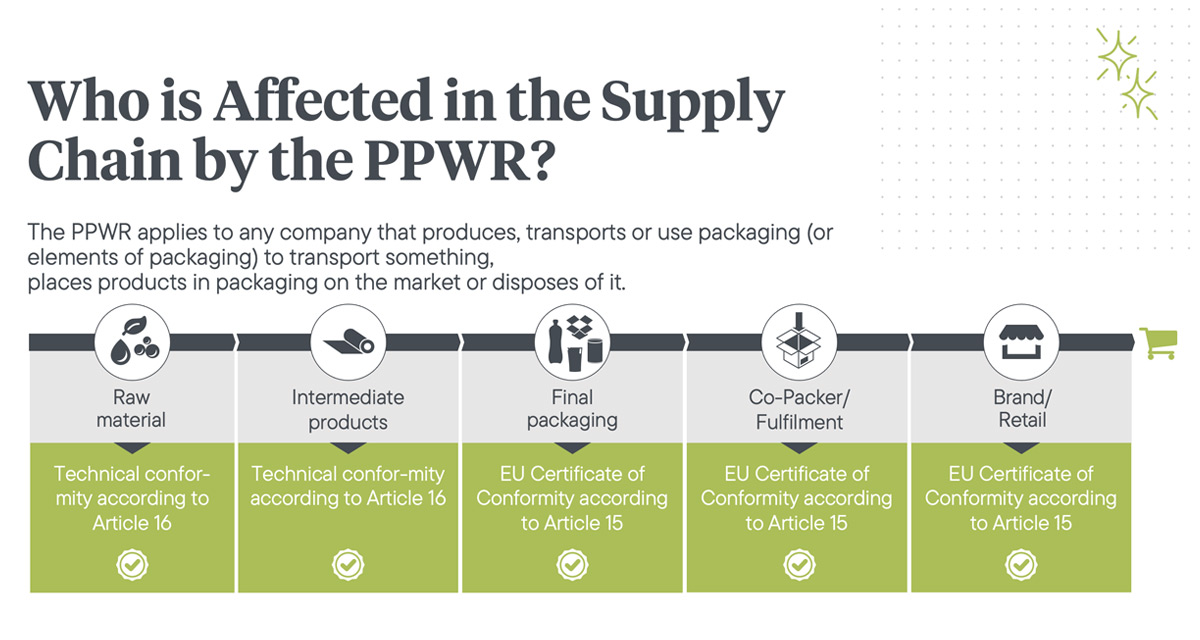
This will impact the entire supply chain from raw material producers to brands and retailers. The first major impact will be the technical conformity assessment required for all packaging by August 2026.

Key targets include recycled content quotas for plastic packaging and reuse targets for various applications starting in 2030 and 2040. It also introduces sustainability reporting obligations.

These packaging regulations also impose sustainability reporting obligations. However, collecting and organizing accurate sustainability data remains one of the biggest challenges for companies. As a result, many are turning to digital tools to streamline data collection, aggregation, and management.

The EU PPWR: A Game Changer for Packaging in Europe

The EU’s PPWR is one of the most important pieces of packaging legislation in recent years.

Sustainability is no longer a choice, but a necessity across the packaging value chain.

Geert De Proost, Director, Product Offering, Converter Software at Esko

The EU’s PPWR is one of the most important pieces of packaging legislation in recent years.

If your packaging artwork, material specifications, supplier documentation, and sustainability data are disconnected, PPWR packaging requirements will expose those gaps quickly. Platforms such as Esko WebCenter help packaging teams centralize artwork, label management, approvals, and compliance workflows so regulatory data and packaging execution stay aligned.

Key PPWR Milestones

  • 2026: The regulation starts to apply from August 12, 2026.
  • 2028: Requirements to minimize packaging weight and volume begin to apply, including limits on unnecessary empty space in sales packaging.
  • 2028: Recyclability criteria and harmonized labeling requirements begin to take shape through secondary legislation.
  • 2030: Recyclability requirements and minimum recycled content targets for plastic packaging begin to apply, subject to the timelines set out in the PPWR.
  • 2030: Certain reuse targets and restrictions on single-use formats come into force.
  • 2035: “Recycled at Scale” requirements begin to apply from January 1, 2035, or five years after the relevant implementing acts enter into force, whichever is later.
  • 2038: The lowest recyclability grade, Grade C, will be banned, leaving Grades A and B as the permitted options.
  • 2040: Recycled content and reuse targets become more ambitious.

Shipping air is no longer just a cost problem.

Under the PPWR, grouped, transport, and e-commerce packaging will be subject to a maximum empty-space ratio of 50%. This requirement applies from January 1, 2030, or three years after the relevant implementing act enters into force, whichever is later.

That puts pressure on online retailers, D2C brands, and packaging engineers to prove that pack size, void fill, and transport configuration are justified. Tools and workflows that help you right-size packaging, such as Esko Cape Pack, become part of compliance planning as well as cost control.

Beverage producers also face specific PPWR packaging obligations.

The sector is required to meet a reuse target of 10% by 2030 and is expected to work toward a 40% target by 2040, with Deposit Return Schemes playing a stronger role for certain beverage packaging categories. That means bottle, label, closure, and logistics choices must work within future return and reuse systems, not just current shelf requirements.

The HORECA sector has its own deadlines too.

By February 12, 2028, takeaway operators must clearly offer consumers reusable packaging for takeaway food and drinks at no extra cost. From 2030, bans on certain single-use formats, including common condiment portions and hotel miniature toiletries, will add further pressure on food service and hospitality packaging teams.

Technical Conformity Assessment

Under the PPWR, packaging must demonstrate compliance with essential requirements, including substance restrictions and recyclability performance.

A key requirement is the EU Declaration of Conformity, which applies from August 12, 2026.

This declaration confirms that packaging complies with PPWR requirements and must be supported by technical documentation.

Substance restrictions are another major consideration.

The PPWR maintains limits on heavy metals and introduces specific PFAS thresholds for food-contact packaging.

This is where static checklists can quickly fall behind. By December 31, 2026, the European Commission, assisted by the European Chemicals Agency (ECHA), must assess the presence of substances of concern in packaging and packaging components. That assessment will look at whether these substances negatively affect reuse, recycling, or chemical safety.

On September 17, 2025, ECHA launched a Call for Evidence on substances in packaging and packaging waste. For packaging teams, the message is simple: SoC compliance will keep evolving. If your artwork and specification workflows depend on manual interpretation, you will need a stronger way to update rules, flag risks, and document decisions as requirements change.

Recyclability Requirements

Recyclability sits at the heart of the PPWR.

From 2030, all packaging placed on the EU market must be recyclable.

This will be assessed using a performance grading system, with packaging classified into Grades A, B, and C under the Annex II recyclability framework.

Those grades will not only affect EPR fees. They will determine market access.

From 2030, packaging must achieve at least Grade C. From 2038, Grade C will no longer be permitted, meaning only Grades A and B will remain acceptable.

This changes the role of recyclability data.

It is no longer enough to say that a pack is “recyclable” in broad terms. You will need material-level evidence, design documentation, and a clear link between structural design, artwork choices, inks, coatings, adhesives, and recycling outcomes.

Structural design tools such as Esko ArtiosCAD support this connection by helping teams create, test, and refine 2D and 3D packaging structures before they move downstream.

Packaging design teams should also pay close attention to compostable and bio-based materials.

Compostable packaging is not treated as a universal solution under the PPWR. It sets specific requirements for compostable packaging under Article 9 and Annex III, including requirements for certain packaging formats.

If your brand has built a sustainability strategy around compostable claims, you may need to reassess whether those materials fit PPWR packaging rules, available infrastructure, and lifecycle impact.

Recycled Content Quotas for Plastic Packaging

The PPWR introduces mandatory recycled content quotas for plastic packaging.

From January 1, 2030, or three years after the relevant implementing act enters into force, whichever is later, minimum recycled content targets include 30% for contact-sensitive PET packaging, 10% for other contact-sensitive plastic packaging, 30% for single-use plastic beverage bottles, and 35% for other plastic packaging.

By January 1, 2040, those targets rise to 50% for contact-sensitive PET packaging, 25% for other contact-sensitive plastic packaging, and 65% for both single-use plastic beverage bottles and other plastic packaging.

These numbers matter now.

Material selection, supplier qualification, food-contact approvals, artwork claims, and procurement contracts all take time to change. If you wait until 2030, your options may be limited and expensive.

Extended Producer Responsibility (EPR) and Fee Modulation

Who is Affected in the Supply Chain by the PPWR? The PPWR applies to any company that produces, transports or use packaging (or elements of packaging) to transport something, places products in packaging on the market or disposes of it.

Extended Producer Responsibility (EPR) is a key mechanism for making producers financially responsible for packaging waste.

Under the PPWR, EPR fees will be modulated based on sustainability performance, including recyclability grades.

This means that better-designed packaging can potentially reduce fees, while harder-to-recycle packaging may become more expensive to place on the market.

EPR is moving from a back-office reporting task to a design and data challenge. The choices your team makes during structure, material selection, artwork, decoration, and production will influence future fee exposure.

Sustainability Reporting and Data Challenges

Upcoming regulations are increasing the need for accurate, accessible, and verifiable packaging data.

Companies will need to gather and manage data related to material composition, recycled content, substances of concern, recyclability, packaging weight, and greenhouse gas emissions.

This is especially relevant as requirements under the PPWR intersect with broader reporting frameworks, including the Corporate Sustainability Reporting Directive (CSRD) and Corporate Sustainability Due Diligence Directive (CSDDD).

Even with timeline delays for some reporting obligations, the direction is clear: sustainability data must become more structured, more reliable, and easier to share across the value chain.

Many companies still rely on spreadsheets, email chains, and fragmented supplier documents. That approach becomes risky when regulations require evidence, traceability, and fast updates.

The move toward Digital Product Passports (DPPs) under other EU legislation will further emphasize the need for data collection and aggregation across the supply chain. For packaging teams, this creates additional pressure to maintain accurate, accessible product and packaging data.

Compliance is no longer just about avoiding recalls. To make compliance a competitive advantage, brands must create a culture of smart innovation with seamless collaboration among product, regulatory, and packaging teams

Kari Barnes, Regulatory Standards Manager, TraceGains

PPWR introduces its own digital labelling requirements. Depending on the packaging and requirement involved, information may be provided through a QR code or another standardized, open digital data carrier. For artwork and prepress teams, digital identifiers will therefore play a growing role in managing and providing access to regulated packaging information.

Manufacturers already preparing DPP infrastructure under the Ecodesign for Sustainable Products Regulation (ESPR) should look for overlap with PPWR packaging data. A single integrated data model is more practical than running two parallel systems that ask suppliers for the same information in different formats.

Consumer Expectations and Demand for Sustainability

While regulatory frameworks are driving the push toward greater packaging sustainability, the journey is neither linear nor swift.

The European Parliament recently postponed implementation deadlines under the EU Corporate Sustainability Reporting Directive (CSRD) and Corporate Sustainability Due Diligence Directive (CS3D).

With support from the European Council, these delays extend reporting requirements for “second wave” large enterprises to 2028 (from 2026) and “third wave” listed SMEs to 2029 (from 2027). This extension gives companies more time to prepare and simplifies the rules, addressing concerns around meeting the original timelines.

However, some entities, such as “first wave” public interest companies and “fourth wave” non-EU businesses, must still adhere to earlier deadlines. These adjustments reflect the evolving nature of sustainability regulation, where implementation timelines adapt to the complexities of aligning diverse stakeholders and industries.

Despite these regulatory shifts, one constant remains: consumer demand is an unrelenting force driving sustainability.

Mintel reports that 49% of U.S. consumers believe companies bear the primary responsibility for improving environmental sustainability, an increase from 36% in 2023. This underscores the growing expectation for businesses to take the lead in environmental stewardship.

Proactively addressing consumer demand for sustainable solutions offers not just a means to meet expectations, but also an opportunity to build trust and stay ahead in a competitive marketplace. By aligning with consumer priorities, brands will demonstrate a genuine commitment to sustainability that resonates deeply with their audience.

Moving Beyond Basic Compliance Through Design for Sustainability

The packaging industry’s role extends beyond mere regulatory compliance by actively integrating design for sustainability (D4R) principles.


This proactive approach involves a fundamental shift in how packaging is conceived and developed.

A key aspect is reducing packaging weight and volume to a minimum while ensuring functionality. This directly impacts palletization efficiency and reduces emissions associated with transportation (lightweighting).

By designing packaging with logistics in mind from the outset, packaging professionals can ship less air and maximize the number of products per pallet and truck. This leads to substantial reductions in CO2 emissions.

Under PPWR packaging rules, this is also becoming a compliance expectation.

PPWR sets a maximum empty-space ratio of 50% for grouped, transport, and e-commerce packaging from January 1, 2030, or three years after the relevant implementing act enters into force, whichever is later. This puts greater emphasis on choosing packaging formats and configurations that minimize unnecessary empty space.

Just as importantly, these efficiencies can reduce costs and increase profitability, offering a competitive edge in a marketplace where customers and investors are increasingly prioritizing ESG performance.

Leveraging Efficient Production Processes

Adopting resource-efficient production processes helps achieve meaningful sustainability goals beyond basic compliance.

A prime example is expanded gamut printing.

This technology allows for the use of the same set of inks for various print jobs, which dramatically reduces ink consumption, minimizes press changeover times, and therefore decreases material waste associated with these changeovers.

The reduced material and energy usage directly translates to lower greenhouse gas emissions across all scopes.

Moreover, minimizing waste and optimizing production flow leads to significant cost savings for packaging producers. The packaging industry must actively explore and implement technologies to simultaneously enhance operational efficiency and improve overall sustainability performance.

In a landscape where Margins are tight and scrutiny is high, sustainability-driven efficiencies can deliver meaningful ROI while helping companies meet their environmental commitments.

Adapting to Harmonized Labeling for Improved Recycling

The PPWR necessitates changes in packaging artwork and printing processes to clearly communicate material composition and proper disposal instructions.

The EC will establish the specific label specifications, including when provided through digital methods, in secondary legislation.

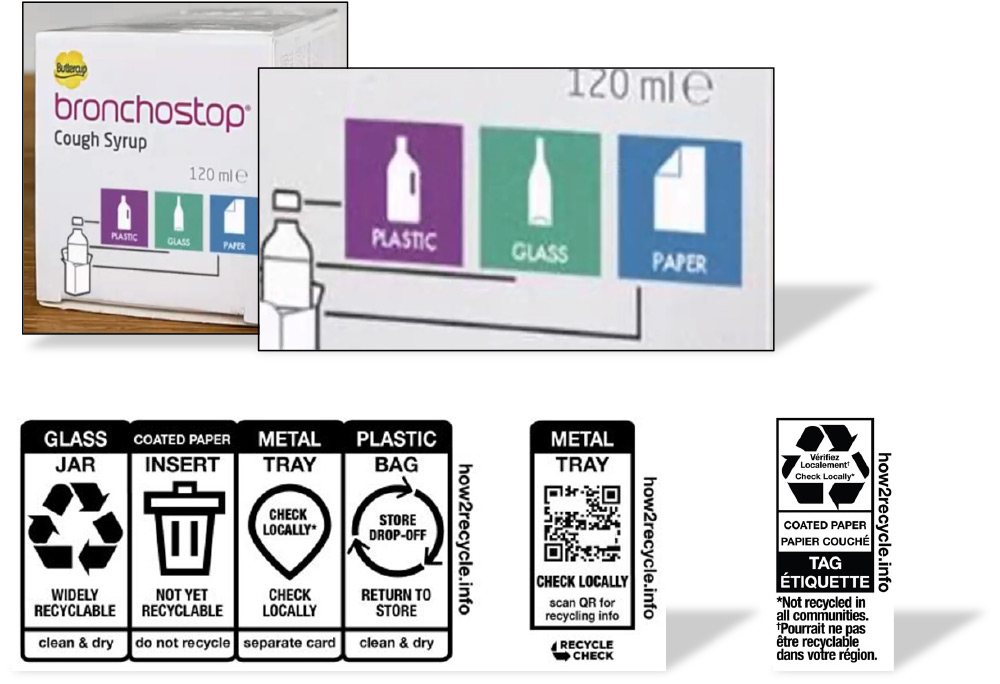
From August 12, 2028, or 24 months after the relevant implementing acts enter into force, whichever is later, packaging placed on the EU market will need a harmonized label providing information on its material composition to facilitate consumer sorting.

The label will be based on pictograms, with additional information required for certain packaging types.

For artwork and prepress teams, these are not last-minute graphic additions. They must be managed as controlled, regulated packaging content.

The PPWR also includes a prohibition to provide or display labels, marks, symbols, or inscriptions that are likely to mislead or confuse consumers regarding sustainability requirements for packaging.

The packaging industry must stay informed of specific label designs and specifications to ensure compliance by the relevant deadlines. As noted during the webinar, consumers will need clear labeling informing them of how to put the right packaging in the right recycling stream.

Green claims add another layer of risk.

The proposed EU Green Claims Directive could add another layer of requirements for environmental claims if adopted. Combined with the PPWR’s ban on misleading sustainability labels, this creates dual exposure for brand owners using claims such as “eco-friendly,” “recyclable,” “compostable,” or “carbon neutral” without the data to prove them.

The Importance of Collaboration and Data Sharing

Achieving true sustainability in packaging necessitates strong collaboration and transparent data sharing across the entire value chain, including material suppliers, designers, converters, brands, retailers, waste management operators, and recyclers.

Leveraging platforms and partnerships to streamline data exchange and guarantee accuracy will be non-negotiable. As highlighted during the webinar, the entire packaging supply chain is affected by these regulations and will need to provide the right data.

The move towards a digital product passport (DPP), part of the upcoming regulations, will further emphasize the need for data collection and aggregation across the supply chain.

This is where PPWR packaging readiness becomes a workflow issue.

If data lives in separate systems, supplier PDFs, email threads, and manual spreadsheets, every regulatory update creates another round of chasing, checking, and rechecking.

Connected packaging workflows help teams keep artwork, specifications, claims, barcodes, material data, and approvals aligned from source to shelf.

For teams still coordinating packaging approvals manually, WebCenter Go approval workflow software provides a structured way to manage packaging files, proofing, compliance checks, and stakeholder reviews in one controlled workflow.

Wrapping it Up

The packaging industry is at a pivotal moment in its sustainability journey. The PPWR and increasing global pressures demand a move beyond basic compliance.

Proactive engagement with regulations, a focus on data collection and digitalization, embracing design for sustainability, and fostering collaboration across the value chain are critical for success.

By viewing sustainability as an integral part of their operations, not just a compliance requirement, packaging industry professionals can meet regulations, drive innovation, enhance efficiency, and contribute to a more circular and sustainable future.