Mitha Shameer is a content specialist who writes for various SaaS platforms across Esko, bringing nearly six years of experience in writing
Key Takeaways
How to Comply with the EU 1169 Food Information Regulation
Getting your food label wrong in Europe carries real consequences.
A missing allergen declaration, an incorrect font size, or a nutrition panel in the wrong format can trigger a product recall, a regulatory fine, or a consumer lawsuit. Mislabeled food is one of the leading causes of food recalls across the EU — and that makes label compliance a core operational responsibility, not a box-ticking exercise.
EU Regulation 1169/2011 (EU 1169) sets the standard for what you must communicate, how you must present it, and where it must appear — whether a consumer is reading your pack in a supermarket or browsing your product page online.
This guide breaks down the full scope of the regulation so you can manage it with confidence.
What Is EU 1169/2011?
Introduced in 2011, enforced from 2014, and fully mandatory since 2016, EU 1169 replaced decades of fragmented labeling laws with a single, unified framework.
The goal is straightforward: every consumer in the EU should have access to clear, accurate, and accessible food information before they make a purchase.
The regulation applies to:
All pre-packed foods sold in the EU
Mass caterers supplying final consumers
Ecommerce listings — your online product page must carry the same mandatory information as the physical label
The obligations are not identical across all food types. For pre-packed foods, the full list of mandatory particulars applies. For non-prepacked and unpackaged foods — including foods sold loose at a deli counter or by a mass caterer — allergen information is mandatory EU-wide, but other required particulars may depend on national rules in each Member State.
If your business operates across both formats, you need separate compliance processes for each.
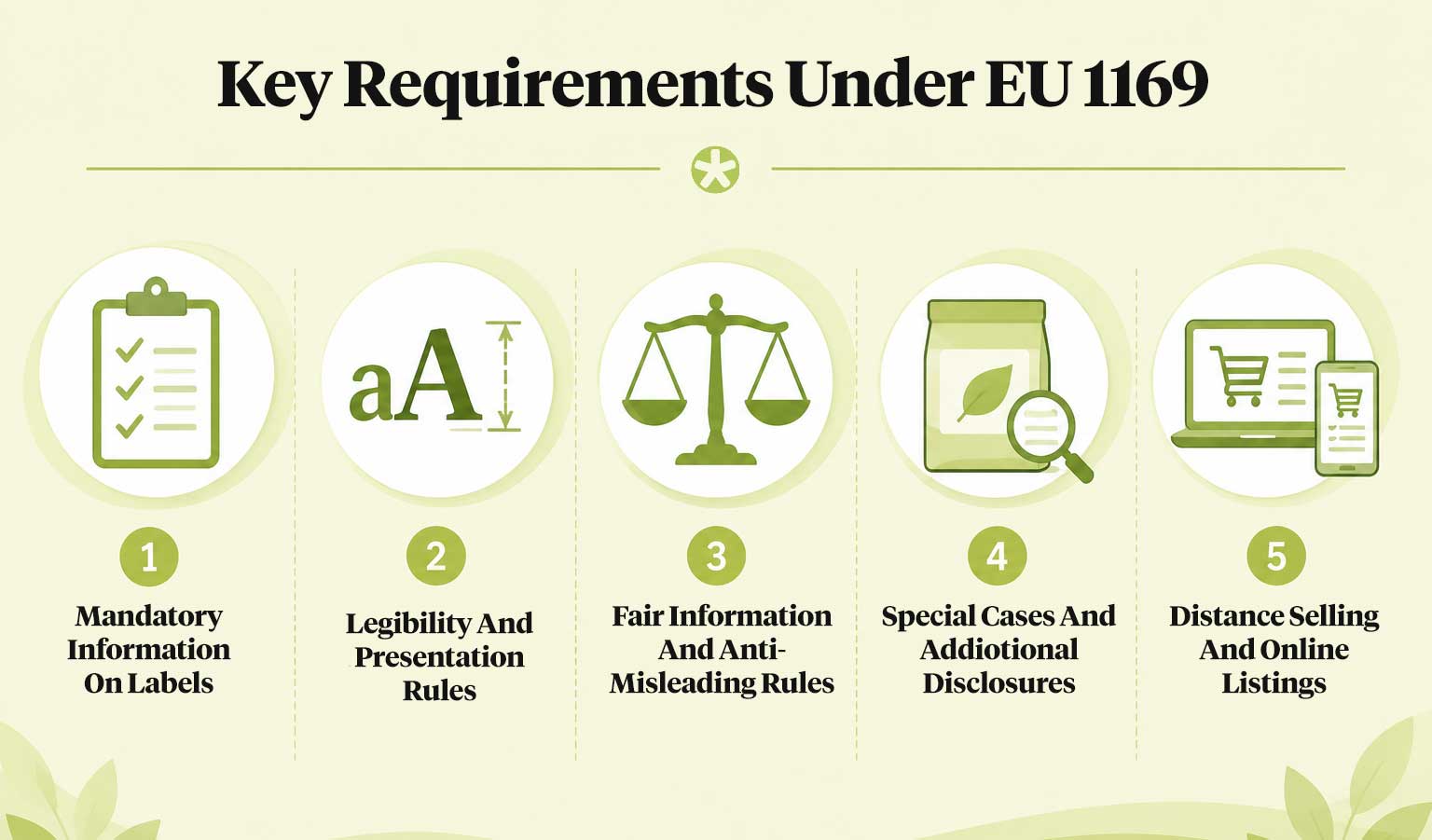
Key Requirements Under EU 1169
The regulation governs everything that appears on your packaging and how you share product details with customers.
1. Mandatory Information on Labels
Every pre-packed food sold in the EU must carry the following:
Name of the food: A clear, legally recognized name — not a marketing name that could mislead.
Full ingredients list: In descending order by weight, with allergens highlighted using a distinct typeset — bold, a different font, or a contrasting color.
Quantitative Ingredient Declaration (QUID): Percentages for ingredients that are emphasized on the pack or that characterize the food.
Net quantity: Stated in standard units — grams, kilograms, or liters.
‘Use by’ or ‘best before’ date: Both are mandatory, but they mean different things. ‘Use by’ is a safety date — consuming the product after this date carries a health risk. ‘Best before’ is a quality date — the food may still be safe after this point, but quality is no longer guaranteed.
The distinction matters: the European Commission has linked date-marking confusion to food waste, with one study estimating that up to 10% of EU food waste is connected to misunderstood date labels.
The Commission ran consumer research on this in 2022 and launched a further segmentation study in June 2024. Getting the right date type on the right product is both a compliance requirement and an increasingly scrutinized consumer-information issue.
Storage and usage instructions: Required where omitting them could mislead or compromise safe consumption.
Name and address of the food business operator: Manufacturer, packager, or importer.
Country of origin or place of provenance: Mandatory for certain meats and products where omission could mislead consumers.
Primary ingredient origin when it differs from the food’s implied origin: This is one of the most commonly missed compliance requirements. Under Article 26(3) and Implementing Regulation (EU) 2018/775 — applicable since 1 April 2020 — if your packaging implies or states a particular origin for the food, but the primary ingredient comes from a different country, you must disclose that difference on the label. A product marketed as “Italian” that uses tomatoes sourced elsewhere is a practical example of where this rule bites.
Alcoholic strength: Required for drinks over 1.2% ABV.
Nutrition declaration: Energy, fat, saturates, carbohydrates, sugars, protein, and salt — in that prescribed order, in a tabular format where space permits. A linear format is only acceptable where space does not allow a table.
2. Legibility and Presentation Rules
Having the right information is only half the job. How you present it matters just as much.
Minimum font size: The x-height of the font must be at least 1.2 mm. For packaging with a largest surface area under 80 cm², the minimum drops to 0.9 mm x-height — but this is an exception, not a default.
Grouped field of vision: The name of the food, net quantity, and alcohol strength must appear together in the same field of vision on the pack.
Allergen emphasis: Allergen information must be visually distinct from the rest of the ingredients list — not buried, not formatted the same way.
Mandatory information cannot be hidden or interrupted: Text, imagery, or design elements must not obscure or break up required particulars.
Language requirements: Mandatory information must appear in a language easily understood by consumers in the Member State where the food is marketed. Countries can require one or more official EU languages.
If you sell the same product in France, Germany, and Poland, you need to verify the language requirements for each market — and your label templates need to account for that variation.
3. Fair Information and Anti-Misleading Rules
EU 1169 goes beyond requiring specific data fields.
Under Articles 7 and 16, the regulation also prohibits misleading consumers through text, imagery, or presentation, even where all mandatory particulars are technically present.
A pack design that implies premium ingredients, a specific origin, or a quality claim that the product does not deliver can constitute non-compliance. The same applies where a usual ingredient has been substituted: the substitution must be disclosed clearly, typically near the food name.
If your artwork team is making design decisions that affect implied claims, they need to understand this rule, not just the regulatory team.
4. Special Cases and Additional Disclosures
Beyond the standard mandatory particulars, EU 1169 and associated guidance call out a number of specific situations that require additional or different labeling:
Defrosted foods: The word “frozen” must appear in the product name for foods that were frozen before sale but are sold defrosted (with limited exceptions).
Date indications for frozen and unprocessed meats and fish: Mandatory date of freezing (or first freezing) applies to these product categories specifically.
Manufactured nanomaterials: Must be indicated in the ingredients list, with the word “nano” in brackets after the ingredient name.
Added water above 5%: Must be declared in the ingredients list for applicable product categories.
Formed meat and fish products: Must carry a specific indication that the product is formed from pieces of meat or fish.
Added proteins from a different animal origin: Must be declared near the product name.
Vegetable oils: Must be identified by their specific plant origin — “palm oil” or “sunflower oil,” not just “vegetable oil.”
Substitute ingredients near the food name: Where an ingredient that consumers would expect to be present has been replaced, the substitute must be disclosed prominently near the food name.
Exemptions: Single-ingredient unprocessed products, water, herbs, salt, and certain other foods listed in Annex V are exempt from some or all mandatory particulars.
5. Distance Selling and Online Listings
Selling food online does not reduce your obligations, it adds complexity to how you meet them.
For pre-packed foods sold at a distance, almost all mandatory information must be available to the consumer before purchase is completed. The one exception is the date mark (either the date of minimum durability or the use-by date), which must be available at the point of delivery. Your product pages, apps, and digital listings must carry accurate, complete label information, not a summary or a subset.
For non-prepacked foods sold online, allergen information must be available before purchase. Other required particulars may depend on the national rules of the Member State where the consumer is located.
The practical implication: your ecommerce content cannot be managed separately from your physical label data. Any update to a label, a reformulation, a new allergen, a changed origin, must flow through to every digital channel at the same time.
Compliance is no longer just about avoiding recalls. To make compliance a competitive advantage, brands must create a culture of smart innovation with seamless collaboration among product, regulatory, and packaging teams.
WebCenter Go and WebCenter Enterprise make collaboration easier by keeping every stakeholder in sync through structured workflows that simplify compliance and accelerate launches
Kari Barnes, Regulatory Standards Manager, TraceGains
The European Commission is also actively studying digital means of conveying food information as part of its broader FIC revision work. QR codes and smart labels are already in use as supplements to on-pack information, but they do not currently replace the obligation to provide mandatory particulars before purchase.
The regulation does not just affect what goes on the label. It changes how you manage information internally, and where the risks accumulate.
More data, less space.
Additional mandatory particulars mean less room for branding or marketing messages. Every design decision involves a compliance trade-off.
Consistency across channels.
Every purchasing situation, physical retail, ecommerce, mobile apps, must display the same information. A change on one channel requires a change on all of them.
Higher scrutiny on allergens.
Formatting for allergens must be verified on every pack, for every SKU, every time a label is updated. One missed update across a product range is a recall waiting to happen.
Language complexity at scale.
If you sell across multiple EU markets, each label version needs to meet the language requirements of its target Member State. Managing that variation manually, across hundreds of SKUs, creates real version-control risk.
Possible re-analysis.
Products may need re-testing if nutritional data, nanomaterial content, or origin information is incomplete or out of date.
Compliance does not have to remain a bottleneck; when issues are identified early, teams can move faster with confidence and turn compliance into a competitive advantage
Jan De Roeck, Director Industry Relations & Strategy
Steps to Achieve Compliance
A structured approach to your labeling workflow reduces risk significantly. Here is where to start.
Conduct a label audit. Check every SKU against the full list of EU 1169 requirements, including the less obvious ones like primary-ingredient origin disclosure, date type accuracy, and substitute-ingredient declarations.
Standardize label templates. Pre-set layouts and preflight checks that enforce correct formatting prevent errors before they reach print. Templates should account for language variants by market and include the correct field-of-vision groupings.
Strengthen data collection. Ensure nutrition, allergen, origin, and nanomaterial data are complete, up to date, and traceable to source. If data is missing, products may need re-testing before labels can be finalized.
Train your teams. Regulatory, marketing, and design teams all make decisions that affect compliance. Everyone involved in label creation or approval needs to understand the rules, including the fair-information and anti-misleading provisions, not just the mandatory fields. Building a structured compliance rulebook for food and beverage labels is a practical way to make that knowledge consistent and repeatable across teams.
Check online listings. Verify that ecommerce and mobile product information mirrors the physical label exactly, and that any label update triggers an automatic review of all digital channels.
Document everything. Maintain an audit trail of approvals and changes. If a regulator asks who approved a label version and when, you need to be able to answer immediately.
Plan for the FIC revision. The EU is actively working on a broader revision of the Food Information to Consumers framework. The agenda now covers front-of-pack nutrition labelling, nutrient profiles, expanded origin labelling rules, date marking reform, alcoholic-beverage labelling, and the formalization of digital means of conveying food information. These are not distant possibilities, they are active workstreams. Your compliance processes need to be flexible enough to absorb them.
How WebCenter Go Simplifies EU 1169 Compliance
Still managing label updates through email chains and shared folders?
That approach does not scale, and under EU 1169, it creates compliance gaps that are hard to close after the fact.
WebCenter Go gives mid-market brands the infrastructure to manage EU 1169 compliance as a repeatable, auditable process rather than a manual scramble before each launch, without the cost or complexity of an enterprise platform.
Packaging and label development can get messy fast when launches, revisions, and approvals run across teams. The value of WebCenter Go is that teams can build approval workflows, proofread pack copy, and check artwork compliance in one place, right out of the box.
Srinivas Kuppa, Chief Product Officer at Esko
Centralized data storage. All nutritional, allergen, origin, and nanomaterial information is stored in one place and updated across SKUs instantly. No more hunting through spreadsheets to find the current version of a nutrition panel.
Workflow automation. Predefined approval steps route labels through regulatory, QA, and legal review in the right sequence. No review gets skipped because someone forgot to forward an email.
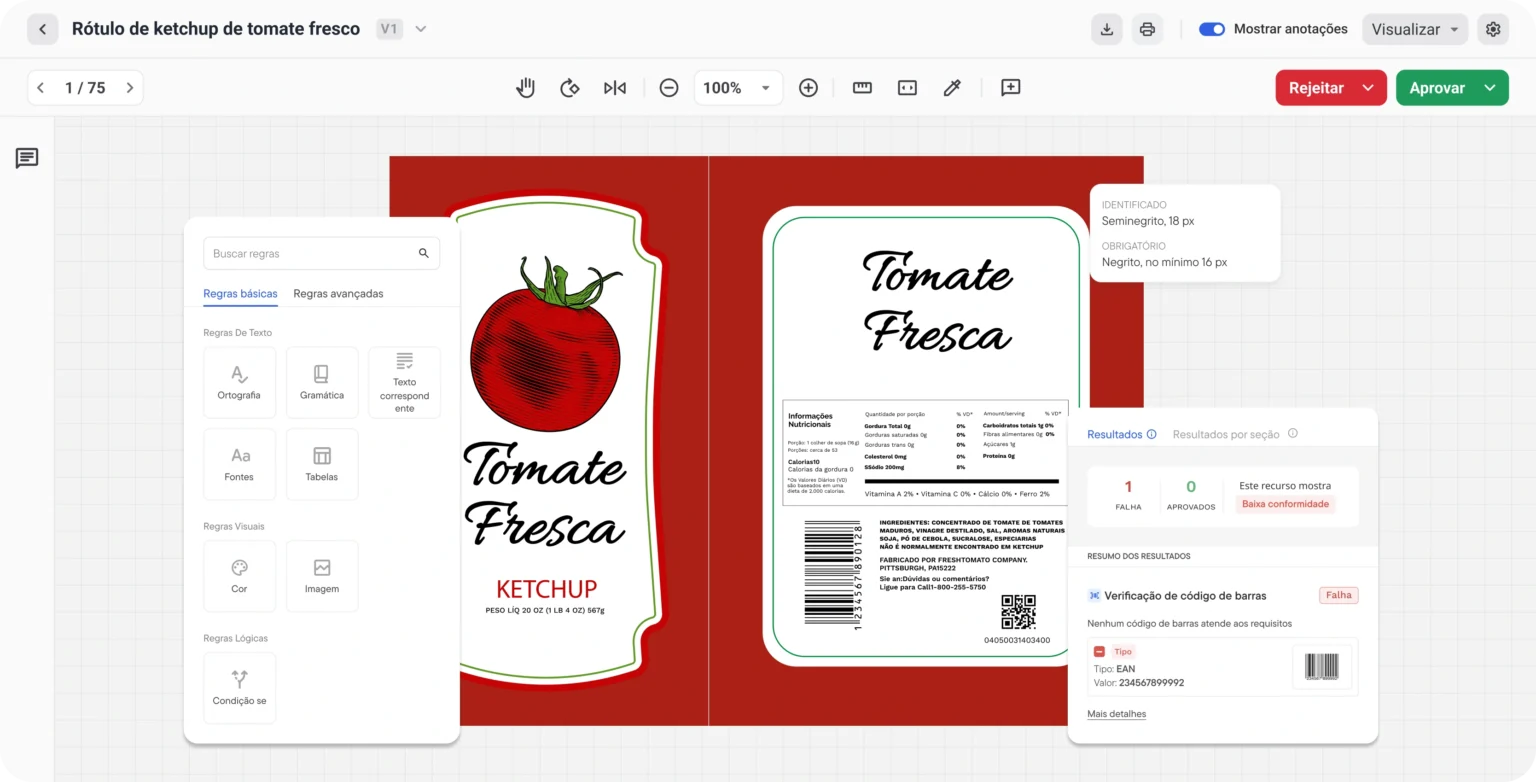
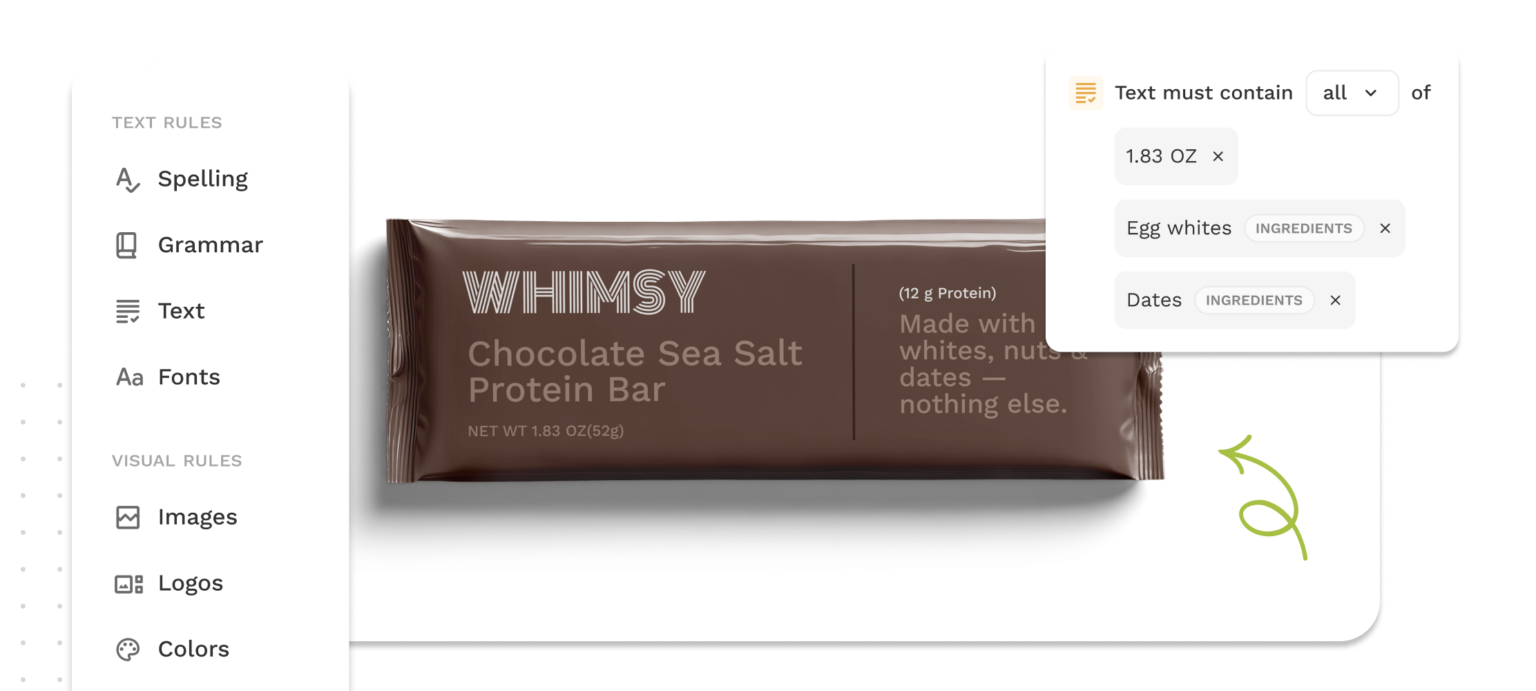
AI-powered proofing and compliance checks. Automatically detect missing allergens, incorrect font sizes, non-compliant nutrition layouts, or missing mandatory fields before the file goes to print. The system flags the issue; your team resolves it.
Version control. Every change is tracked. You can compare versions side by side or in difference mode, and you always know which file carries the current approval.
Audit-ready records. Export full approval histories in one click. When a regulator asks for documentation, you have it.
Digital asset management. Artwork is organized by SKU, market, and launch date. Finding the right file for the right market takes seconds, not hours.
Real-time collaboration. Reviewers annotate directly on artwork, timestamped, assigned, and logged. No version confusion, no lost feedback.
The result is faster approvals, fewer errors, and a clear record of compliance for every label you produce.
The Bottom Line
EU 1169 is a consumer safety regulation, a brand reputation issue, and an operational challenge, all at once.
The requirements are detailed, the scope is broad, and the consequences of getting it wrong are significant. With the right process and tools in place, you can manage EU 1169 compliance without firefighting every label update.
Compliance doesn’t have to be a burden; it can become a strategic advantage with the right tools in place
Gwen Bultelle, CPG Category Specialist at Esko
The goal is a workflow where compliance is built in from the start, not checked at the end. WebCenter Go turns that goal into a practical reality, giving your teams the structure, visibility, and automation to keep every label accurate, every time.
Book a demo today and see how you can stay compliant, avoid costly mistakes, and speed up your packaging approvals.