Whether you have a full-time pet product business or you’re looking to start one, you’re at the right place.
Pet food products are regulated at two levels: by the Food and Drug Administration (FDA) and the Association of American Feed Control Officials (AAFCO). While there are no requirements for premarket approvals, the Federal Food, Drug, and Cosmetic Act (FFDCA) mandates that pet foods, like human foods, must be safe to eat, produced under sanitary conditions, contain no harmful substances, and be truthfully labeled.
It helps to understand exactly what each body does. FDA sets and enforces federal requirements for pet food safety and labeling. AAFCO is not a regulator or approver — it publishes model regulations that individual states often adopt into their own feed laws. States then handle their own review and registration processes.
That means your label may need to satisfy both the federal layer and the specific requirements of every state where you sell. For a closer look at how state-by-state complexity plays out in practice, see strategies for pet food labeling regulations.
This guide breaks down the latest pet food label requirements, from ingredient lists to Guaranteed Analysis, along with a FREE downloadable checklist.
Disclaimer: This blog post derives information from the U.S. Food and Drug Administration (FDA) and the AAFCO website and is updated as of 2026. Do refer to the FDA and AAFCO websites for final and updated information regarding regulations. This content is provided for informational purposes only and does not constitute legal or regulatory advice.
The Key Differences Between Pet Food and Pet Drugs
The FFDCA defines food as “articles used for food or drink for man or other animals…and articles used for components of any such article.”
Courts generally interpret this to mean products primarily used for taste, nutrition, aroma, or as components of such a product. For example, cat food containing the amino acid taurine, which may help with heart health in cats.
The FFDCA defines drug to include “articles intended for use in the diagnosis, cure, mitigation, treatment, or prevention of disease in man or other animals” and “articles (other than food) intended to affect the structure or function of the body of man or other animals.” For example, a product intended to make a cat’s urine more acidic to maintain urinary tract health.
FDA premarket review is not required for pet food products but is mandatory for pet drugs.
That said, the line between food and drug is not always obvious in practice. FDA specifically flags claims related to disease treatment or prevention, and also reviews certain functional claims such as urinary tract health, low magnesium, and hairball control. If your label or accompanying marketing materials make those kinds of claims, FDA may treat the product as a drug regardless of how you intend it.
Legal Definitions of Terms
A few key definitions to know before reading further.
Principal Display Panel (PDP)
The Principal Display Panel (PDP) is the label’s front panel and the part a consumer will see first under customary display conditions for retail sale. It must be large enough to accommodate the required label statements.
Note: Although products have labels on their inner and outer containers, they have only one PDP on the outer package.
Information Panel (IP)
The Information Panel (IP) refers to the back and side panels of a label. If a package has more than one PDP, the IP is the panel to the immediate right of any PDP, highlighting the significance of meticulous packaging design.
Required Label Statements
The FFDCA defines food as “articles used for food or drink for man or other animals…and articles used for components of any such article.”
Courts generally interpret this to mean products primarily used for taste, nutrition, aroma, or as components of such a product. For example, cat food containing the amino acid taurine, which may help with heart health in cats.
The FFDCA defines drug to include “articles intended for use in the diagnosis, cure, mitigation, treatment, or prevention of disease in man or other animals” and “articles (other than food) intended to affect the structure or function of the body of man or other animals.” For example, a product intended to make a cat’s urine more acidic to maintain urinary tract health.
FDA premarket review is not required for pet food products but is mandatory for pet drugs.
That said, the line between food and drug is not always obvious in practice. FDA specifically flags claims related to disease treatment or prevention, and also reviews certain functional claims such as urinary tract health, low magnesium, and hairball control. If your label or accompanying marketing materials make those kinds of claims, FDA may treat the product as a drug regardless of how you intend it.
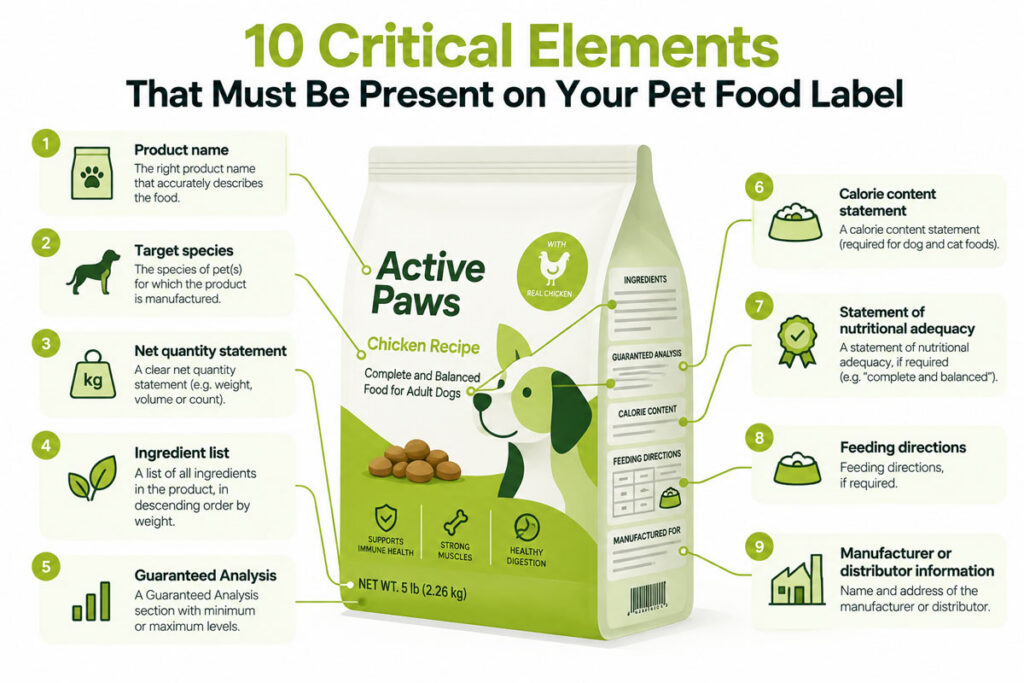
10 Critical Elements That Must Be Present on Your Pet Food Label
Your pet food label must follow the Model Regulations for Pet Food and Specialty Pet Food as defined by AAFCO. Here’s what every label must include:
The right product name
The species of pet(s) for which the product is manufactured
A clear net quantity statement
A list of all ingredients in the product
A Guaranteed Analysis section
A calorie content statement (required for dog and cat foods)
A statement of nutritional adequacy, if required
Feeding directions, if required
Name and address of the manufacturer or distributor
1. Product Name and Intended Species
The product name should clearly communicate what the product is and which species it is intended for. Using words such as “for Dogs” allows consumers to identify the intended species at a glance.
Product names can focus on a single key ingredient, such as “beef” or “tuna.” Because many consumers purchase based on that one ingredient, AAFCO has five naming rules you must follow when featuring a product component in the name.
The 100% Rule
If a product name uses a single ingredient with no qualifiers, such as “Beef for Dogs,” and the product contains only that ingredient (excluding water, processing aids, and required vitamins and minerals), the named ingredient must comprise 100% of the product. This is the strictest naming standard and applies to single-ingredient products.
The 95% Rule
This rule applies to products consisting primarily of very few ingredients. For example, a product named “Beef for Dogs” would require that beef comprise at least 95% of the total weight, excluding water and condiments added for processing. If water and condiments are included, the named ingredient must still comprise 70% of the product.
Note: If the name includes a combination of ingredients, such as “Chicken and Fish Dog Food,” the two named ingredients combined must comprise 95% of the total weight.
III. The 25% or “Dinner” Rule
This rule applies to canned and dry products. If the named ingredient comprises at least 25% of the product (excluding water for processing) but less than 95%, the product name must include a qualifying descriptive term such as “dinner.” For example, “Chicken Dinner for Dogs.”
Including added water, the named ingredient must still comprise 10% of the product. Descriptors other than “dinner” may also be used, such as “platter,” “entree,” “formula,” and “nuggets.”
Note: If multiple components are named, such as “Chicken and Fish Dinner Cat Food,” both ingredients must total 25% of the product, and each named ingredient must be at least 3% of the total.
The 3% or “With” Rule
The use of the term “with,” as in “Cat Food With Fish,” mandates that fish must be at least 3% of the product.
The “Flavor” Rule
No specific percentage is required, but the product must contain an amount sufficient to be detected.
In a name like “Beef Flavor Dog Food,” the word “flavor” must appear on the label in the same font, size, and color as the word “beef.”
2. Net Quantity Statement
The net quantity statement tells consumers exactly how much product is in the container.
This statement must appear on the bottom third of the principal display panel, separated from other statements with clear space before and after it. Net contents are typically expressed in counts or weights for dry goods, and in gallons, pints, or ounces for liquid-based goods.
AAFCO requires that weight be expressed in ounce-pound units and must include the appropriate metric unit, for example: 50 lb (22.67 kg).
Abbreviations are permitted for units in the net quantity statement and may be uppercase or lowercase, though lowercase is generally preferred. For example: oz for ounce, qt for quart, gal for gallon, lb for pound, and fl for fluid. Metric units must be lowercase only, with the exceptions of mL for milliliter and L for liter.
Note: If the statement is expressed in units of count, such as capsules or tablets, it must be accompanied by a statement of the weight or size of individual units to convey the total amount of feed present.
3. Guaranteed Analysis
All pet food product labels must include an AAFCO Guaranteed Analysis section.
This section highlights the minimum percentage of crude protein and crude fat, and the maximum percentage of crude fiber and moisture. If the product is advertised as containing significant nutrients, that information must also appear. Each guarantee must be expressed as a specific number or percentage, for example 12%, not a range such as 10-15%, and must indicate whether it is a minimum or a maximum.
Guarantees are printed in a specific order as defined in the AAFCO guidelines.
If your product carries a low-fat or reduced-fat claim, additional crude-fat guarantees are triggered. Any non-standard or non-essential guarantees you choose to include must follow AAFCO ordering rules and may require a disclaimer. When in doubt, check the current AAFCO Official Publication for the specific ordering and qualification requirements that apply to your product type.
How To Express Guarantees
Percentage by weight applies to:
Crude protein, equivalent crude protein from NPN, lysine, methionine, and other amino acids
Crude fat, crude fiber, ADF, and NDF
Calcium, salt, and sodium (when present) must be stated as a percentage by weight using the following format:
When the minimum is below 2.5%, the maximum must not exceed the minimum by more than 0.5 percentage points (for example, minimum 2.0%, maximum 2.5%).
When the minimum is between 2.5% and 5.0%, the maximum must not exceed the minimum by more than 1 percentage point (for example, minimum 3.0%, maximum 4.0%).
When the minimum is above 5%, the maximum must not exceed the minimum by more than 20% of the minimum and by not more than 5 percentage points (for example, minimum 28.0%, maximum 33.0%).
Potassium, magnesium, sulfur, phosphorus, and maximum fluorine (when stated) must be expressed as a percentage by weight, along with minimum and maximum salt and total sodium.
Other mineral guarantees (when present) must be stated in parts per million (ppm) when the concentration is below 10,000 ppm (1%), or as a percentage by weight when the concentration is above 10,000 ppm (1.0%). Mineral guarantees must be grouped in order of unit of measurement.
Vitamin guarantees (when present) must be stated in the following units:
Vitamin A, D, and E: International Units (IU) per pound
Vitamin D3 for Poultry Feeds: International Chick Units (ICU) per pound
Vitamin B12: milligrams or micrograms per pound
All other vitamins: milligrams per pound
Notes:
When species-specific feed guarantees require a copper, selenium, or zinc guarantee, it must be expressed as parts per million (ppm).
Guarantees for crude protein, crude fat, and crude fiber are not required when the feed is not intended to supply those substances or when they are present at levels too low to make a significant contribution to the intended function of the feed.
Dog and cat foods must carry a separate Calorie Content statement. This is one of the most commonly missed elements on pet food labels, and its absence can create compliance problems at the state level.
The statement must be expressed in kilocalories per kilogram (kcal/kg) of product as fed, and also in kilocalories per familiar unit, such as per cup for dry food or per can for wet food. It must appear as its own labeled section, separate from the Guaranteed Analysis. The heading “Calorie Content” is required and cannot be buried within other label copy.
If your product makes a calorie-related claim, such as “light,” “lite,” “low-calorie,” or “reduced calorie,” the calorie content statement becomes even more critical, as those claims trigger additional formulation and comparison requirements. See Other Label Claims below.
5. Ingredients
Every pet food label must include a section listing all ingredients used in the product.
Ingredients must be listed by their common names, arranged in descending order by weight, and presented in the same font type and size.
A few additional rules catch brands off guard:
Pet food labels generally cannot use collective ingredient terms. You cannot group multiple ingredients under a single umbrella name.
For certain meat ingredients and by-products, AAFCO may require species identification. “Meat by-products” alone may not be sufficient depending on the species.
Grade or quality references are prohibited inside the ingredient statement. You cannot describe an ingredient as “premium” or “choice” within the list itself.
It is also worth noting that while finished pet foods generally do not require FDA premarket approval, individual ingredients may still need established legal status. That means GRAS (Generally Recognized As Safe) status, food-additive approval, or clearance through FDA’s current consultation pathways.
When ingredient, claim, or translation requirements change, brands need a single source of truth and clear impact assessment so on-pack revisions can be coordinated quickly and consistently across markets.
Products labeled as treats, snacks, or supplements are not required to carry a nutritional adequacy statement, though there is no restriction on including one.
The statement should explain how the product can meet the animal’s daily nutrient needs for a given life stage. FDA deems a pet product unsafe if it claims to be “complete,” “balanced,” or “100% nutritious” when it is not suitable for sole nourishment.
To label a product as “complete and balanced,” you must substantiate nutritional adequacy through one of two methods.
Method 1: Formulation
The product must be formulated to provide nutrient levels that meet an established profile. Currently, the AAFCO Dog or Cat Food Nutrient Profiles are used. Products that meet these profiles must include the statement:
> “(Name of product) is formulated to meet the nutritional levels established by the AAFCO (Dog/Cat) Food Nutrient Profiles.”
Method 2: Feeding Trial
The product is fed to dogs or cats under strict AAFCO Feeding Trial Protocol guidelines and found to provide proper nutrition. These products must carry the statement:
> “Animal feeding tests using AAFCO procedures substantiate that (name of product) provides complete and balanced nutrition.”
The statement must also specify the life stage for which the product is suitable, such as “growth” or “maintenance.” Some products meet the nutritional needs “for all life stages.”
Products that do not meet either method must state: “This product is intended for intermittent or supplemental feeding only,” unless the product is already identified as a “snack,” “supplement,” or “treat.”
It is important to be clear about AAFCO’s role here. AAFCO does not regulate, approve, certify, or endorse individual pet food products. It publishes the nutrient profiles and feeding-trial protocols that brands use to substantiate their adequacy claims. Meeting those guidelines is a manufacturer’s responsibility, not something AAFCO validates on a product-by-product basis.
7. Feeding Directions
Feeding directions must be written in simple, understandable daily terms to help consumers measure and feed accurately.
At a minimum, feeding directions must include:
If instructions cannot be printed on the front of the label, a reference directing the reader to their location, such as “see back of label for feeding directions.”
A note that caution and warning statements must appear in a prominent place on the label.
For medicated feed, specific information regarding intended dosage, weight restrictions, mixing instructions, and withdrawal time, if applicable.
For complete-and-balanced products, feeding directions must be specific enough to be actionable. That means including the animal’s body weight or size as a reference point and expressing the recommended amount in a familiar unit such as cups or cans per day. A vague instruction like “feed as desired” does not meet the standard.
For products labeled “for all life stages,” feeding directions must account for the highest-demand life stage, typically growth and reproduction, since those nutrient levels cover all other stages.
Therapeutic diets are a specific exception. Products sold under veterinary supervision may use the statement “use only as directed by your veterinarian” in place of standard feeding directions. This exception applies only where the product is genuinely intended for veterinary-directed use.
8. Manufacturer's Name and Address
The manufacturer’s name, along with street address, city, state, and zip code, must be printed on the label. The street address may be omitted if it is listed in the current city directory or phone book.
If the food is not manufactured by the responsible party, the name must be qualified with a phrase such as “Manufactured for ” or “Distributed by .”
The manufacturer may state the principal place of business in the address in lieu of the actual place where the feed was manufactured, packed, or distributed, as long as it is not misleading.
9. Other Label Claims
Products labeled “premium” or “super-premium” are not required to contain higher-quality ingredients or meet higher nutritional standards than other complete and balanced products.
To use the term “natural,” AAFCO has developed a specific definition. For the most part, it is equivalent to the absence of artificial flavors, colors, or artificial preservatives. Natural preservatives such as mixed tocopherols may be used.
Note: “Natural” is not the same as “organic.” Organic refers to the conditions in which plants and animals were raised. To make an organic labeling claim, the pet food must satisfy the criteria set by the United States Department of Agriculture (USDA).
On the topic of artificial colors: FDA announced on February 5, 2026, that it intends to exercise enforcement discretion for certain voluntary animal-food claims tied to the absence of FD&C certified colors. This does not replace the underlying color-additive approval requirements, but it does affect how “no artificial colors” claims are evaluated in practice. If your label carries that type of claim, check the current FDA guidance to confirm your position.
Calorie and Fat Descriptive Claims
Terms like “light,” “lite,” “low-calorie,” “less calorie,” “reduced calorie,” “lean,” “low-fat,” “less fat,” and “reduced fat” are not just marketing language. Each one triggers specific requirements.
Additional crude-fat guarantees must appear in the Guaranteed Analysis.
A comparison disclosure is required.
Using these terms without meeting the underlying requirements is a labeling violation. Verify the current AAFCO thresholds and disclosure requirements before finalizing your label.
Human-Grade Claims
“Human grade” is not casual marketing language.
Using this claim on a pet food label carries specific expectations around ingredient sourcing, manufacturing facility standards, and how the claim is presented on the label. AAFCO’s guidance requires that every ingredient in the product be human edible and that the product be manufactured, packed, and held in a facility that complies with federal regulations for human food.
If any part of the supply chain or manufacturing process does not meet that standard, the claim cannot be made, even if some individual ingredients are human edible. Review the AAFCO human-grade guidelines before adding this claim to any label.
A Note on AAFCO's Label Modernization
Something important is affecting every brand operating in this space right now.
AAFCO approved a revised set of model regulations on July 31, 2023, under its Pet Food Label Modernization (PFLM) initiative. The updated framework introduces a Nutrition Facts-style panel, a new intended-use statement, ingredient-statement updates, and handling and storage requirements.
AAFCO recommended a six-year enforcement-discretion period tied to the 2024 Official Publication. That means brands are currently operating in a transition environment rather than under a fully static rule set.
If you are planning a label refresh or launching a new product, check the AAFCO PFLM page to understand where your target states are in the transition timeline.
Wrapping It Up
Pet food products do not require FDA approval before launching, but that does not make compliance optional.
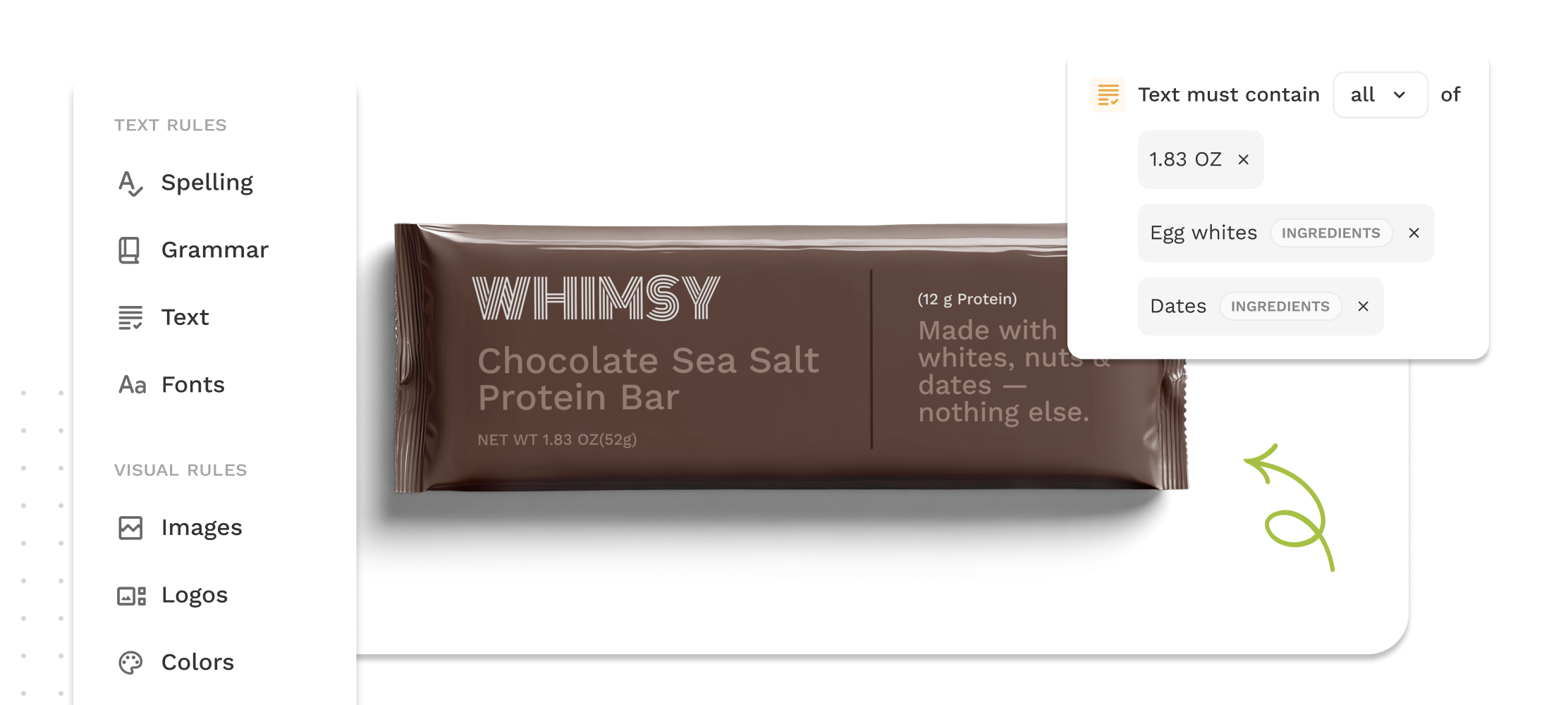
For mid-market pet food brands managing label complexity across multiple SKUs and states, WebCenter Go provides an affordable, fast-to-deploy solution for keeping labels accurate and audit-ready. For teams that need to go further, Verify Comply adds AI-powered artwork compliance checks directly inside WebCenter Go — automatically verifying copy, claims, and label data against defined rulebooks before files go to press.
Compliance doesn’t have to be a burden; it can become a strategic advantage with the right tools in place.
Simplify pet food labeling compliance with Esko WebCenter Go and Verify Comply, combining streamlined artwork management with AI-powered compliance checks to help ensure accurate, compliant labels before they go to print.