Written by Loïc Aigon
Product Manager, PitStop, Enfocus
For more than two decades, Enfocus products have helped print professionals automate processes, improve quality, and solve increasingly complex production challenges. As successive releases introduced new capabilities, our customers benefited from more powerful tools and greater workflow flexibility. But with that power came a new challenge: helping users quickly understand how to take advantage of everything the products have to offer.
For experienced users, years of product knowledge often provide a natural path to solving new challenges. For new users, however, the learning curve can appear much steeper. As products evolve, discovering the right feature, understanding the recommended workflow, or finding the answer to a specific question can become increasingly difficult.
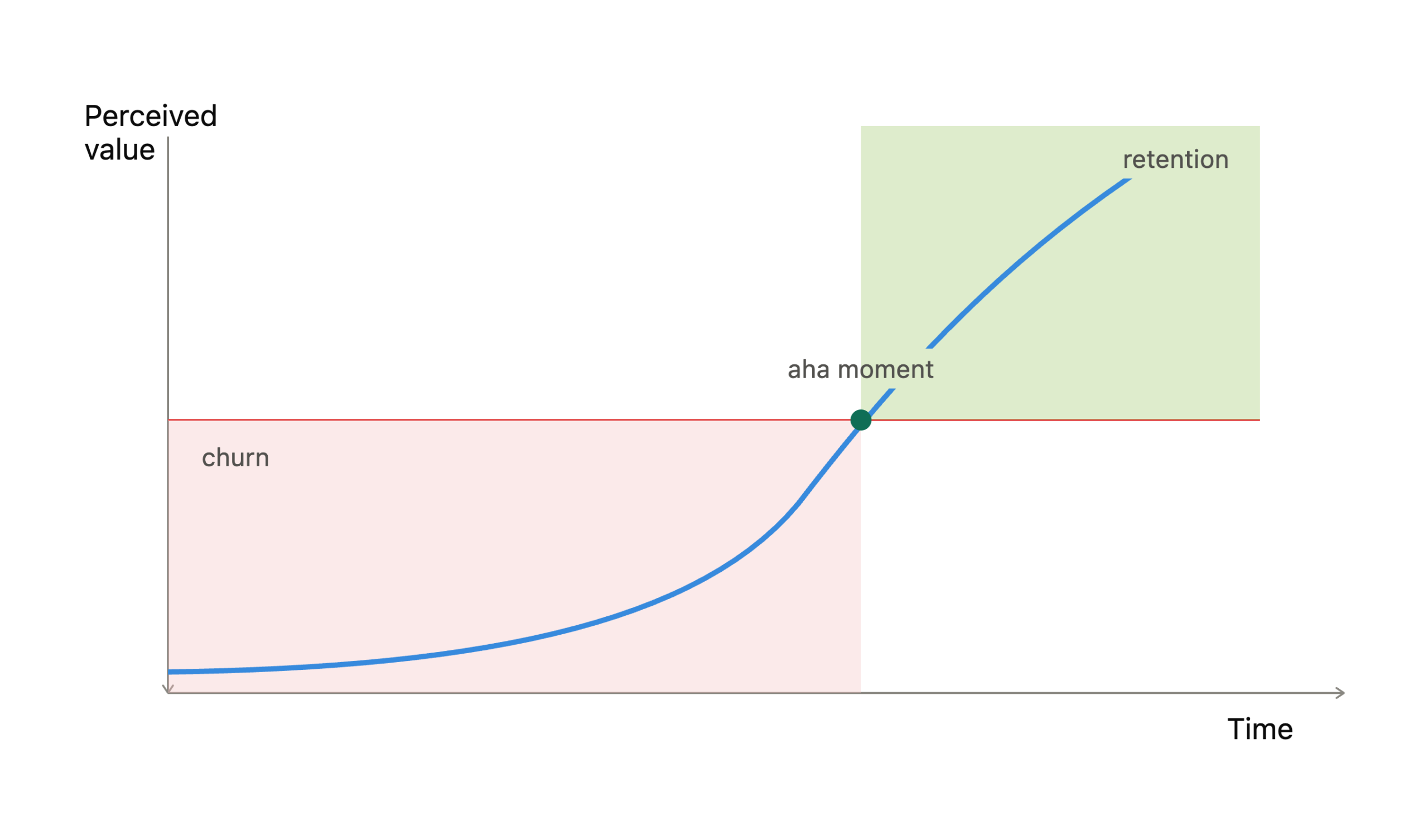
This creates a challenge for every software vendor. The longer it takes users to achieve meaningful results, the longer it takes them to realize the value of their investment.
At Enfocus, we began asking a simple question:
How can we make product expertise available exactly when users need it?
Why Documentation Alone Isn't Enough
The answer was not simply to create more documentation.
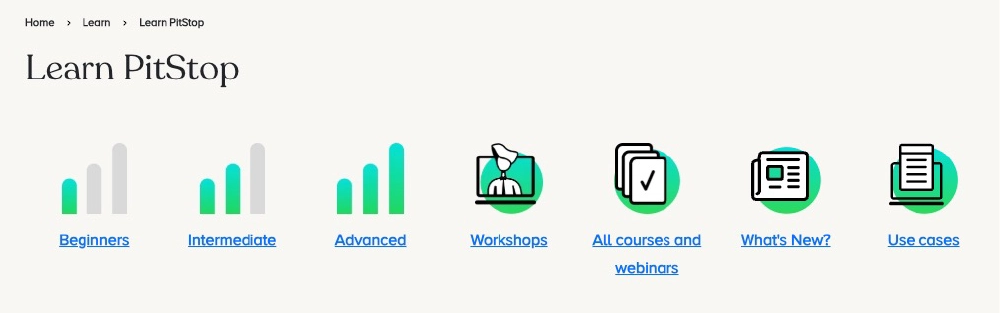
Over the years, Enfocus has invested heavily in product guides, learning resources, videos, tutorials, and knowledge bases. The information exists. In many cases, it exists in considerable depth.
The challenge is that users rarely approach documentation with a learning mindset when facing an immediate problem.
Most users are not looking to read an entire chapter about a feature. They are trying to complete a task. They have a specific objective, a specific question, and often limited time to find the answer.
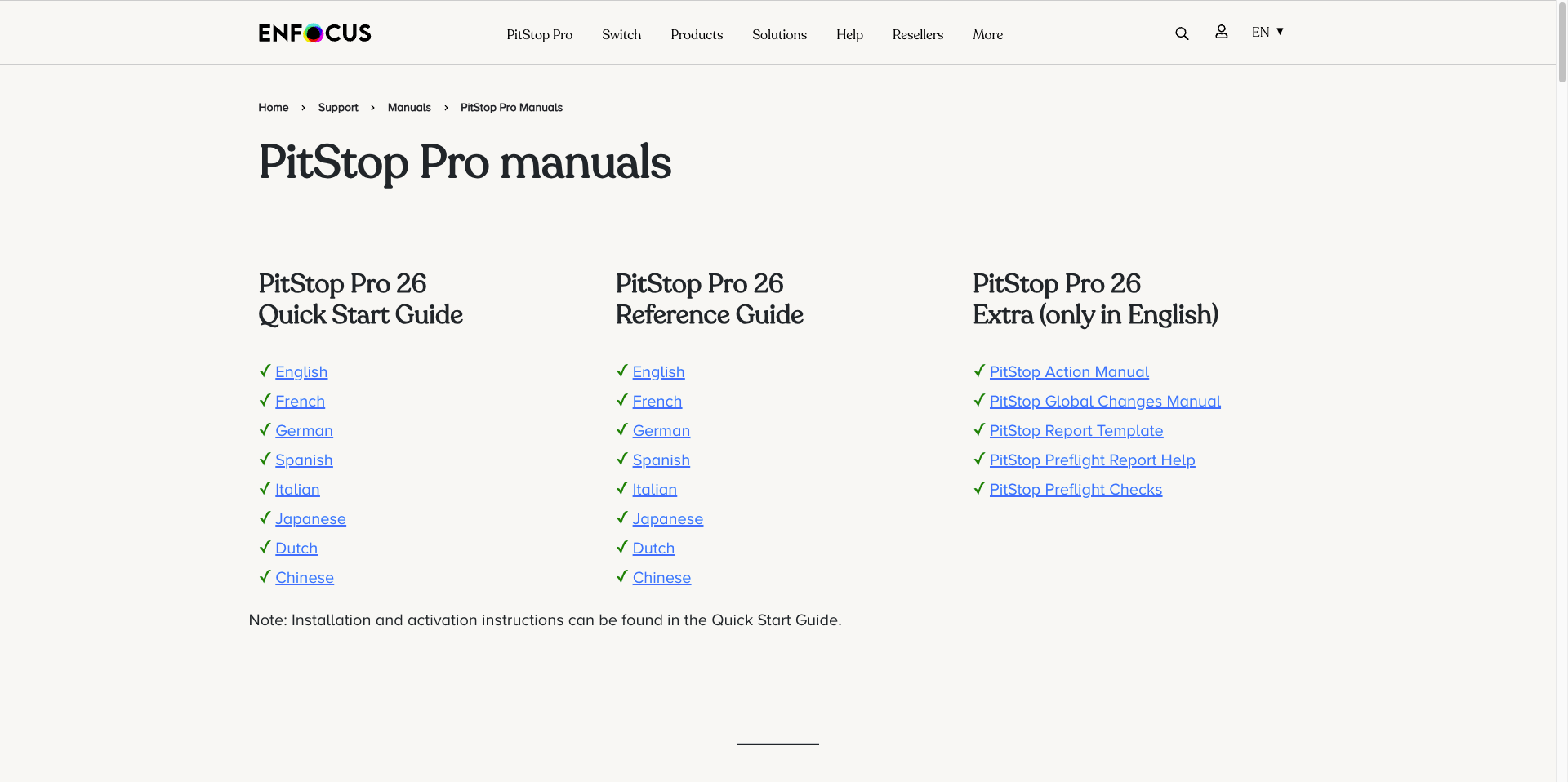
Documentation is typically organized around products, features, and concepts. Users, on the other hand, think in terms of goals:
- How do I create this Action List?
- Why is this check failing?
- Which setting should I use?
- How can I automate this process?
The gap between available information and immediate problem-solving is where many onboarding and adoption challenges emerge.
Why General-Purpose AI Is Not Enough
The rise of large language models has fundamentally changed how people seek information.
Today, many users naturally turn to AI tools when they need assistance. Rather than searching manuals, they ask a question in natural language and expect a direct answer.
However, applying general-purpose AI to professional software support presents significant challenges.
While these systems are remarkably capable, they are not designed around the specific knowledge domains of products such as PitStop Pro or Switch. Without access to authoritative product information, they may rely on assumptions, outdated information, or incomplete understanding of product functionality.
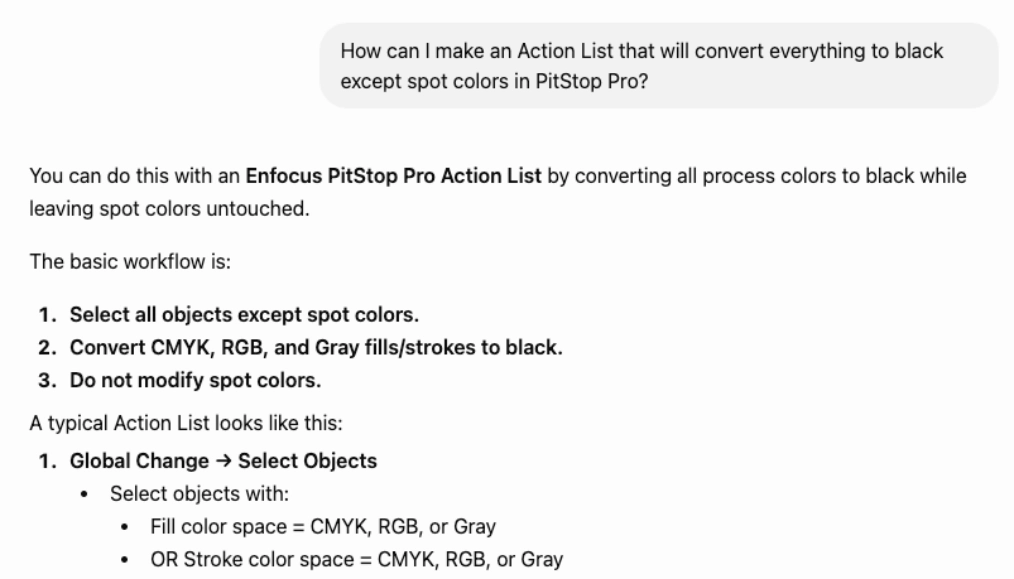
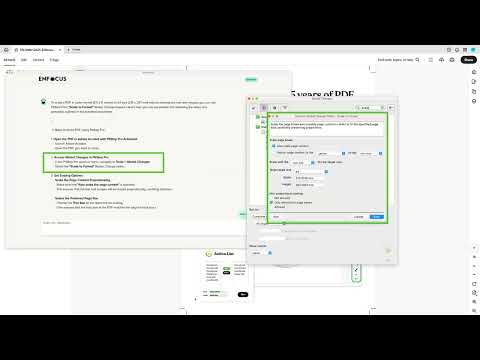
Asking advanced questions to a general AI model quickly throws hallucinations. In the above example, there is nothing of a “Select Objects” Global Change in PitStop Pro. Users trying to get assistance here leave more frustrated than helped.
The result can be guidance that appears convincing but does not accurately reflect how the software behaves.
For product support and onboarding scenarios, trust is essential. Users need answers that are not only fast but also aligned with documented product behavior.
This led us to a different conclusion: AI alone was not the solution. AI needed to be grounded in trusted product knowledge.
Designing Botus Around Trusted Expertise
Our main objective with Botus is to transform documentation into a more accessible and interactive form of guidance.
Years of product documentation gave us a valuable source of expertise accumulated by product teams, support engineers, trainers, and technical writers. Rather than asking users to manually navigate this information, we explored how AI could help users access it more naturally.

Our design philosophy was simple:
- Answers should be based on trusted product knowledge.
- Guidance should be relevant to the user’s question.
- Responses should be practical and actionable.
- Accuracy should take precedence over speculation.
The goal was never to generate answers from scratch. The goal was to connect users with relevant expertise more efficiently.
Turning Product Knowledge Into Actionable Guidance
Botus combines modern AI capabilities with a curated body of product-specific information.
When a user submits a question, Botus identifies the most relevant knowledge related to that request and uses it to formulate an answer. Rather than relying solely on the language model’s general training, responses are informed by authoritative Enfocus content.
This approach allows Botus to provide guidance that is both conversational and grounded in product knowledge.
Equally important, Botus was designed with reliability in mind.
Not every question has a perfect answer. In situations where available information is limited or ambiguous, it is often preferable to acknowledge uncertainty than to present potentially misleading guidance as fact.
For this reason, Botus is designed to help users understand where information originates and to encourage verification when appropriate.
Delivering Guidance Where Users Need It Most
With the introduction of Botus in PitStop Pro 25.11, users can ask questions directly from within the application and receive guidance without interrupting their workflow.
Whether they are exploring a new capability, troubleshooting a specific challenge, or trying to understand how a feature works, users can access product knowledge through a natural conversation rather than a traditional search experience.
The interaction does not stop at the first answer. Users can ask follow-up questions, refine their request, and continue the conversation as they work through a problem.
The result is a more accessible learning experience that adapts to the user’s immediate needs.
Accelerating Time-to-Value
For new users, one of the most significant barriers to adoption is uncertainty. Not knowing where to start, which feature to use, or how to perform a task can slow progress and create frustration. By providing immediate access to product knowledge, Botus helps reduce that friction.
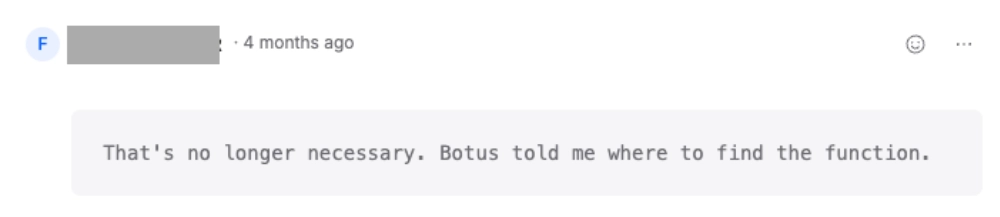
Users spend less time searching and more time accomplishing their goals. They can discover capabilities more quickly, learn at their own pace, and gain confidence while working with the software.
Ultimately, this shortens the path between installing the product and realizing its value.
In other words, it accelerates time-to-value.
AI as a Companion, Not a Replacement
Botus was never intended to replace documentation, training programs, support teams, or experienced users. Its purpose is to complement these resources by making expertise easier to access at the moment it is needed.
For many users, especially those early in their journey with PitStop Pro, Botus acts as a knowledgeable companion that helps them navigate the product and build confidence more quickly. As the underlying knowledge base continues to evolve, Botus will continue to improve alongside it.
Making Expertise More Accessible
The early response to Botus has been encouraging. Users are asking questions, exploring workflows, and increasingly relying on Botus as part of their learning experience. It is nice to see when customers publicly report that they were able to find the information they needed directly through Botus, avoiding lengthy searches through documentation or additional support interactions.
For Enfocus, this is ultimately what AI should enable. Not the replacement of expertise, but the democratization of expertise.
By combining modern AI with trusted product knowledge, Botus helps transform years of accumulated documentation into an interactive guidance experience—making it easier for every PitStop Pro user to learn, succeed, and realize value faster.