

Written by Geert de Proost
Director, Software Product Offering – Converters, Esko
Converter operations are under pressure from rising job volumes, shorter run lengths, and increasing variability across materials. While hardware continues to evolve, the most persistent bottlenecks remain upstream.
Esko’s R&D focus is on applied AI: targeted intelligence designed to reduce decision latency and eliminate the “interrupt culture” that plagues onboarding, planning, and prepress.
Onboarding: Eliminating the Internal Handoff Loop
Onboarding is often where speed goes to die. Customer Service Representatives (CSRs) are frequently forced to pause work and wait for internal departments to provide technical answers.
By combining domain technologies on the S2 platform, Esko is empowering CSRs to bypass these bottlenecks and move files forward immediately.

Color reconstruction using Print Clone
When a buyer provides a physical sample without technical metadata, the CSR no longer needs to hunt for elusive print specs. Print Clone guides the user through a few simple measurements to reverse-engineer the original color profile.
We’ve developed a proprietary machine learning model to replicate the overprint behavior of the source printer based on very few measuring points.
The system then uses existing brand color management protocols to convert the file to the target press color space, delivering a match without requiring an on-site color expert.

Planning: Scaling Decisions Beyond Human Limits
As complexity scales, especially in multi-site operations, the number of production variables exceeds human processing capacity. A single order might involve 50 SKUs, each with different quantities, across various presses and embellishment devices.
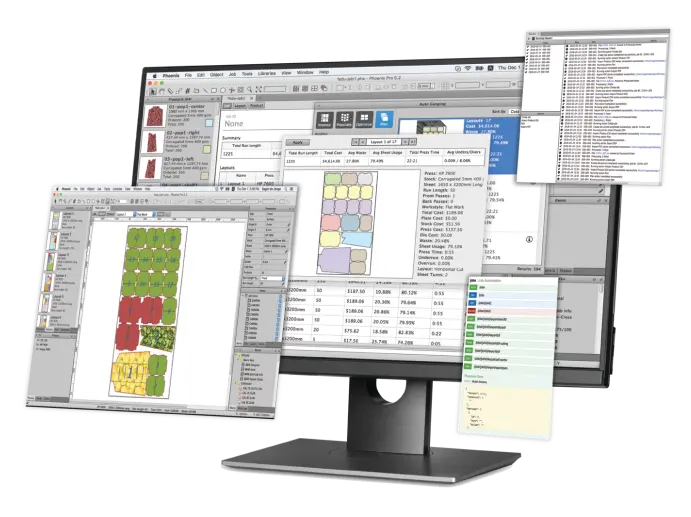
Our AI-based planning engine, integrated into Phoenix, acts as the mastermind of the operation by utilizing three core pillars:
- Digital twins: The engine uses digital twins of every device to simulate the shop floor. By modeling the precise mechanical and economic constraints of our installed base, the engine helps users prepare for all possible “what-ifs,” allowing them to visualize the impact of production changes on throughput, waste, and margin before a single job hits the press.
- Combinatorial optimization: Advanced AI algorithms triangulate millions of possible combinations to find the most economical, green, or fastest plan. This level of performance and speed is simply not possible with manual planning or conventional software techniques.
- The human edge: Instead of replacing the planner, we liberate them. By handling the heavy mathematical lifting, the AI allows planners to apply their tribal knowledge and decades of experience to the final touches of a plan, rather than getting lost in the data.
Prepress: Increasing Throughput Without Increasing Risk
The primary KPI of prepress is first-time-right. However, the sheer complexity of modern file construction makes manual editing a high-risk, and often dangerous, activity. One small change can trigger unintended errors elsewhere in the artwork.
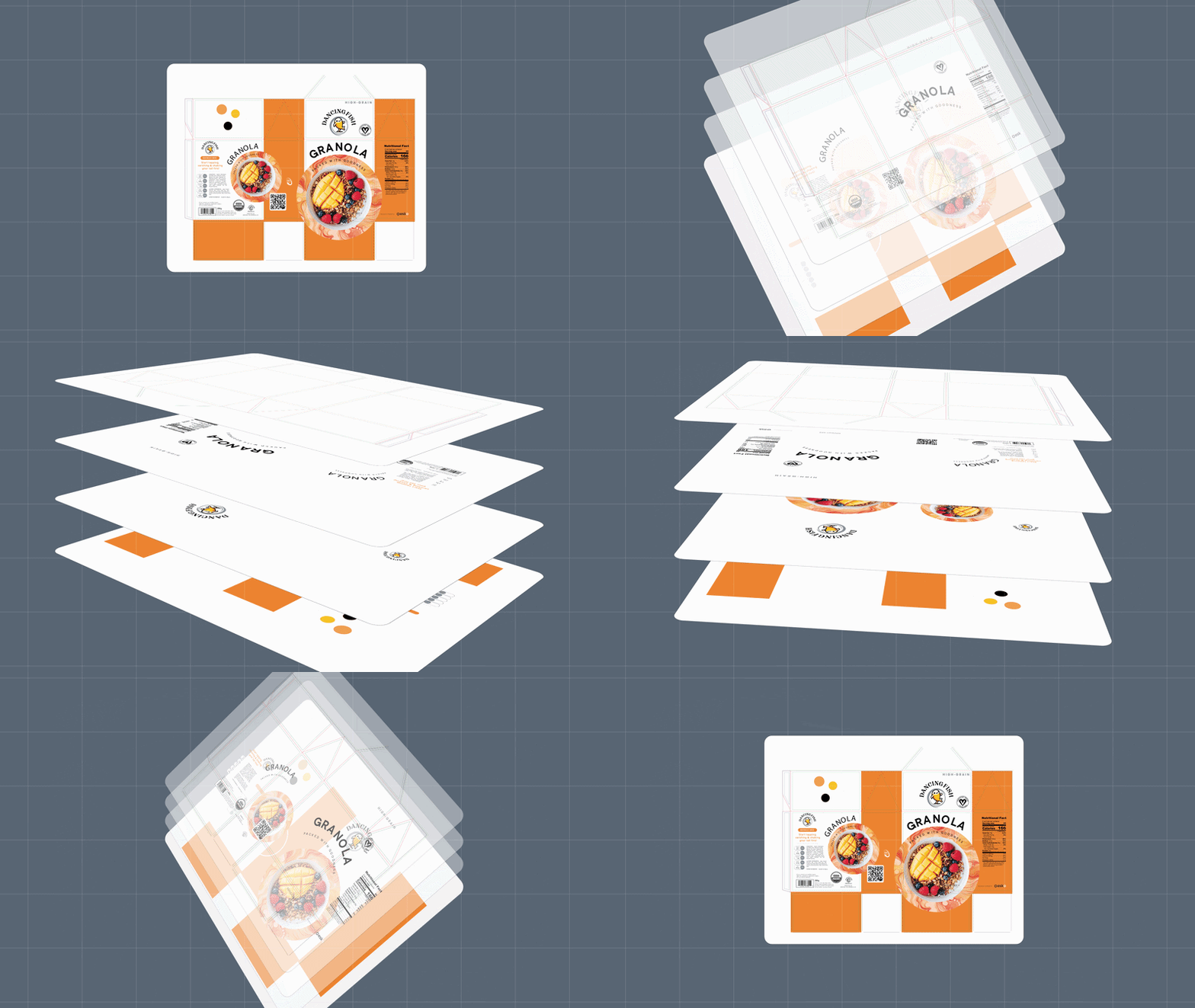
AI-based Smart Select changes this dynamic through semantic file understanding:
- Logical segmentation: Smart Select intelligently analyzes and segments files into logical objects, combining customized machine learning on vector spaces with Esko’s deep PDF expertise and proprietary PDF kernel.
- Secure editing: By understanding the structure of the file, the AI allows operators to isolate and edit elements with total security. This transforms prepress from a high-friction bottleneck into a high-throughput engine that allows teams to handle higher job volumes with consistent, reliable accuracy.
A Consistent Innovation Pattern
At Esko, our AI strategy follows a clear mandate: Apply intelligence where complexity exceeds human efficiency.
While generic AI models struggle with the nuanced physics of packaging, Esko’s AI is applied intelligence refined by millions of real-world production cycles. With decades of accumulated knowledge from our global installed base, we have mapped the actual behaviors of printing presses, the geometric constraints of CAD, and the semantic complexity of packaging workflows.
By closing the gap between raw data and operational logic, we allow converters to scale their operations with a level of precision and risk mitigation that is inaccessible to those relying on general-purpose software.
The future of packaging has evolved from being just about automation to also using deep domain intelligence to remove the friction that slows you down.
We’ve built the engine. Now, it’s time to see how much more your facility can achieve with these tools.