

Written by Srinivas Kuppa
Chief Product Manager of Marketing, Esko
The packaging industry is reaching a breaking point. SKU proliferation, shifting global regulations, and a shortage of specialized talent are all systemic risks to the packaging digital thread.
For decades, software has relied on deterministic logic: rigid rules and fixed workflows. While essential, these systems are brittle. They break when data is messy or formats change. To scale, we need a new foundation that combines human-like reasoning with the precision of a mathematical rulebook.
The Limits of Probabilistic AI
Most current AI excitement centers on Large Language Models (LLMs). These are probabilistic, meaning they work on best guesses and statistical patterns. While they are highly capable specialists for classifying data or generating content, they cannot guarantee the same answer twice.
In a regulated packaging environment, “probably correct” is a liability. This is why many home-grown AI pilots fail. They lack deterministic guardrails to ensure 100% compliance.
The Esko Solution: Neuro-Symbolic Architecture
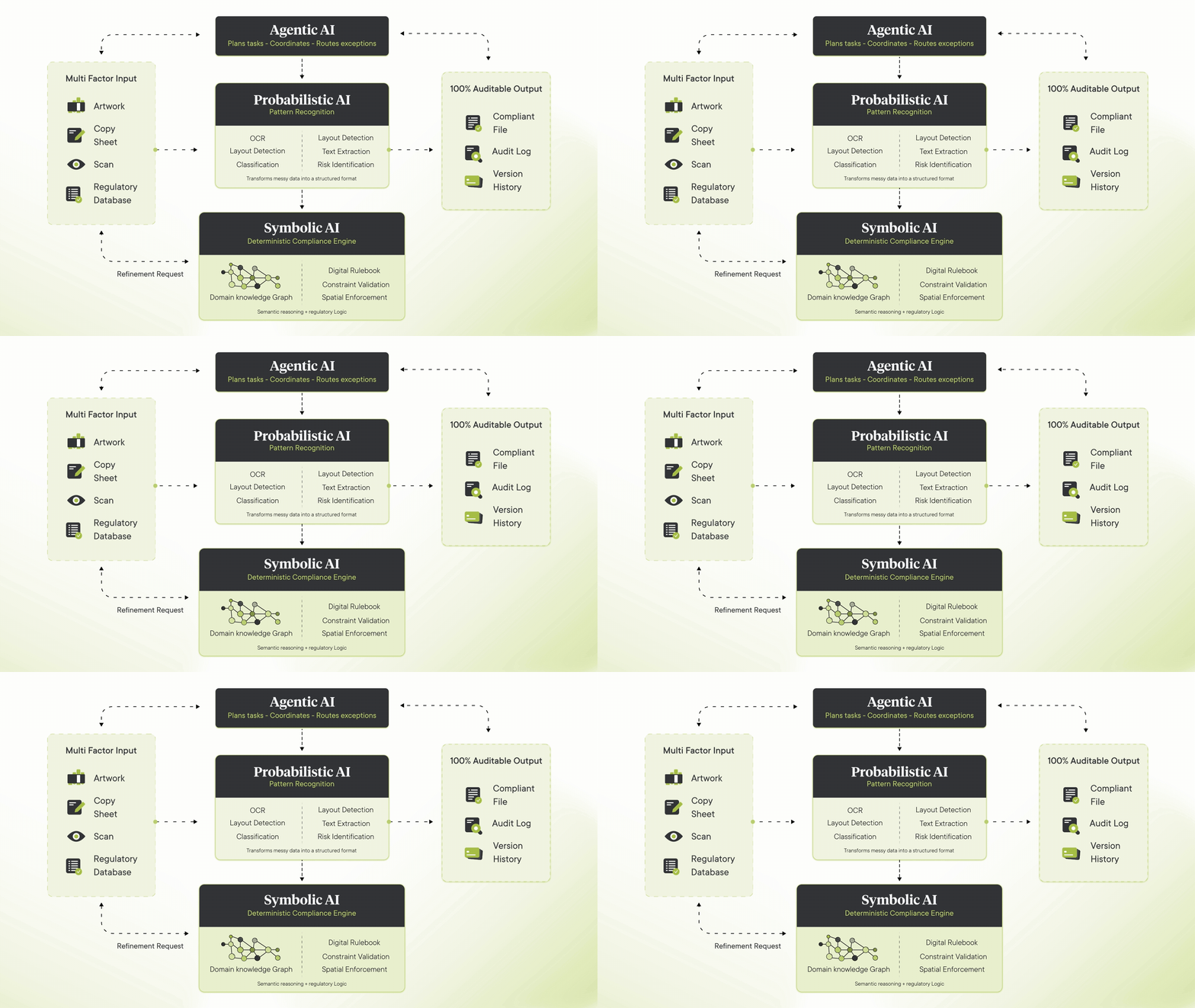
To solve this, Esko has pioneered a Neuro-Symbolic architecture. This framework bridges the gap between the pattern recognition of neural networks and the rigorous logic of symbolic reasoning.
Agentic AI (The Orchestrator)
Agentic AI adds a level of independence. It can interpret a packaging brief, plan multi-step tasks, and coordinate both AI and human contributors. It acts as the flexible glue, using cognition to identify missing inputs or propose final-ready files without manual guidance at every step.
Probabilistic AI (The Specialist)
This layer excels at finding patterns and interpreting unstructured data. It can look at an artwork file or a low-quality scan and extract text or identify graphics. It transforms messy real-world inputs into a format the system can reason with.
Symbolic AI (The Compliance Foundation)
This is Esko’s digital rulebook on the Comply module, that can be automatically created when you import your copy sheets or manually built with an easy-to-use rule builder. It uses symbolic logic and constraints to ensure that every character, barcode, and color swatch aligns exactly with the law. It is deterministic: the outcome is always predictable, defensible, and fully auditable.
Why Esko’s Knowledge Graph Changes the Game
Traditional rule engines fail because they lack semantic understanding. They follow literal IF-THEN logic. If a rule looks for “Milk” but the document says “Dairy Solids,” a traditional system fails. Because it typically works like this:
- IF allergen list changes, THEN trigger reroute
- IF artwork layer = X, THEN run check Y
- IF label type = Z, THEN enforce rule set ABC
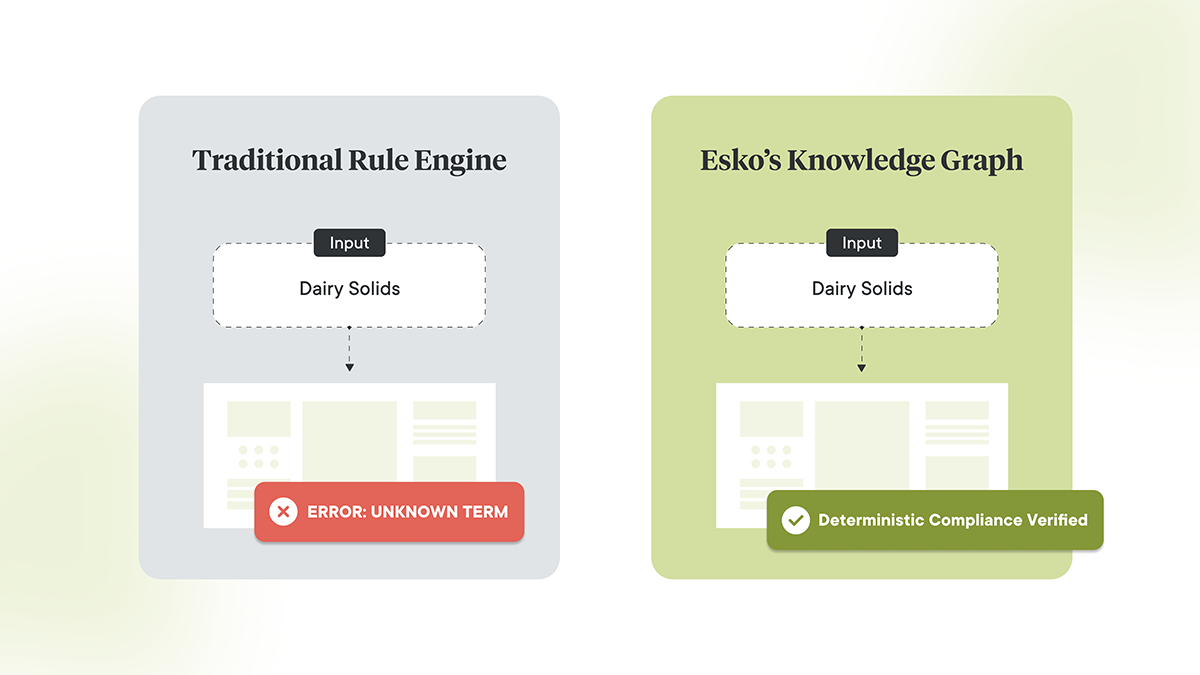
Esko solves this with a Domain-Specific Knowledge Graph.
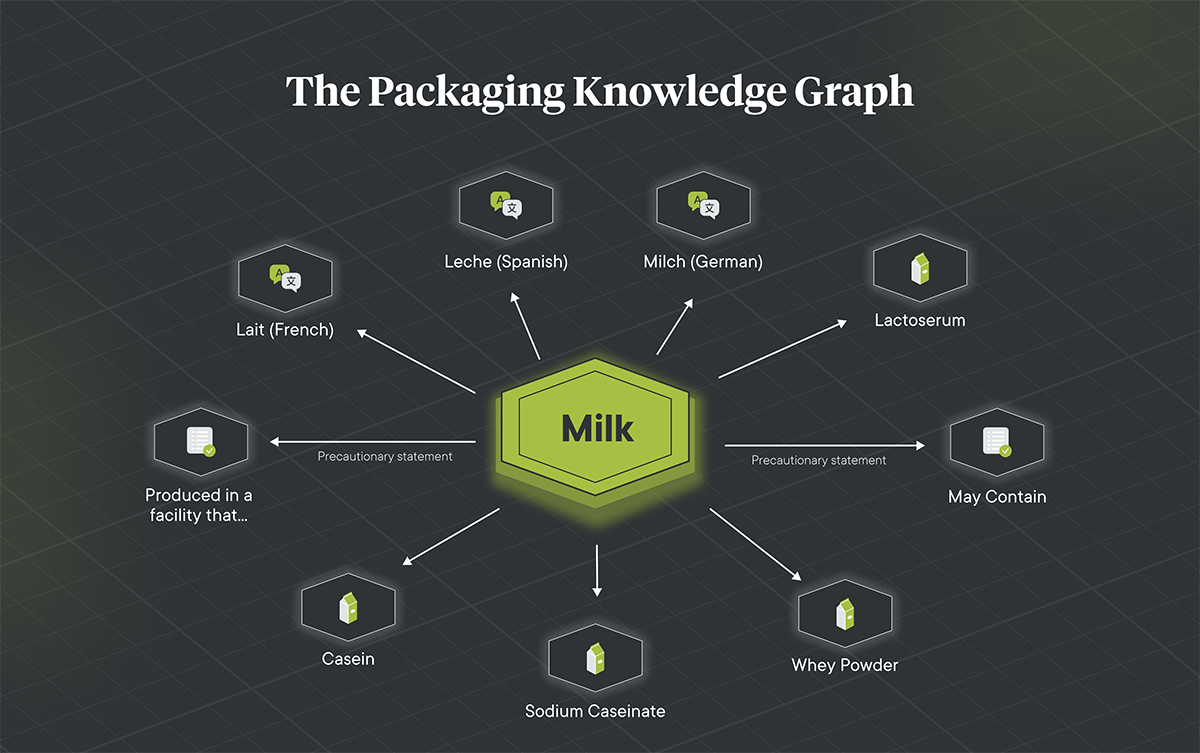
This Knowledge Graph is a specialized ontology built from 30 years of codified packaging expertise, that essentially understands the intent behind the data. It maps relationships between ingredients, allergens, and regional regulations.
-
The benefit: It resolves synonyms automatically (e.g., mapping
“lactoserum” to “milk”). - The result: It validates packaging data based on meaning, not just matching text. This allows the system to recognize a Nutrition Facts panel even if the style or placement shifts.
The Pros and Cons of AI Approaches
As a CPO, I believe in transparency regarding technology trade-offs. Here is how we evaluate the different AI tools within our platform:
Why Esko? Why Now?
Most internal home-grown AI projects fail because they lack the connective tissue of a packaging-specific knowledge graph. They try to use general-purpose AI to solve a specialized problem.
Managers who have struggled with failed AI POCs often find that general-purpose AI lacks two things: context and auditability.
- Context: General AI doesn’t understand that “Contains Milk” must be adjacent to a nutrition table. Our Symbolic AI enforces these spatial and regulatory constraints natively.
- Auditability: Unlike black box AI, our Neuro-Symbolic architecture provides a step-by-step audit trail. You can see exactly which rule was applied to which symbol to reach a compliance decision.
Final Thoughts: Engineering the Future
Smarter packaging management is what we are building into the Esko S2 Cloud Platform right now. By combining the flexibility of modern AI with the precision of symbolic reasoning, we are delivering:
- 50–70% reduction in artwork cycles.
- Elimination of manual rework.
- Protection of the 1–3% of revenue typically lost to packaging errors.
This is the work Esko has been building toward. We are advancing an intelligent, auditable, and scalable system that allows brands to move faster without sacrificing the accuracy that their reputation depends on.
Read more about our packaging intelligence layer for compliance here.