
Table of content
For packaging teams, a barcode has traditionally been one of those small but critical elements that simply needs to be right.
It needs to carry the correct product information, scan properly, and stay matched to the right artwork as products move through production, distribution, and retail.
But that job is getting bigger.
Brands and retailers want better traceability, consumers expect greater product transparency, and regulations are placing more demands on how product information is shared. Packaging teams, meanwhile, have to accommodate all of this within the same limited space on a label or pack.
This is where 2D barcodes come in.
Capable of carrying more information than traditional linear barcodes, 2D barcodes are becoming an increasingly important part of packaging, retail, healthcare, logistics, and other industries.
So, what exactly is a 2D barcode, and what does its growing adoption mean for packaging teams?
Let’s take a closer look.
What Are 2D Barcodes?
A 2D barcode, or two-dimensional barcode, stores information across both the horizontal and vertical dimensions of the symbol.
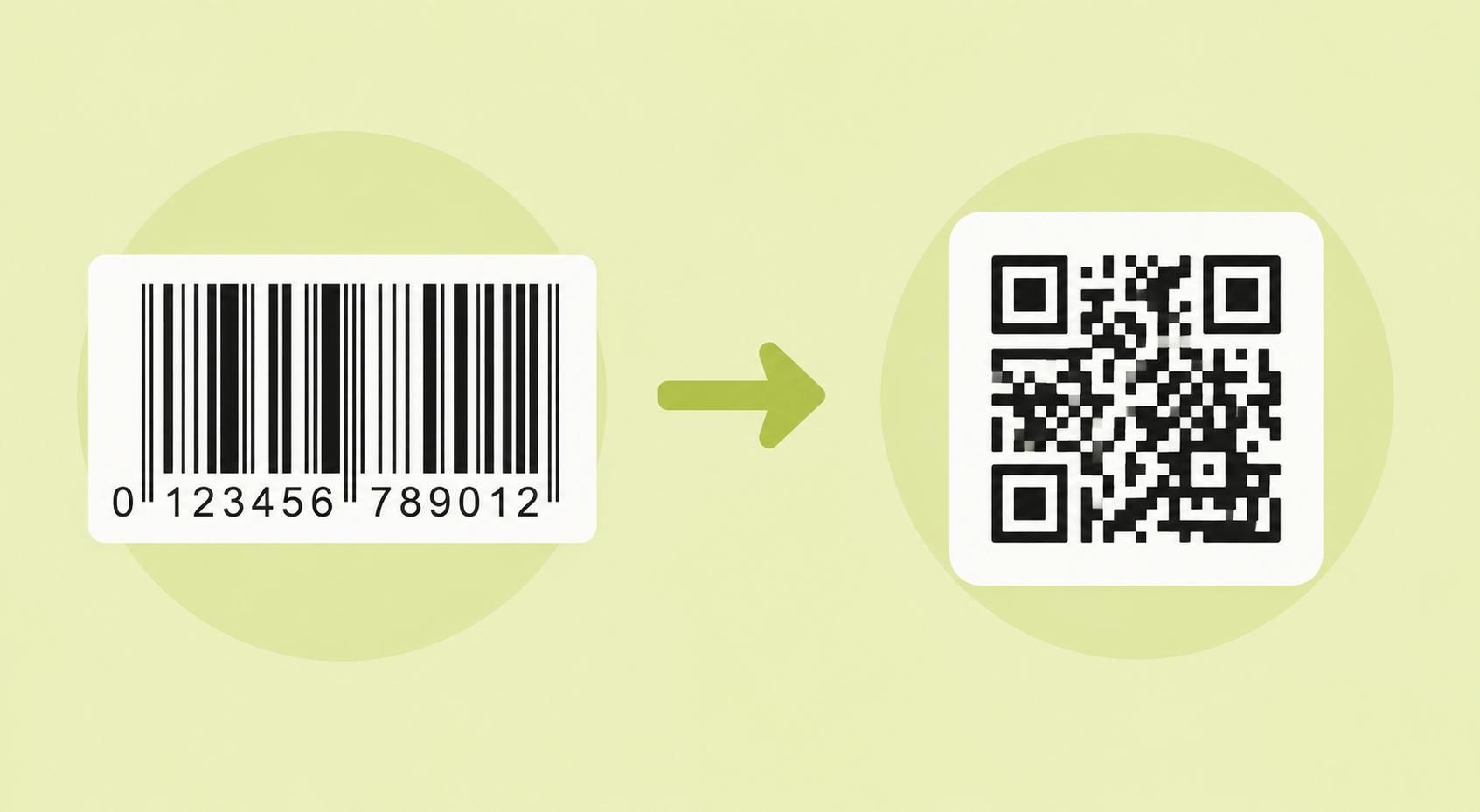
Traditional 1D barcodes, such as the UPC or EAN codes you see on everyday consumer products, use a series of bars and spaces. 2D barcodes use patterns of shapes such as squares or dots instead. Because information is encoded across two dimensions, they can hold more data while remaining relatively compact.
You’ve probably already seen plenty of them.
The QR code on a restaurant table is a 2D barcode. So is the Data Matrix code you might see on a pharmaceutical pack.
A traditional retail barcode is commonly used to encode a product identifier such as a Global Trade Item Number (GTIN). More capable GS1 barcodes can also encode attributes such as batch numbers and expiration dates.
That gives packaging teams considerably more possibilities for what a barcode can do.
The exact information depends on the type of 2D barcode, the standard being used, and its intended application.
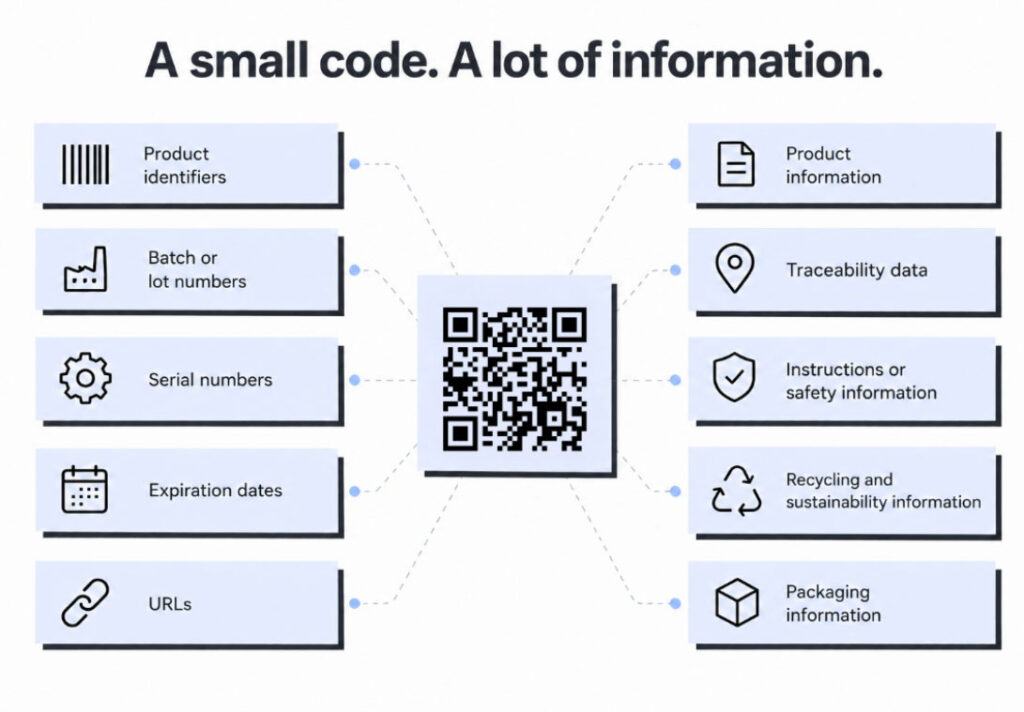
Depending on the implementation, a 2D barcode can carry or provide access to information such as:
- Product identifiers
- Batch or lot numbers
- Serial numbers
- Expiration dates
- URLs
- Product information
- Traceability data
- Instructions or safety information
- Recycling and sustainability information
- Packaging information
Under GS1 standards, Application Identifiers can give meaning and structure to information such as GTINs, batch/lot numbers, serial numbers, and expiry dates.
Think about a carton of yogurt.
A traditional retail barcode can identify the type of yogurt being sold. With an appropriately implemented 2D barcode, the encoded data could go further and identify information such as the GTIN, and batch and expiration date.
That distinction matters if there is a problem with one particular batch.
Instead of knowing only what product this is, systems can potentially identify which batch of the product this is and when it expires.
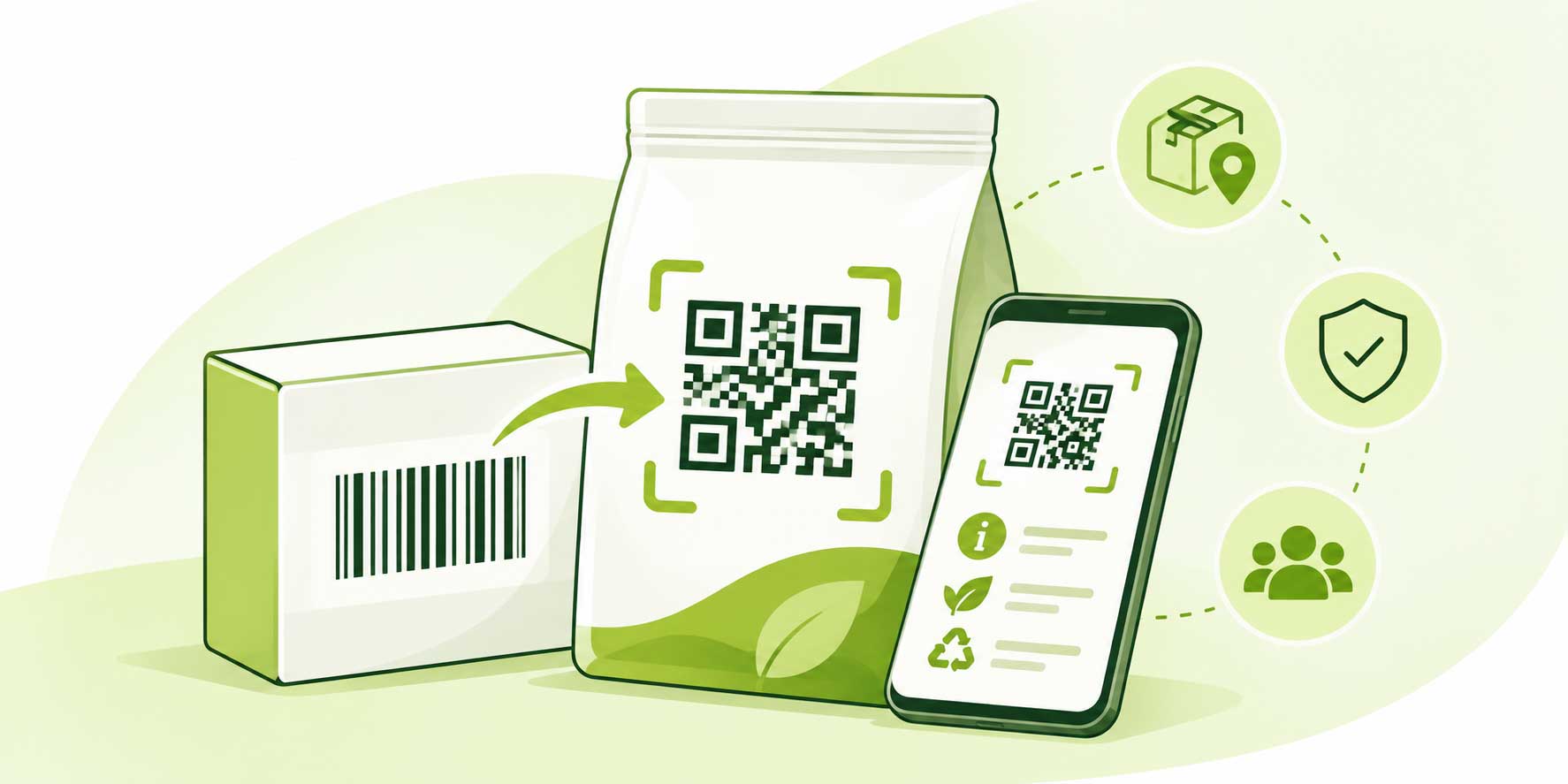
And when a web-enabled approach such as GS1 Digital Link is used, the same physical code can also connect users to online information and services. GS1 gives examples ranging from instructions and recycling information to product information and patient safety leaflets.
A small square on the packaging can therefore do quite a lot of work.
Common Types of 2D Barcodes
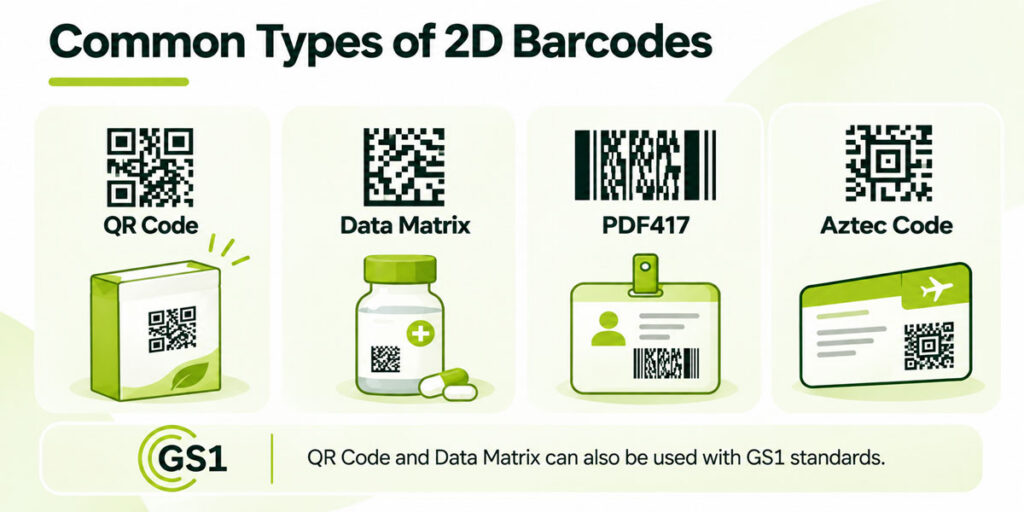
Not all 2D barcodes are the same. Different formats have been developed for different environments and applications.
Here are some of the types you’re likely to stumble upon.
QR Code
This is probably the most recognizable 2D barcode.
QR codes have become part of everyday life because they can be scanned easily by smartphones. You’ll find them on restaurant menus, event tickets, advertisements, product packaging, payment screens, and plenty of other places.
For packaging, QR codes are particularly useful when a brand wants to connect a physical product with digital information.
Also read: QR-Linked Packaging: Common Mistakes and How to Fix Them
Data Matrix
A Data Matrix code also uses a pattern of light and dark cells to encode information. Its compact size makes it useful when space is limited.
Data Matrix codes are used in industrial applications and are particularly important in healthcare. Within GS1 standards, GS1 DataMatrix is the 2D barcode of choice for healthcare products at point of sale.
PDF417
PDF417 is a stacked 2D barcode capable of carrying relatively large amounts of information. Rather than looking like a square QR code, it has a wider rectangular appearance.
It is commonly found in applications such as identification documents, transportation, and logistics.
Aztec Code
Aztec codes are another compact 2D format. One place you may already recognize them from is digital transportation tickets and boarding passes.
They are designed to work efficiently in relatively small spaces and are recognizable by the square pattern at their center.
GS1 DataMatrix and QR Codes with GS1 Standards
This is where an important distinction comes in.
A barcode’s symbology such as QR Code or Data Matrix is only part of the picture. How the data inside it is structured also matters.
GS1 supports several 2D barcode options for specific applications. For example, GS1 DataMatrix can encode structured information using GS1 Application Identifiers, while QR Code and Data Matrix can carry GS1 Digital Link URI syntax.
And one misconception is worth clearing up:
A QR code is a type of 2D barcode. But not every 2D barcode is a QR code.
Why 2D Barcodes Matter for Packaging
So why is the packaging industry paying so much attention to them?
Because the humble barcode is starting to take on a much bigger job.
More Information in Limited Packaging Space
As mentioned before, packaging space is valuable.
The same label may need to accommodate branding, ingredients, warnings, claims, regulatory information, nutritional details, symbols, instructions, and more.
And the pack itself isn’t getting any bigger.
Since 2D barcodes can carry more data than traditional 1D barcodes while remaining relatively small, they offer a way to support richer product information without requiring another large block of printed content.
This can be particularly useful for smaller packs where every millimeter counts.
Check out 10 steps to barcode your product here.
Better Product Traceability
Knowing the product identifier is useful.
Knowing the product identifier and the batch, serial number, or expiration date can be much more useful.
GS1 standards allow 2D barcodes to encode identifiers and attributes that can support more granular product tracking.
Imagine a food company discovering an issue associated with a particular production batch.
When the relevant batch information is available within the barcode and connected systems are set up to use it, the business can identify affected products more precisely. That can support more targeted recall processes instead of treating every unit of the product as identical.
Also read: Decoding Compliance: Your Guide to 2D Traceability in Packaging (2023 – 2030)
Product Authentication
Unique identifiers and serialization can also support product authentication and anti-counterfeiting systems.
This is especially relevant for industries where knowing exactly which product is in someone’s hands matters, from healthcare and cosmetics to premium consumer goods.
The barcode itself is only one part of such a system, of course. Authentication depends on the data, systems, and processes behind it.
Consumer Engagement
This is perhaps the side of 2D barcodes most consumers already understand.
Instead of fitting every piece of information onto the physical pack, a QR code can connect consumers with digital content.
That could mean:
- Instructions for use
- Allergen information
- Recipes
- Recycling guidance
- Product origin
- Promotions
- Additional safety information
- Product information in different languages
2D barcodes can also provide an entry point to Digital Product Passports (DPPs), which are designed to make relevant product information digitally accessible throughout a product’s lifecycle. Instead of trying to squeeze information about materials, sustainability, product origin, or end-of-life guidance onto the physical pack, consumers and other stakeholders can access relevant information digitally.
With GS1 Digital Link, a single identifier can connect to different kinds of information and services on the web rather than being tied to only one static destination.
Inventory and Supply-chain Applications
Richer product data isn’t useful only to consumers.
Batch, lot, serial and expiry information can support processes across manufacturing, warehousing, distribution, and retail.
The important point is that the value isn’t simply in having a more advanced barcode.
It comes from the systems throughout the product’s journey being able to capture and use the information inside it.
What You Need to Know About GS1 2D Barcodes and Sunrise 2027
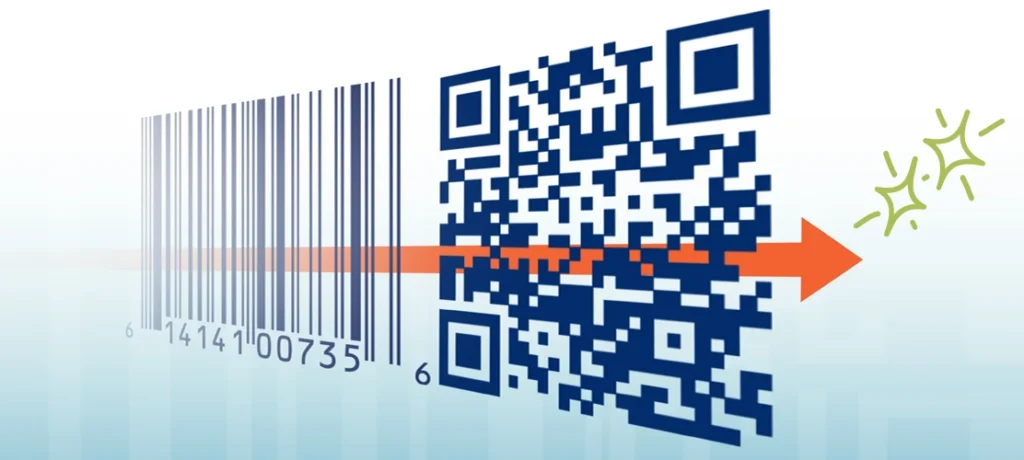
If you’ve been researching 2D barcodes recently, you’ve probably come across the term GS1 Sunrise 2027.
It sounds like a hard deadline when every familiar barcode suddenly disappears from supermarket shelves.
That’s not quite what is happening.
GS1 describes its Ambition 2027 as an industry goal for retail POS systems to be capable of reading and processing a defined set of 2D barcodes using GS1 standards by the end of 2027, in addition to existing linear barcodes.
Your Existing 1D Barcode isn’t Simply Disappearing in 2027
The transition is gradual.
GS1 states that linear barcodes such as EAN/UPC will continue to coexist with 2D barcodes while they remain useful. During the transition, products may carry both a traditional barcode and a 2D barcode while retailers upgrade their systems.
Why does that transition take time?
Because scanning a new barcode at checkout isn’t just about whether the scanner can physically see it.
Retailers may need compatible imaging hardware, software changes and processes capable of interpreting the additional data. GS1 notes that the 2027 ambition can require software upgrades and, where scanners aren’t already image-capable, hardware upgrades too.
Which 2D barcode Should Brands Use?
There isn’t one universal answer.
GS1 explicitly notes that it does not expect a single 2D barcode to be selected for every industry. The appropriate option depends on the use case and sector.
GS1 DataMatrix, Data Matrix with GS1 Digital Link and QR Code with GS1 Digital Link are among the options approved within the GS1 system for particular applications.
So the question for a brand isn’t simply:
“When should we put a QR code on our packaging?”
It is:
“What do we need this code to do?”
Do you need batch-level traceability? Consumer-facing information? Expiration data at checkout? Serialization? Several of these together?
The answer influences the data, barcode, and systems you need.
2D Barcode Labels in Packaging Workflows
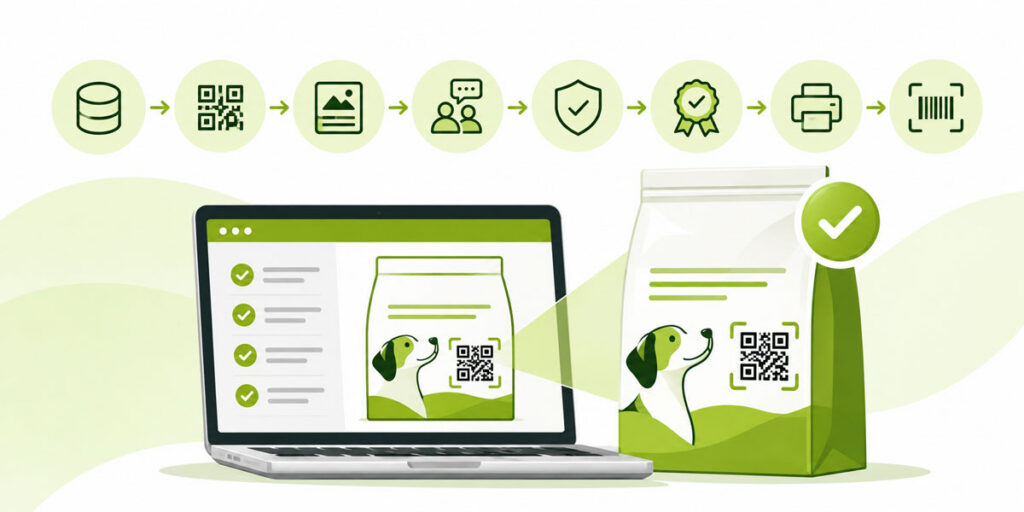
Here’s where things become very relevant for packaging teams.
Creating the barcode is only one step.
A typical journey might look something like:
Product data → Barcode generation → Artwork placement → Review → Verification → Approval → Print → Scan
At every stage, something can go wrong.
Say you’re launching the same product in ten markets.
You have multiple artwork versions, perhaps different languages, regulatory requirements, and product data. One market changes an expiry-related requirement. Another SKU gets updated. Someone downloads yesterday’s artwork instead of today’s approved version.
The barcode may look perfectly normal.
But is it the right barcode?
That is why barcode management needs to be treated as part of the packaging workflow rather than as a graphic that gets dropped onto artwork near the end.
Teams need to know:
- Where the encoded data came from.
- Whether it belongs to the correct product or variant.
- Whether the barcode meets the required specifications.
- Whether it has changed between artwork versions.
- Whether it can actually be scanned.
- Whether the correct artwork has been approved.
- Whether the approved version is the version sent to production.
For brands managing hundreds or thousands of SKUs, these checks quickly become difficult to handle manually.
With a structured packaging management tool like WebCenter Go, you can keep the barcode, product data, artwork version, reviews, and approvals connected. It also offers built-in quality checks that help identify barcode and QR code issues before artwork moves forward.
This makes barcode verification part of the artwork process itself, rather than another check added at the end.
Common 2D Barcode Implementation Challenges
Moving toward 2D barcodes creates new opportunities, but it also introduces practical challenges packaging teams need to consider.
Incorrect encoded data
A barcode can scan successfully and still be wrong.
If the GTIN, lot number, serial number, expiry date or URL encoded in it is incorrect, perfect print quality won’t solve the underlying problem.
This makes data accuracy just as important as barcode readability.
Code size and available space
Yes, 2D barcodes can fit a lot of information into a relatively compact area.
That doesn’t mean they can be made as small as you want.
The amount of data, printing process, barcode type, substrate and scanning environment can all influence implementation. Teams need to plan for the code during packaging design rather than squeezing it into whatever space remains at the end.
Print quality
The barcode on your designer’s screen isn’t the barcode the consumer or retailer scans.
It still needs to survive printing.
Packaging materials, inks, printing methods, and production conditions can affect the finished symbol. What looks sharp in the PDF may behave differently once printed on a curved bottle, flexible pouch or textured carton.
Contrast and placement
A beautifully integrated code isn’t particularly useful if scanners can’t reliably read it.
Barcode placement, surrounding clear space, contrast, orientation, and packaging shape all need to be considered, according to the applicable barcode specifications.
That’s where DeskPack chips in. It offers a barcode generator plugin that supports barcode-specific controls like margins, magnification, output resolution, bar width reduction, and supported 2D standards.
Data changes across SKUs and markets
One product can quickly turn into:
5 flavors × 4 sizes × 8 markets = 160 packaging variations.
Now imagine managing barcode information across all of them.
As the number of variants increases, manually keeping the correct code connected to the correct artwork becomes increasingly risky.
Barcode and artwork version mismatches
This mistake is easily underestimated.
The barcode was updated.
The artwork was updated.
Both files are technically correct.
They’re just not the versions that belong together.
Strong version control and structured approvals help packaging teams reduce the chances of an outdated barcode or artwork reaching production.
Verification
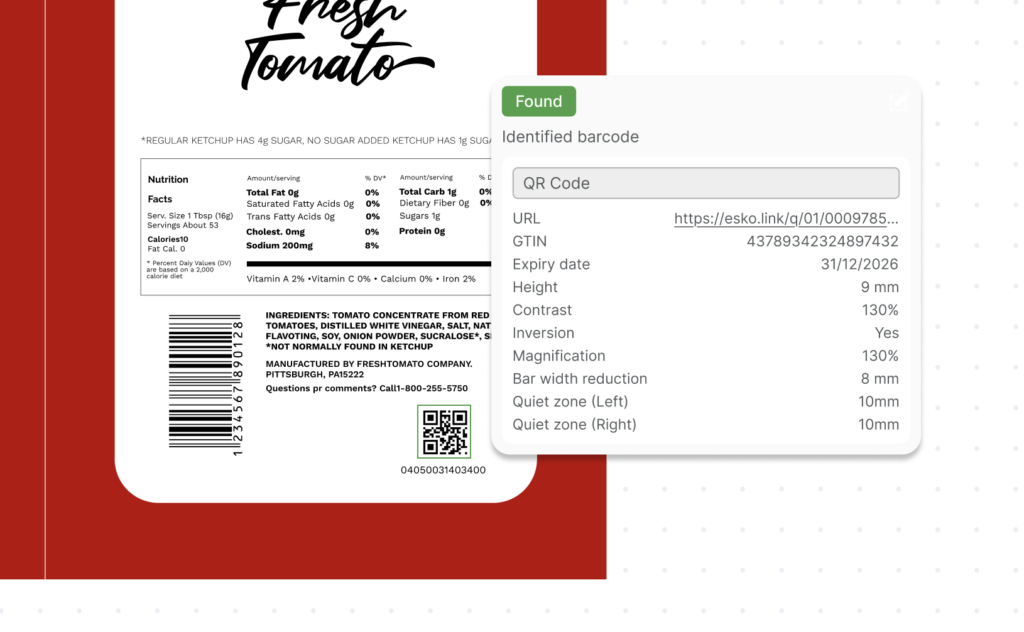
Don’t make the first real test of your barcode for the supermarket checkout.
Barcode verification should be considered throughout development and production. Teams need to confirm not only that a code can be scanned, but also that it carries the expected information and meets the applicable requirements.
If you want to send out error-free QR codes or barcodes, Esko’s Verify Comply simplifies it for you. Be it placement, contrast, quiet zone, or GTIN number, the AI-powered compliance software helps you spot red flags and inconsistencies in your 2D barcodes across packs.
Retailer and scanner readiness
2D capability isn’t identical everywhere yet.
GS1 notes that current POS capabilities depend on retailers’ scanning equipment and host systems. Camera-based scanners may have the ability to read 2D symbols, but functionality and support for specific formats still depend on configuration and system readiness.
That makes testing and coordination with retail and supply-chain partners an important part of implementation.
The Future of 2D Barcodes in Packaging
For years, the barcode has largely been something machines use to answer a simple question:
What product is this?
2D barcodes can help answer considerably more.
Which batch is it from?
When does it expire?
Which individual item is this?
And, when connected to digital information:
How do I use it?
Where did it come from?
How do I recycle it?
Where can I find more information about it?
That makes the evolution of barcodes bigger than a change from lines to squares.
For packaging teams, it brings the physical pack closer to the growing amount of digital information surrounding a product.
It can support richer traceability across supply chains, give consumers access to information that would be difficult to fit onto a label, and also support product-specific digital experiences. And as regulatory and sustainability information continues to evolve, connected packaging can provide another way of making relevant information accessible.
GS1 Digital Link is particularly interesting here because it allows standardized product identifiers to work with the web, potentially allowing one physical code to connect to multiple types of information and services.
The code may stay the same while the digital information available through it evolves.
For a packaging team, however, that also raises the bar for managing the information behind the artwork.
Conclusion
2D barcodes are giving a familiar piece of packaging a much bigger role.
As retail moves toward broader support for 2D barcodes, packaging teams need to think beyond simply adding a new square code to an artwork file.
What information needs to go into it? Where does that data come from? Which barcode fits the use case? How will it be verified? And how will teams make sure the right code stays connected to the right artwork as products, SKUs, and markets change?
Those are useful questions to start asking now.
Because the transition to 2D barcodes isn’t just a barcode change. For packaging teams, it’s also a data, artwork, and workflow change.