
Written by Geert de Proost
Director, Software Product Offering – Converters, Esko
Lately, the topic of AI in prepress has come up a number of times in conversations with converters. Some are excited about AI. Some are wondering where it’s headed. And others are convinced it will replace prepress operators.
For sure, AI brings transformation and perhaps disruption. However, I’ve been around prepress long enough to see the industry and prepress operators reinvent themselves more than once, and the advent of AI means another instance of the same.
From my experience, every time prepress has evolved, both companies and operators have benefited. I expect this to be the case again, except perhaps that in this instance, AI and prepress operators will combine their unique brain power to create the next level of efficiency and automation together.
There was a time when a single person owned everything from design to final output. Then came specialization: interactive editing, dedicated prepress teams, and expert tools, all of which caused design to move upstream. In the early 2000s, rules-based automation was introduced, responsibilities shifted, and efficiency steadily improved.
On paper, that should have made the prepress department quieter. In reality, the opposite happened. Every time I talk to prepress operators today, I hear the same thing: “We’ve never been busier.”
That paradox, generally known in economics as Jevens Paradox, is what keeps this conversation interesting as well as urgent .
Automation Created Free Time, but Industry Dynamics Filled it.
Yes, automation removed work and created value. But new pressures filled the gap almost immediately. The biggest one? SKU explosion:
- More variants
- More regional versions
- More frequent updates
- Lower volumes per job
What used to be a single artwork now becomes dozens of near identical files, each needing to be correct, compliant, and first-time right press ready. The total workload hasn’t gone down; it’s multiplied.
At the same time, designers were never expected to be prepress or print experts, and they don’t have a KPI on the printability of their designs. Their focus is on design and shelf impact.
However, today, with powerful AI design tools at their fingertips, many no longer need to understand printing at all. AI helps them move faster, experiment freely, and push visual boundaries. That’s great for creativity and design. But it doesn’t help with prepress and production.
And brands? They’re fully aware that packaging is one of their most powerful marketing assets. Shelf shout, differentiation, emotional engagement… these all happen on pack. Designers now use every tool available to maximize visual impact. Many of these tools are AI-powered (think Canva, for example). The result is packaging designs with complex effects, dense artwork, and unconventional structures. Visually stunning, yet technically fragile. This complexity inevitably lands on the prepress desks, making editing more complex than ever.
Quality Expectations Haven’t Relaxed. They’ve Tightened.
What makes this even more challenging is that quality tolerance has effectively dropped to zero.
In packaging in general, and in regulated markets in particular, errors aren’t embarrassing. They’re expensive and sometimes dangerous. For example, in food safety, regulatory compliance, transparency, and traceability functions, there’s no room for interpretation or approximation. This means prepress operators are expected to:
- Process more jobs
- Handle more complexity
- Catch more errors
- Work faster
- And still deliver first-time-right quality
All of this is happening while labor shortages are on the rise, and new generations are entering the workforce with very different expectations about how work should be done.
Something must give.
AI Won’t Replace Prepress. It Will Redefine What “Expert” Means.
Whenever AI enters the conversation, the fear is predictable: Is this going to replace people? In my experience, that’s the wrong framing. AI is not here to replace prepress expertise. It’s here to protect it.
What we’re seeing now is the emergence of a new efficiency layer. One that offloads the repetitive, interruption- driven and non-value – adding work that consumes expert time today.
Higher design complexity dramatically increases the risk of an operator unintentionally introducing an error while trying to fix one. When artwork contains thousands or even millions of vectors, making even a small change can become risky and time-consuming.
Traditional applications offer powerful tools for experts, but they were never designed for the exponential growth in design complexity we see today. This creates frustration for operators who are expected to work faster while maintaining strict quality standards.
This is where AI and prepress operators complement each other very well. Take Smart Select in Esko ArtPro+, for instance. It turns thousands of individual vectors into logical objects, allowing the prepress operator to easily select and safely edit without any risk of inadvertently introducing an error.
This doesn’t deskill the job. It removes unnecessary effort, delays, and frustration, so experts can focus on the work that truly requires their expertise.
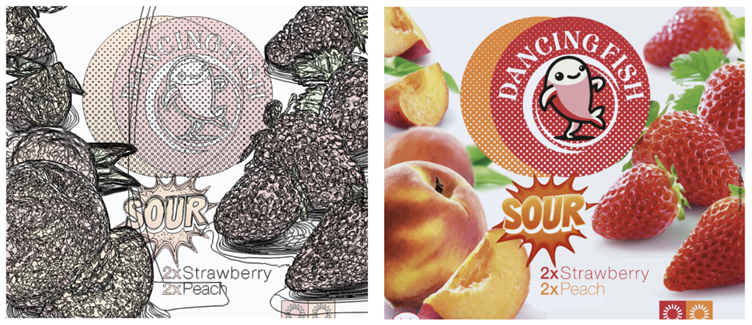
Esko ArtPro+ Smart Select nicely illustrates how AI assists prepress operators turning thousands of vectors into logical objects that operators can easily select and safely edit

AI in Esko ArtPro+ makes object replacement (e.g. a logo update) intent aware, – to use approved assets only – and reversible
Quality Control at a Scale Humans Can’t Match
AI dramatically increases both accuracy and capacity in quality control. Unlike humans, AI doesn’t get tired. It doesn’t lose focus on the 37th SKU variant. It doesn’t miss the same error twice. That doesn’t mean the prepress and quality control teams step away from quality. It means they stop spending their days looking for problems and start focusing on solving the ones that matter.