
Written by Jan De Roeck
Marketing Director, Esko
Walking the halls of interpack in Düsseldorf is always a useful reminder of how broad the packaging industry really is. This year’s event brought together an impressive cross-section of processing and packaging technology: machinery, materials, coding, inspection, robotics, automation, artificial intelligence, software, and all the supporting expertise that turns packaging from an idea into a product on shelf.
The scale alone tells part of the story. interpack 2026 attracted almost 171,000 visitors from 169 countries and featured 2,866 exhibitors from 55 countries. More importantly, the show attracted maybe fewer visitors compared to previous editions, but 63% of the crowds in the aisles identified themselves as decision-makers. ¹
That matters because packaging is nowadays considered a strategic business topic in the boardroom. Design and print quality are important, but procurement will look at unit cost, whilst production managers will look at speed and accuracy of the filling process. Packaging touches all the hot topics in business today: sustainability, compliance, brand consistency, operational efficiency and speed-to-market.
One observation stayed with me throughout the exhibition: the variety of filling and packaging technologies is enormous. Food, beverage, pharma, cosmetics, confectionery, bakery, non-food and industrial goods all come with their own expectations, constraints, and line realities. A carton, label, pouch, or sleeve may look like a finished product when it leaves the converter, but in reality, it is only a half-product. Its real test comes later, when it has to perform in a much larger system.
That system is the brand owner’s production environment.
On a high-speed filling line, packaging quality is measured in motion. It is measured when a flat carton is erected, when a label is dispensed, when a sleeve is applied, when a pouch is filled and sealed, and when thousands of units need to move through the line without disruption.
At that moment, quality extends far beyond print. Colors and designs may be perfect. The barcode may be readable. The branding may be consistent. But if the pack does not run on the filling line, it is not fit for purpose, and a lot of waste will be generated as a consequence.
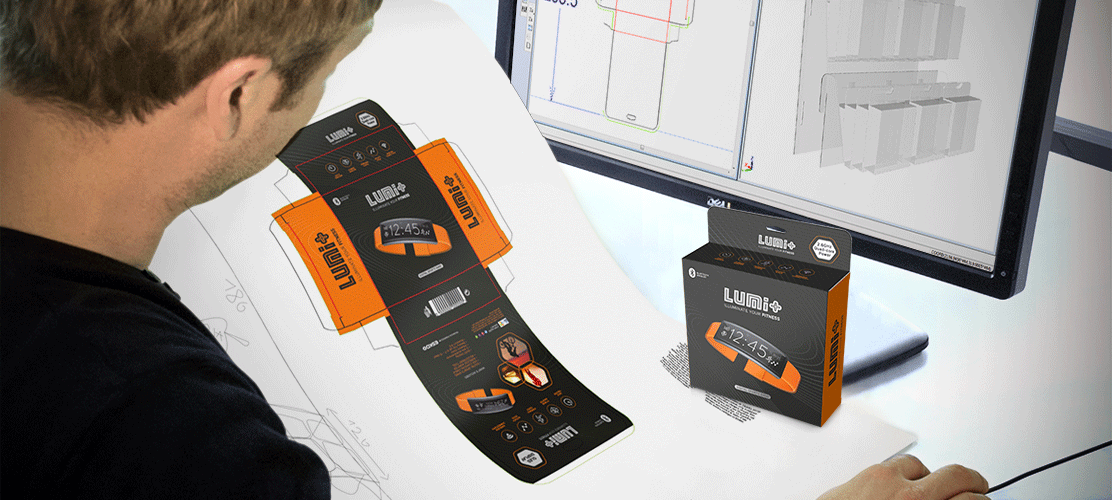
Consider folding carton packaging. The cut and crease lines must be positioned with precision, and the crease depth must be right for the board, the design, and the intended filling process. If the creases are too shallow, the carton may not erect cleanly at speed. If they are too deep, the fibres may break, creating weakness, cracking, or visual defects. The issue is not cosmetic. It becomes a line-performance issue. Every misfeed, jam, or rejected carton has a cost: lost time, wasted material, lower efficiency, and increased pressure on production teams.
The same applies to varnishes and coatings. A coating may have been chosen for visual impact, scuff resistance, barrier performance, or a tactile brand experience. Yet on the filling line, that same surface must also release properly. If sheets stick together during infeed, the line slows down or stops. The problem may not be visible in a PDF, proof, or even a finished printed sheet. It becomes visible when the packaging is expected to separate, move, fold, seal, and perform at industrial speed.
This is why quality in packaging needs a broader definition.
Print quality remains essential, of course. Brand owners care deeply about brand identity and shelf impact. But packaging quality also includes dimensional accuracy, substrate behavior, structural integrity, machinability, regulatory correctness and recyclability.
Packaging Europe’s interpack coverage captured this broader industry conversation well: brand owners and suppliers are now discussing packaging systems that must deliver recyclability, product protection, operational efficiency and commercial viability together. ²
That is a very important shift. Packaging cannot be optimized in isolated steps. A beautiful design that creates production complexity is not a good outcome. A sustainable material that fails on the line is not a scalable solution. A technically correct artwork that reaches production too late still damages the business case. And a pack that performs well in print production but fails during filling has simply moved the quality problem downstream.
interpack 2026 also showed why this discussion is becoming more urgent. The show’s hot topics included smart manufacturing, innovative materials and future skills, with a strong focus on automation, resource efficiency, regulation, circularity, and AI. ³
Packaging Europe’s reflections similarly pointed to AI and automation as dominant themes, especially in machinery, inspection and operational control. ⁴ As lines become smarter, faster, and more automated, tolerance for packaging variability decreases. The line expects packaging to arrive right-first-time, with every specification understood, controlled, and communicated.
For brand owners, this means packaging quality must be defined from the application backwards:
- What does the pack need to do on the line?
- What stressors will it face?
- Which surfaces will it touch?
- How will it be erected, filled, sealed, labelled, coded, inspected, packed, and transported?
- Which requirements are driven by regulation, machinery, materials, and/or brand experience?
For packaging suppliers, this creates an opportunity to elevate the conversation. The most valuable partners are the ones with deep domain expertise who understand the full journey from specification to shelf, and who can help translate brand ambition into packaging that performs across every step of that journey.
That is where the future of packaging quality lies. Quality starts with a detailed and accurate specification. Quality is a chain of connected decisions, data, and controls that must remain aligned from concept through production and into the brand owner’s filling environment.
The filling line is where packaging proves itself, at least before the consumer makes their final call. And the better we understand that reality, the better we can design, produce and manage packaging that performs beautifully, consistently, and at speed.
References
¹ https://www.interpack.com/en/Facts_and_Numbers
² https://packagingeurope.com/news/live-updates-from-interpack-2026/14167.article
³ https://www.interpack.com/en/Media_News/interpack_Magazin/Technology_Innovation/interpack_2026_Innovations,_specials_and_new_perspectives
⁴ https://packagingeurope.com/features/packaging-europes-reflections-on-interpack-2026/14282.article