
Written by Gouri Sasidharan
Gouri, a content specialist at Esko, loves adding a dash of creativity to everything she writes.
Not long ago, we were speaking with a packaging team at a popular mid-sized brand. The kind doing real volume, managing multiple SKUs, and keeping up with retail demands, and we asked them how they handle label reviews.
The answer made us stop for a second.
“WhatsApp”. That was it.
Not a dedicated proofing platform nor a structured approval system. But a group chat, where someone takes a screenshot of a dieline, the creative director drops a thumbs up, and that’s the approval. That’s the so-called paper trail where everything gets filed (or doesn’t) when the print run comes back wrong, and everyone’s trying to figure out who signed off on what.
We weren’t there to judge, and we didn’t. Because the more we talked, what struck us was that it’s not just the complicated process but also what sat underneath it: a small group of people quietly absorbing an enormous amount of pressure, with very little visibility into how close they were to the edge.
Mid-Sized Brands Have a Specific Problem
Enterprise brands have entire departments, agencies, procurement teams, and systems for managing systems, while small brands have a handful of teams who move fast and keep things simple.
However, mid-sized brands sit in an uncomfortable middle. They have the complexity of a large company, such as multiple SKUs, retail partners with strict requirements, regulatory compliance, and seasonal launches, but often not the headcount or infrastructure to match.
What that creates is a small packaging team carrying a disproportionately large load. And they’re usually doing it with a mix of disconnected tools: email chains, shared drives, spreadsheets held together by institutional memory, and a review process that lives in someone’s inbox.
It’s a lot to carry. And most of the time, nobody’s counting the weight.
What Burnout Actually Looks Like in Packaging Teams
It rarely announces itself.
It looks like a packaging coordinator on her sixth cup of coffee by 2 pm, still working through a revision list that arrived at 4:58 pm the day before.
It looks like a packaging manager alone at his desk at 3 am, sending voice notes to himself so he doesn’t forget what needs fixing by morning, because the legal team sent a new claim, the printer needs the file by 6 am, and there’s nobody else to sort it out.
It looks like someone is eating lunch at their desk again because a supplier just flagged a color-matching issue, and the day was already full before that landed.
These moments don’t feel dramatic in isolation. They feel like just doing what it takes. But they add up. And the person absorbing them is burning something that a long weekend and a “you really saved us on that one” on Monday morning can’t fully recharge.
Burnout in a packaging team often looks like this:
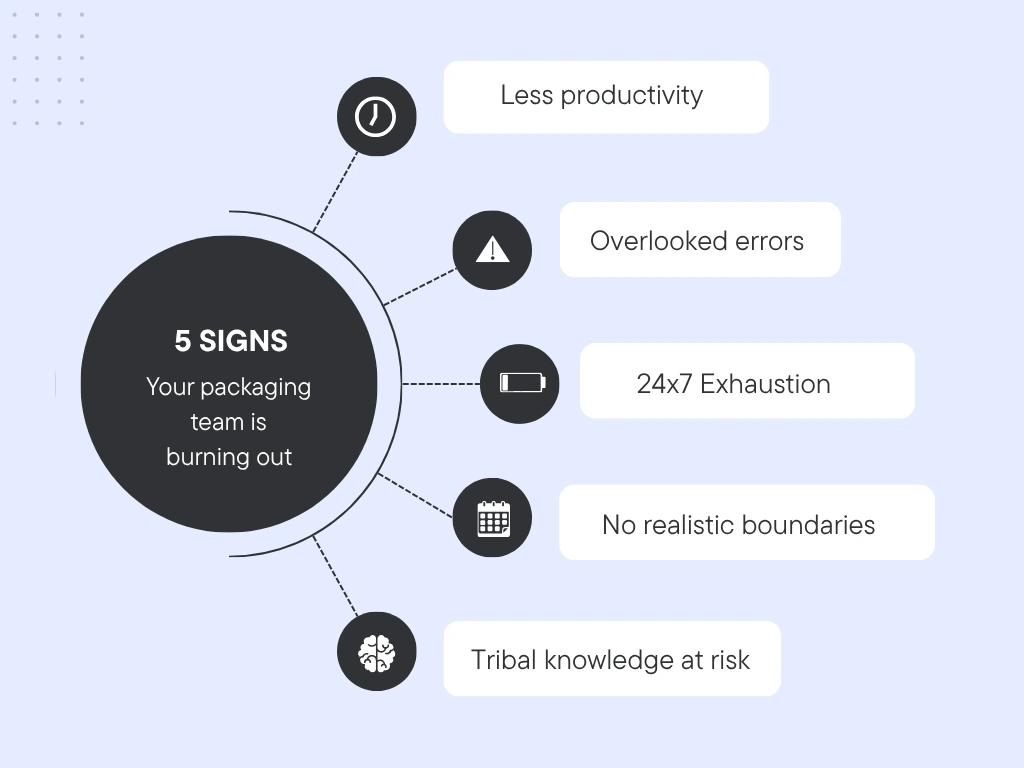
- Productivity drops: Tasks that used to take an hour take three. Not because the person has gotten worse at their job but because they’re running on empty. The focus isn’t there. The decisions feel harder than they should. And somewhere in the background, the to-do list keeps growing.
- 24×7 exhaustion: Your performer of the quarter is not just end-of-week tired but bone-tired on a Tuesday morning. The one where someone sits down at their desk and has to actively force themselves to start. Packaging work is high intensity by nature with tight deadlines, high stakes, and lots of moving parts and when there’s no real break from that intensity, the body and mind start rationing energy.
- Errors slip: The artwork that’s been approved a dozen times goes to print with last year’s net weight. Not because anyone is careless, but because careful people stop catching things when their attention is spread too thin (and when you’re running on five hours of sleep and a cold brew, your attention is always spread too thin.)
- High dependence on key individuals: In many mid-sized brands, one or two people hold everything in their heads, such as the supplier contacts, color profiles, and unwritten rules about how the VP likes to see proofs. When those people burn out and take leave, most of the knowledge stays with them, and progress slows. And no one fully realizes how much was stored there until it’s gone.
Packaging is nobody’s responsibility. It sits between departments, so everyone assumes someone else is handling it. That’s how errors fall through the cracks.
- Nobody pushes back on anything: A burnt-out team stops saying “that’s too much” or “we need more time.” Pushing back takes energy they don’t have. So, the 7 pm ask on a Thursday gets a quiet yes, and the work pile just grows without anyone officially agreeing that it should.
Why It Keeps Happening in Mid-Sized Brands
At this point, you might be wondering why you should take our word for any of this. Fair question.
We’ve spent the last several years working closely with mid-sized brands across industries on their packaging operations. And across those conversations with packaging managers, creative leads, operations heads, and brand teams, burnout in packaging is one of the most common things we hear about. Not always by name. Sometimes it comes up as “our team is just stretched” or “we’ve had a lot of turnovers lately.” But it’s the same thing, showing up in disguise.
- The team is under-resourced for the ambition: Growth is exciting. Adding SKUs, entering new channels, expanding into new markets — all of them are good business. But the packaging workload that comes with it often isn’t met with proportional investment in teams or suitable tools.
- The process hasn’t grown with the business: What worked when you had six SKUs doesn’t work when you have sixty. But mid-sized brands often inherit the lean startup habits they built early and never step back to redesign the process for where they are now. So, the team runs the same informal systems at ten times the volume and wonders why everything feels impossible.
- Reviews are chaos: Multiple stakeholders, no single source of truth, and feedback arriving from six different directions in six different formats. What more can your team ask for?
The WhatsApp group that started as a quick workaround is now the approval system, except no one can find the message where the Director of Product said the blue was fine, and verbal feedback from a meeting that no one documented.
Now, before blindly buying a productivity app or workflow automation tool, one must always keep in mind that a new piece of software won’t fix a culture where people feel unseen or a process where expectations are perpetually unclear.
The foundation has to be solid first. Then the right tools can actually contribute and make use of their complete potential.
So let’s start with the foundation.
Taking Care of the Team First
1. Acknowledge It Before You Try to Fix It
Leaders don’t necessarily need to solve employee stress, but they do need to validate it. A team that feels heard is more resilient than one that feels managed. Something as simple as “I know this quarter has been a lot. What would actually help right now?” goes further than most teams expect. Ask genuinely and mean it.
2. Cut the Workload Before You Optimize It
There’s a tendency to respond to an overwhelmed team by trying to make them more efficient. But sometimes the answer isn’t a better process for the same impossible volume. Set realistic boundaries on what the team takes on and prioritize mindfully.
3. Encourage Work-life Balance
If the culture quietly rewards people who reply at midnight and penalizes those who don’t, things won’t land well with your packaging teams. Leaders set the tone here more than they realize. It’s time to normalize leaving on time, not sending non-urgent messages after hours, and not glorifying the 3 am hustle again.
4. Clarify Responsibilities and Job Roles
Role ambiguity is a slow burn. When people aren’t sure what decisions they’re allowed to make, or where their responsibility ends and someone else begins, they tend to either overreach (and exhaust themselves) or underreach (and wait to be told).
5. Give People Actual Autonomy
Micromanaged teams burn out faster. When someone is trusted to own their work, they’re more engaged and resilient. But it doesn’t mean you abandon them. Do periodic check-ins to see if they’re doing good.
6. Build Cross-collaboration Deliberately
Burnout often hits the hardest where people are siloed. When knowledge is shared across the team — where more than one person understands compliance, does quality checks on an artwork file, or knows the supplier’s preferences — the load distributes more evenly. Nobody becomes a single point of failure, and people actually feel like they’re on a team rather than running parallel solo operations.
7. Celebrate What Gets Done
Packaging teams spend a lot of time responding to what went wrong. Not enough time acknowledging what went right. A successful launch, a clean print run, a complex compliance challenge navigated well are all worth naming. The recognition can be genuine and consistent.
8. Review Both the Process and People
When things keep going wrong, the instinct is often to look at who dropped the ball. But more often, the issue is the process they were working inside. Regularly stepping back to ask “what’s creating unnecessary pressure here?” and actually acting on the responses removes friction before it becomes a people problem.
The Quiet Investment That Pays Back Loudly
The brands that manage to scale packaging without burning out their teams usually have one thing in common: they invested in the team and process before they needed to.
They didn’t wait until a launch went sideways. They didn’t wait for a resignation letter. They didn’t wait until someone’s sixth coffee of the day to wonder if the workload was sustainable.
They built a healthy work environment, system, clarity, and tools, while the team still had the capacity to do it properly.
For mid-sized brands, this is the move. Because the cost of burnout in delayed launches, lost institutional knowledge, and the very real expense of replacing a senior packaging person is almost always higher than the investment in preventing it.
However, when the process is healthy, but friction still exists, that’s where you consider adopting a tool to improve your packaging compliance workflows.
And if you’re not sure where to start, a demo of WebCenter Go is a pretty good first step.