Written by Geert de Proost
Director, Software Product Offering – Converters, Esko
I’ve always been fascinated by chess players.
Not because of how fast they play, but because of how they think. In a matter of seconds, they evaluate countless options, weigh tradeoffs, anticipate consequences, and choose a move that keeps them several steps ahead down the line.
Lately, I’ve been thinking about how production planners are being asked to do something very similar. They’ve become chess players, if you will. But the difference is that their board continually changes while they play.
The Quiet Explosion of Complexity
When I talk to planners today, one thing becomes clear very quickly: the job has fundamentally changed.
Shorter run lengths, more variants, and faster delivery expectations. Plus, constant cost pressure and sustainability targets. Add that to the internal pressure to maximize press uptime and keep operations profitable, and it’s no surprise that planning has become one of the most critical roles in a converting business.
What worries me is not just that planning is harder. It’s how fast complexity is growing.
Digital presses and advanced finishing technologies bring incredible flexibility. But they also bring new constraints. Mergers and acquisitions multiply the number of production options across sites.
And customer demand keeps fragmenting into smaller jobs with constantly shifting volumes.
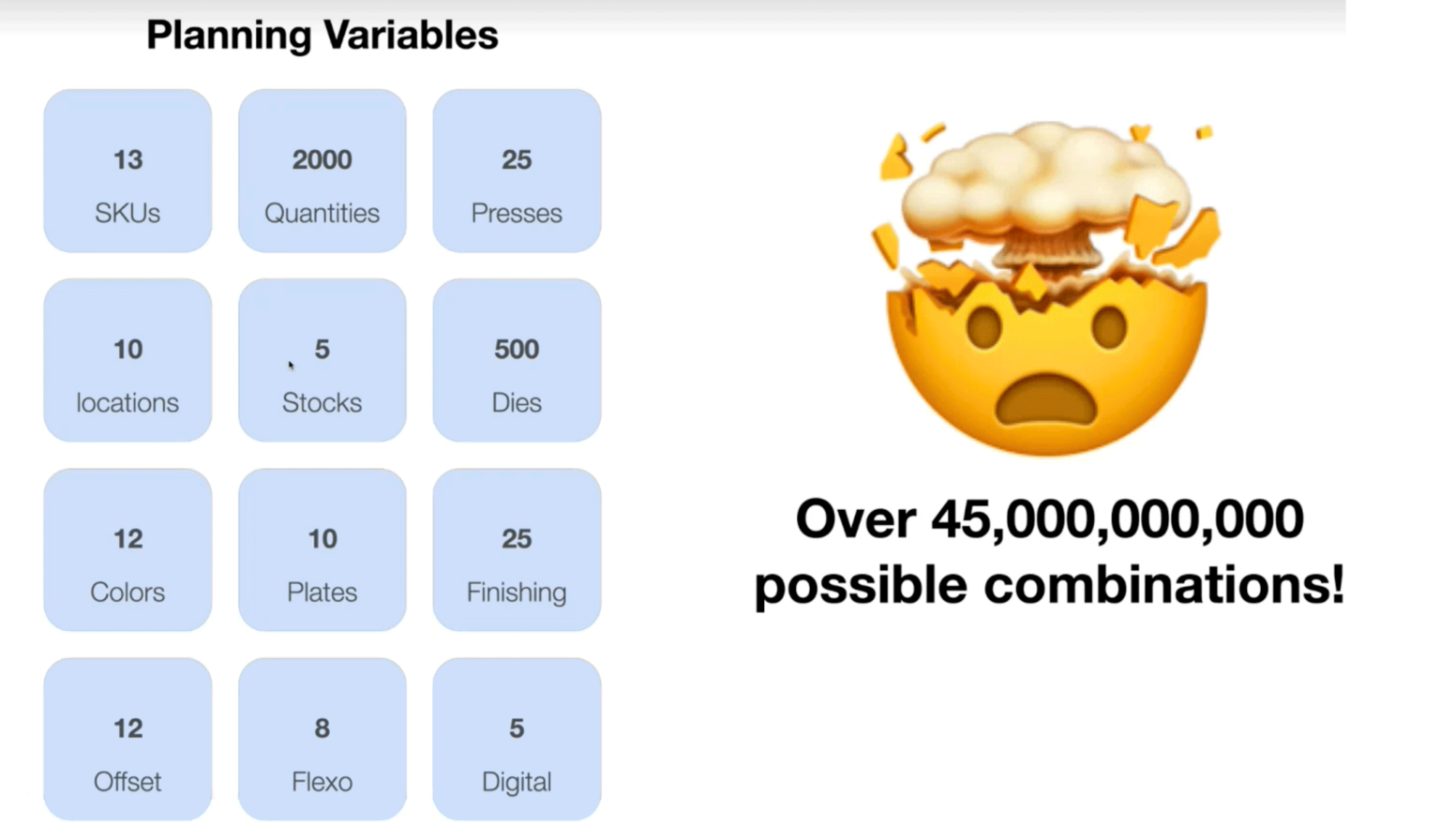
The number of possible planning options doesn’t grow linearly anymore. It explodes.
Tribal Knowledge is Not a Strategy
Traditionally, we’ve relied on experience to absorb this complexity.
Great planners are often veterans. They carry decades of hard-earned knowledge in their heads, including what works, what doesn’t, and where the traps lie. That knowledge is invaluable. But it’s also fragile.
Planning isn’t something you learn at university. And when experienced planners retire, replacing them is far from straightforward. At the same time, the job they’re being replaced with is already more complex than it was ten years ago.
Relying solely on tribal knowledge in this environment isn’t a strategy. It’s a risk.
When Planning Meets Estimation, Everything Slows Down
There’s another dynamic I see play out repeatedly, especially in midmarket operations. Planners don’t just plan. They estimate. They support presales. They get pulled into “quick questions” from customer service. And every one of those interruptions feels justified because fast responses win business.
But over time, this model breaks down.
The planner’s day becomes fragmented, focus is lost, and core planning quality suffers. And The business quietly accumulates risk. Not just operational risk, but continuity risk.
We’re asking the same people to go faster, think deeper, respond quicker, and somehow make fewer mistakes all at once.
This does not scale any longer.
Some Problems are No Longer Human Problems
This is where I believe we need a mindset shift.
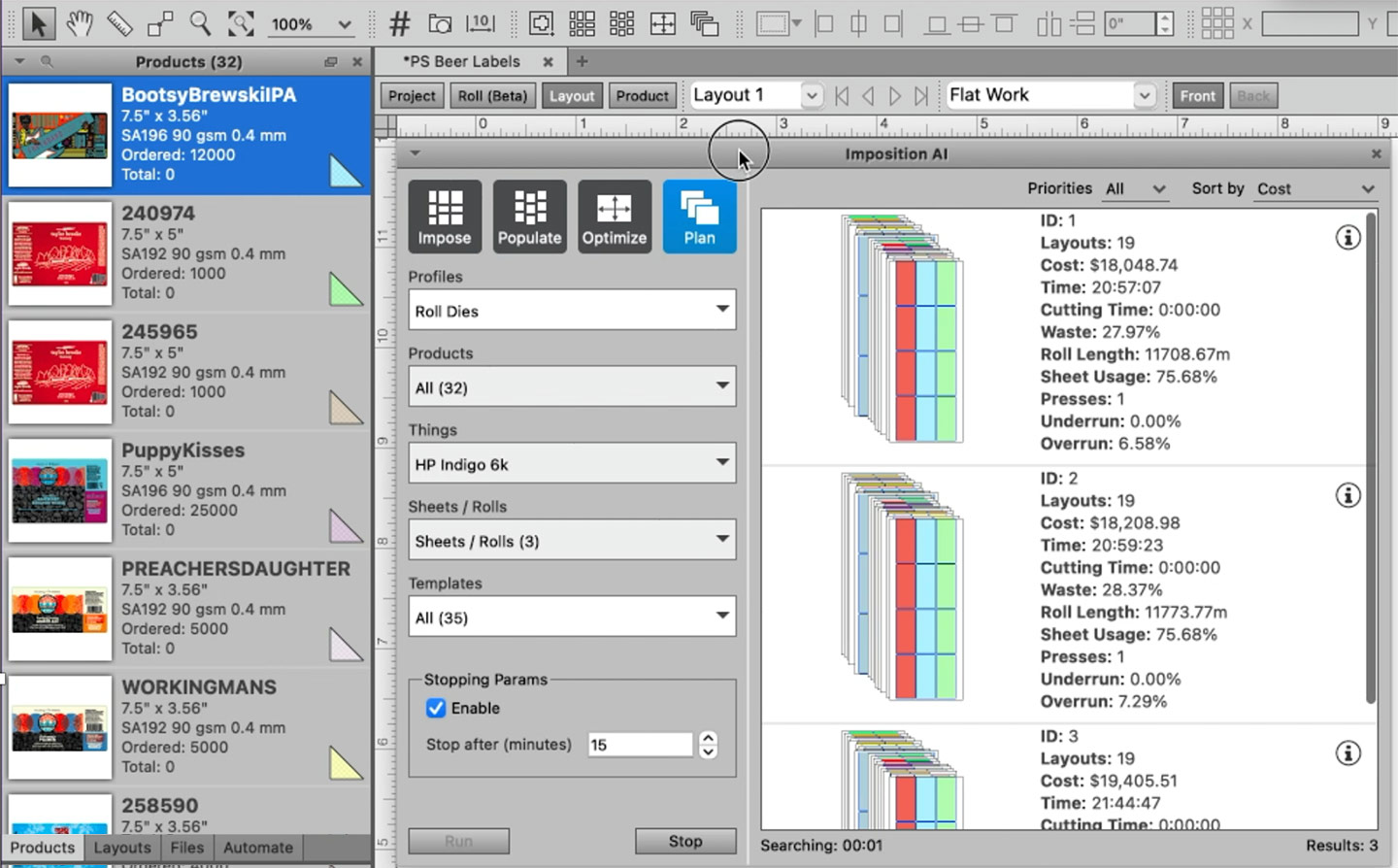
Planning, at its core, is an optimization problem. You’re trying to find the best way to produce one or more orders across multiple SKUs, machines, tools, sites, and constraints — while balancing cost, delivery speed, and sustainability.
Expecting a human being — even a very experienced one — to consistently find the optimal solution in that space is unrealistic. As a result, significant production opportunities are often lost because evaluating different possibilities is too complex, time-consuming, or cumbersome.
That doesn’t diminish the planner’s role. Rather, it’s quite the opposite.
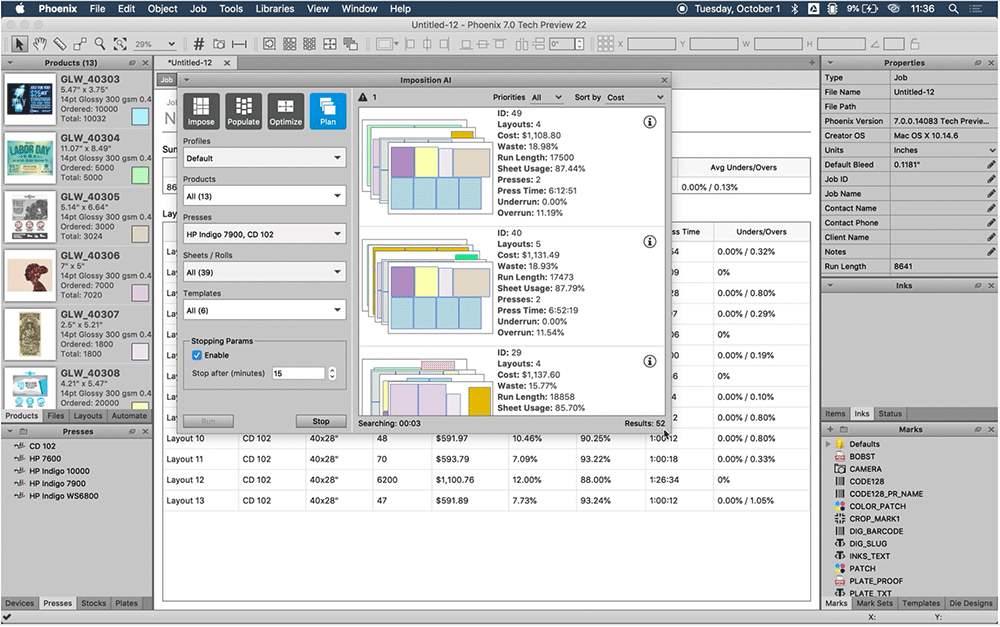
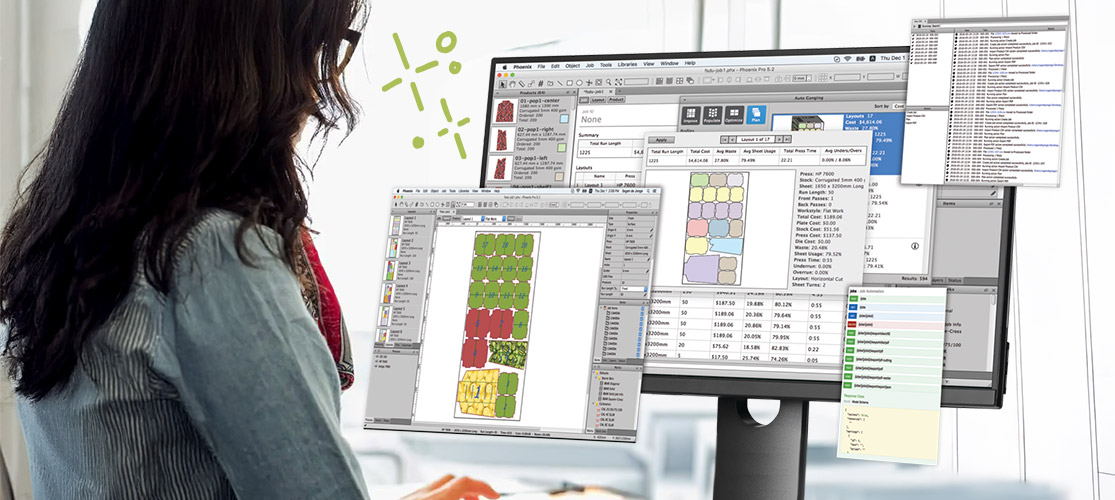
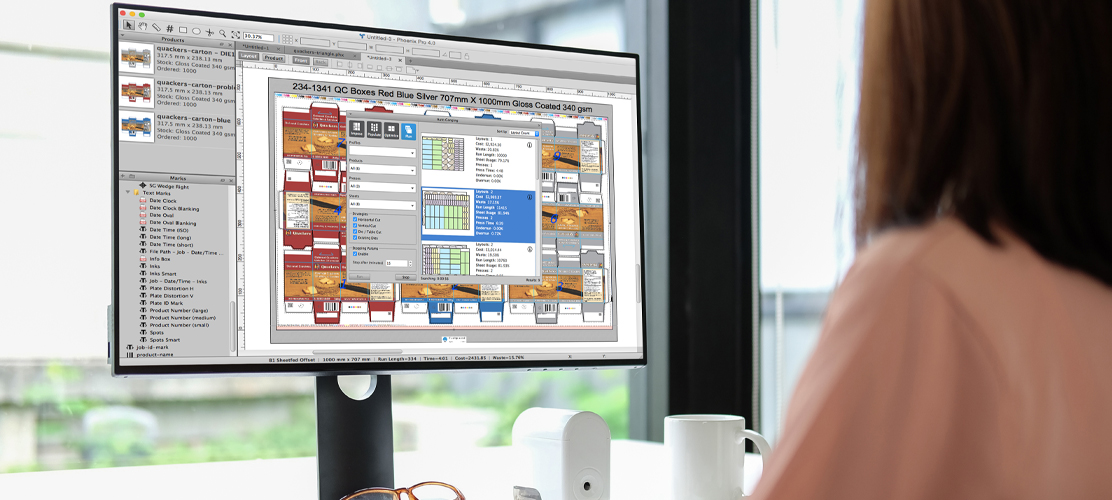
It means we should stop asking planners to do the impossible and instead support them with systems that can explore a plethora of options quickly and objectively. Let AI do what it is good at: evaluating thousands or millions of alternatives. And let planners do what they’re good at: judgment, context, and experience-based decision making.
By introducing the right technology—configured collaboratively with key team members to reflect real-world logic and best practices—organizations can establish not only an optimized method of manufacturing, but also a consistent result, regardless of who creates the plan.
Democratizing Planning Without Dumbing It Down
The same principle applies beyond the planning desk.
If we want faster customer responses, we shouldn’t achieve that by interrupting planners more often. We should achieve it by making the right parts of planning intelligence accessible to nonexpert roles — in a controlled, integrated way.
Customer service shouldn’t need to understand every production constraint to respond to a quote request. They should be able to rely on systems that connect planning logic, cost implications, and MIS data seamlessly to provide faster responses and top-quality service to their customers.
That’s not about simplifying the business. It’s about exposing complexity responsibly.
Why Multisite Planning Changes Everything
Once you look across multiple production sites, the stakes rise even further.
Choosing the best site, press, and finishing path can have a dramatic impact on cost, service level, and throughput. But this kind of decision making is simply beyond what traditional, application-centric software — or human intuition alone — can handle.
Multisite planning isn’t an extension of single site planning. It’s a different problem altogether.
Why The Platform Approach Matters
All of this leads to the conclusion that these challenges cannot be solved by adding yet another standalone tool. They require a different foundation. A platform approach that connects processes, personas, and data and allows expertise to scale without being diluted.
It makes advanced capabilities available where they add value, without overwhelming users who don’t need them. And it creates full transparency across the process internally and externally. That is also the essence of Esko’s S2 platform.
Done right, this doesn’t replace planners. It protects them and preserves knowledge. It also gives businesses a way to grow without burning out the people who keep operations running.
A Responsibility to the Industry
Accelerating cycle times, reducing cost, and increasing throughput without adding headcount sounds ambitious. Maybe even unrealistic. But given the pressures converters are facing today, I don’t think we have the luxury of aiming lower.
As an industry, we owe it to planners — and to the people who depend on them — to acknowledge that the game has changed. And to build systems that are designed for the reality we’re in now, not the one we wish we still had.
Chess players don’t win by remembering old games. They win by seeing the board clearly as it is and choosing the next move accordingly.