Packaging Trends 2027 – Chapter 1

Introduction > Chapter 1
AI Moves from Assistant to Operator
For a long time, the relationship between people and software was fairly straightforward. You told the system what to do. Click here. Enter this information. Run this check. Send this file.
Even automation followed much of the same logic. Someone had to define the steps in advance, and the system followed them.
AI is beginning to change that relationship. Instead of simply waiting for instructions at every stage, newer AI systems are becoming capable of understanding an objective, working through a series of tasks, and using different tools to move the work forward.
Today, packaging teams are increasingly coming to AI with something more concrete. A customer wants to reduce the time it takes to create a brief. Another wants to automate artwork checks. Someone else is looking at how to get work from concept to print-ready files with fewer manual handoffs.
Instead of simply helping someone complete an individual task, AI is beginning to take responsibility for a sequence of tasks within a defined workflow.
The technology is still developing. Human oversight remains essential, particularly where packaging decisions carry regulatory, quality, environmental, or consumer-safety implications. But the direction is becoming clearer as AI is moving closer to the work itself.
David Crow, Director of Packaging Intelligence at Esko, describes this as a move toward solving problems that were previously difficult to automate.
“AI can act as the flexible glue.”
From Experimenting with AI to Solving Real Problems
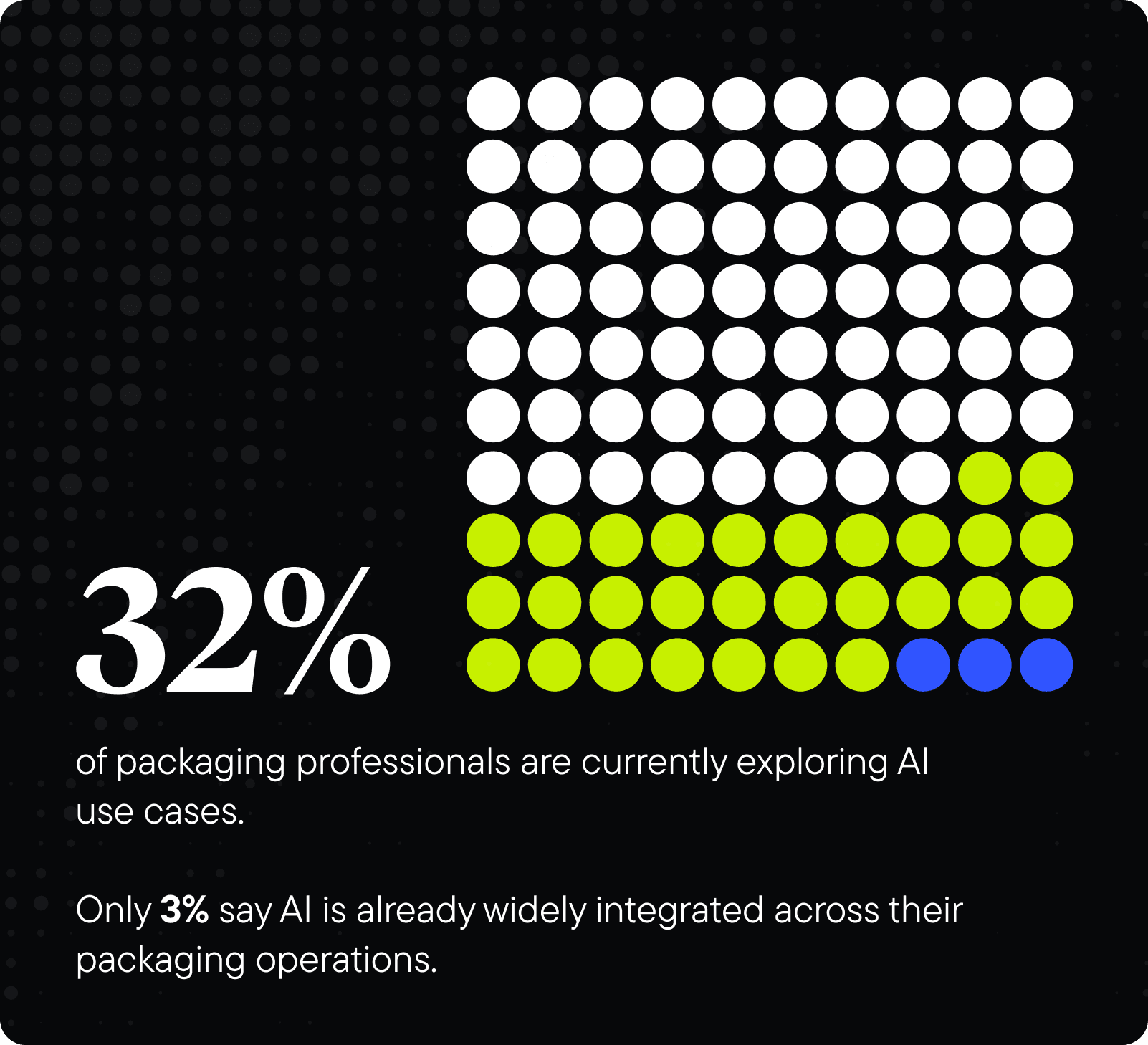
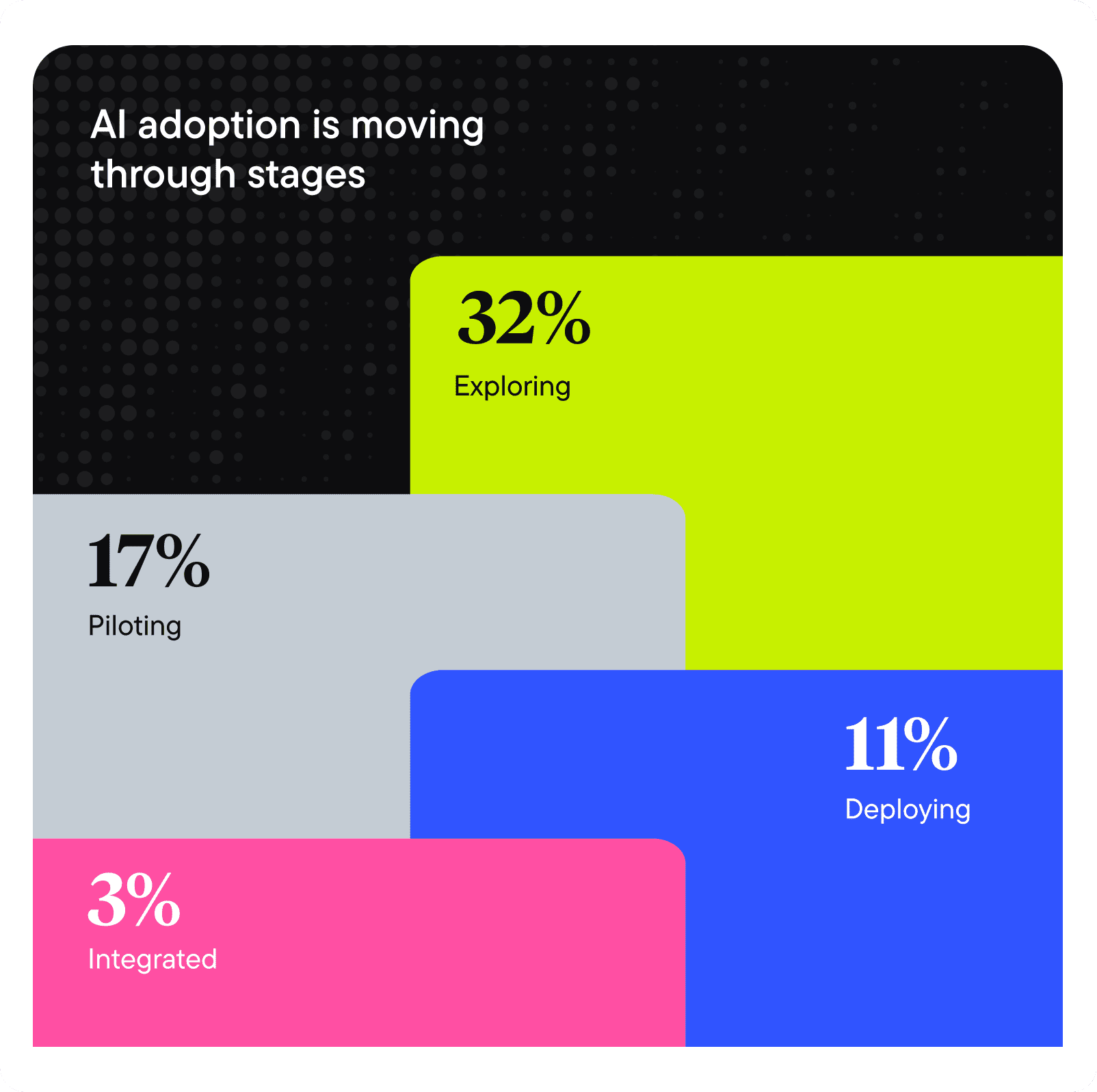
The packaging industry does not have an AI shortage. There are tools to test, demos to watch, and increasingly ambitious promises about what AI could transform next. That abundance is also how organizations end up experimenting with technology simply because the technology is there.
Crow has noticed a change in customer conversations over the past year. Earlier discussions were often broad: what is AI capable of, and what might come next? Increasingly, customers are bringing specific problems to the table.
This is an important sign of maturity.
Rather than asking where AI can be inserted into an existing process, organizations are beginning to ask which problems are worth solving with AI and how it can help solve them.
Srinivas Kuppa, Chief Product Officer at Esko, sees a similar shift. He says customers are increasingly looking at AI across the packaging workflow, from concept through artwork creation and into print readiness. The ambition is becoming broader than adding an AI feature to an existing application. It is about understanding where intelligence can change the process itself.
This distinction will become increasingly important in 2027.
Packaging organizations have traditionally automated tasks that are predictable and rules-based. Yet many of the activities that consume time sit between those clearly defined tasks. These are the spaces where conventional automation often struggles.
AI brings another possibility: using context and accumulated knowledge to help navigate work that has traditionally depended heavily on human expertise.
The Workflow is Ready for a Rethink
Consider what happens between a marketing concept and a finished piece of packaging artwork.
A brief needs to be created. Content needs to be interpreted and organized. Artwork needs to be produced. It then needs to be checked against brand, regulatory, and print requirements. Errors need to be corrected. Different versions may need to be prepared for markets, formats, or production requirements.
There are plenty of individual tasks in that chain that can be automated. The bigger opportunity is connecting them. Kuppa describes the packaging workflow in two broad stages: moving from concept to artwork-ready, and then from artwork-ready to print-ready. Both contain opportunities for AI, although they involve different kinds of work.
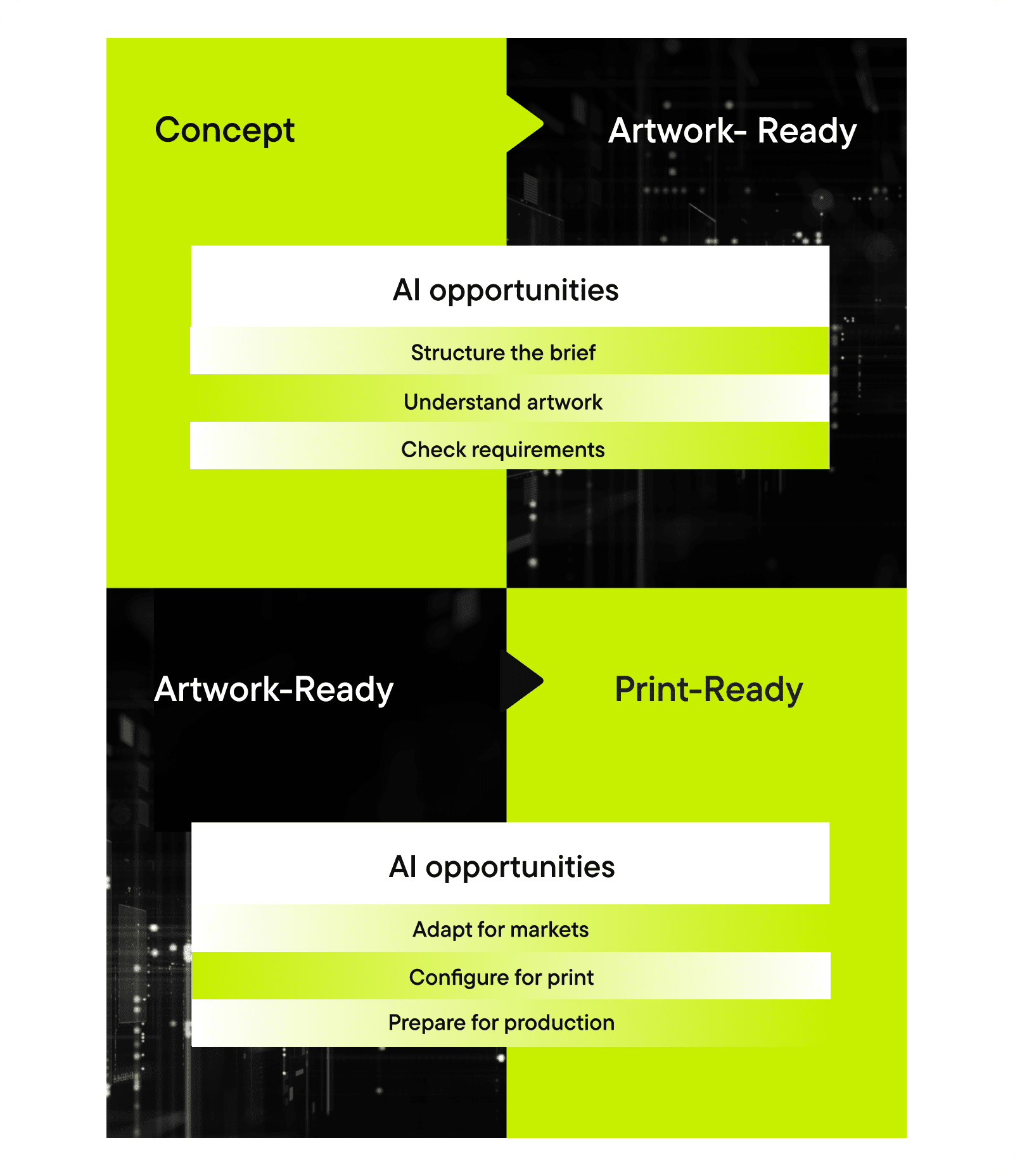

The first stage is already seeing rapid development. AI can help turn unstructured content into a structured brief, understand artwork content and layout, check compliance requirements, and assist with corrections. To this end, Esko has also been developing agentic capabilities that can work directly with packaging artwork, including understanding graphics, text, and imagery, and helping identify and correct issues.
The next stage involves preparing artwork for the realities of production: different packaging formats, geographies, print configurations, and production methods. This complexity creates another opportunity for more intelligent automation.
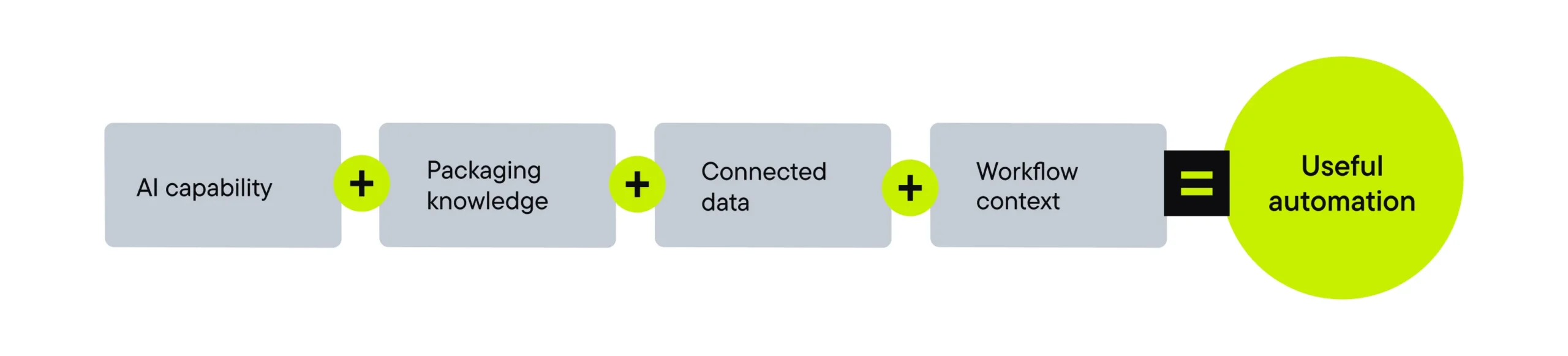
The important point is that these capabilities do not have to exist as one all-purpose AI system. AI services can perform specialized tasks within a larger workflow, while agents can coordinate these capabilities where appropriate.
This distinction may become increasingly relevant as the market matures. The agent itself may get the attention because it is the visible part of the experience. But the real value will come from the specialized packaging knowledge and tools working underneath it.
But specialized AI is only useful when it has the right knowledge to work with. Packaging workflows depend on specifications, artwork structures, regulatory requirements, brand standards, production constraints, and years of accumulated expertise.
This makes data quality and accessible business knowledge just as important as the AI itself. If critical knowledge lives in disconnected documents, inconsistent processes, or with individual employees, AI may expose those gaps rather than solve them.
Preparing for AI, then, may mean improving data quality, connecting systems, and making informal knowledge more accessible.
The Human Role is Changing
As AI takes on more work, the question naturally becomes: what continuing role will people have?
There is no single answer.
Some packaging tasks are relatively low-risk and highly repeatable. Others can affect regulatory compliance, product quality, environmental requirements, or consumer safety. The appropriate level of automation will depend on the consequences of an incorrect decision.
Kuppa describes a progression from traditional human-led workflows, through AI advisory systems, and human-in-the-loop approaches, toward greater levels of AI automation.
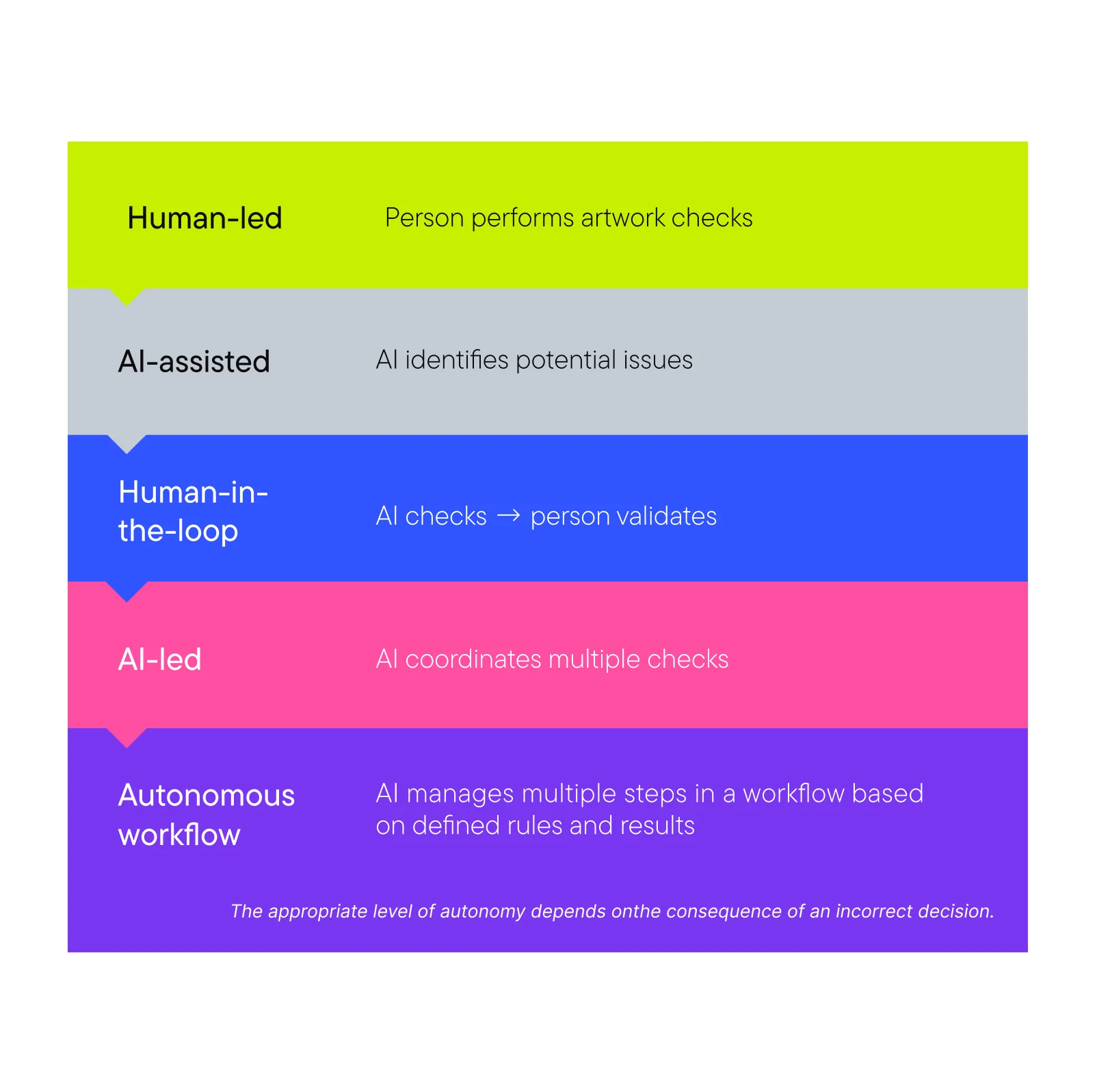
This spectrum may be more useful than thinking about automation as an on-or-off decision.
Crow makes a similar point from a different perspective. AI can improve productivity and change where people spend their time, but accountability for important decisions still needs to sit with people.
This means the role of the packaging professional could change. Instead of spending as much time carrying out repetitive checks or moving information among systems, people may spend more time defining objectives, setting the right parameters, reviewing outputs, and making decisions where experience and judgment matter most.
This shift is already visible in other knowledge-intensive fields. In Stack Overflow’s 2024 Developer Survey of more than 65,000 developers, 62% said they were already using AI tools in their development process, while 80% expected AI to become more integrated into testing over the following year. Software development, in other words, is moving toward a model where AI takes on more of the work, while people remain responsible for reviewing and validating the result. Packaging could follow a similar pattern, with expertise moving further upstream into the way workflows are designed and further downstream into validation and approval.

The next question is how far that model could go.
Crow points to the idea of a longer “task horizon”: AI moving beyond short, well-defined activities and managing sequences of work over a longer period. Today, a system might extract information from a document and turn it into a structured brief. A more advanced system could potentially interpret that brief, check artwork, identify errors, suggest corrections, respond to changes, and know when the work is complete.
As AI models become more capable of managing sequences of activities, the range of workflows they can participate in could expand.
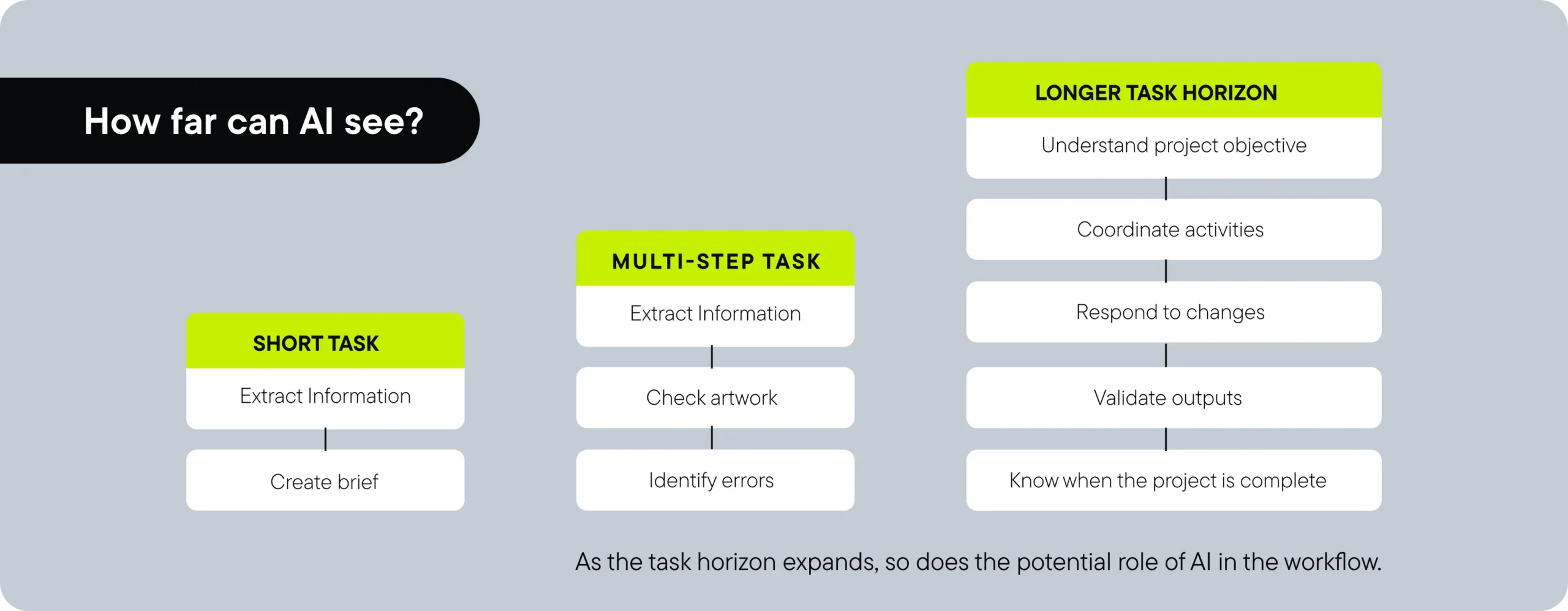
This is still a forward-looking possibility, rather than an approach that makes sense for every packaging process today. But it could change how organizations think about process design.

Adoption Needs a Practical Starting Point
For all the excitement around agentic AI, the path from demonstration to a deployable, dependable production system is not automatic.
A compelling prototype can be built quickly. A system that works reliably inside a real packaging operation is a different challenge. This is where governance, security, integration, and measurement become important.
Crow suggests starting with a small, lower-risk part of the business, using a pilot to learn what works and quantifying the results before expanding. This approach allows organizations to build governance and confidence alongside the technology rather than waiting for every question to be answered before starting.
It also provides something increasingly important in AI discussions: evidence.
If an AI application reduces the time required to create a brief, improves the consistency of artwork checks, or reduces rework, those benefits can be measured. If it does not deliver meaningful value, the organization has learned something before making a much larger commitment.
The same principle applies to security.
AI systems can interact with sensitive business information, so organizations need to understand what data a system accesses, how that information is processed, and whether it is retained. The level of scrutiny should reflect the risk associated with the application.
For example, a system that classifies an element in a technical drawing presents a different risk profile from one making a decision that could affect regulatory compliance or product safety.
This makes a risk-based approach increasingly important as AI becomes embedded in more packaging workflows.

The Bigger Opportunity is Beyond the Workflow
Perhaps the most interesting possibility is what happens when AI connects workflows that have traditionally been treated separately.
Kuppa challenges packaging organizations to think beyond improving one process at a time. Consumer insights could inform demand planning. Demand signals could influence manufacturing decisions. Packaging development could respond more directly to market feedback. Digital channels could help brands understand demand before committing to production volumes.
This is a much broader vision of AI than simply making today’s tasks faster.
It also points toward a packaging lifecycle where information can move more continuously between the market, product development, packaging, production, and distribution.
AI Will Need to Earn its Place
There is still plenty of uncertainty about where AI will go next. Models are improving quickly, and the capabilities available in another year may look very different from those available today.
This makes precise predictions difficult. It also makes it tempting to focus on the newest tool or the most ambitious claim.
For packaging organizations, a more useful question may be much simpler: Which problems are worth solving?
Crow’s advice is to identify and rank problems before getting caught up in the technology. If a process involves significant manual effort, repeated rework, or heavy dependence on specialized knowledge, it may be worth investigating whether AI can change the equation.
This mindset reflects one of the most important shifts in packaging AI adoption.
AI is becoming more capable of participating in the work, but its value will still depend on the problem it is solving, the knowledge it can access, and the people responsible for the outcome.
For packaging leaders looking toward 2027, the opportunity is to start connecting these pieces now, and perhaps ask a slightly uncomfortable question: If we were designing this process today, knowing what AI may become capable of, would we build it the same way?

 Tap to read





Want to keep a copy?
Download the complete 2027 Packaging Trends report to save, share, or read offline.