
Table of Contents
- What Are EU MDR and IVDR, and Why Do They Matter?
- The New Labeling and Artwork Requirements
- Instructions for Use (IFU): What Must Be Included, and in What Format
- What Should You Do to Stay Compliant?
- How WebCenter Go Can Help
- Wrapping Up
The Medical Device Directives (MDD), implemented in 1992, don’t work well with how the present medical device industry is progressing.
Newer solutions such as devices, test kits, and mobile applications have called for a major regulatory update. The European Union responded with the Medical Devices Regulation (MDR) and In Vitro Diagnostic Regulation (IVDR), making monitoring of production and distribution more standardized and transparent.
If you are reading this in 2026, the question is no longer whether MDR and IVDR apply to you. It is how far along your implementation is. Four EUDAMED modules became mandatory on 28 May 2026, IVDR transition deadlines are now class-specific and actively running, and label data governance is more tightly connected to device registration than most teams anticipated.
This article covers what the regulations require, what has changed recently, and what you need to do to stay compliant.
What Are EU MDR and IVDR, and Why Do They Matter?
The EU’s medical devices industry saw its most significant regulatory change in roughly 20 years with the introduction of MDR and IVDR. Both regulations replace the older Medical Device Directives, which did not account for recent developments in the field.
EU Medical Devices Regulation (MDR)
The MDR governs the production and distribution of medical devices across the European Union. All 27 member countries must follow these regulations to sell products in the European Economic Area.
The new MDR focuses on a life-cycle approach to device regulation rather than a pre-launch approval stage. The aim is to make manufacturers more responsible for their products throughout their entire life cycle.
In Vitro Diagnostic Regulation (IVDR)
The IVDR regulates in-vitro medical devices such as SARS-CoV-2 tests, HIV tests, and similar products. Given the volume of clinical decisions made on the basis of these results, stronger oversight was essential.
IVDR transition timelines are staggered by device class under Regulation (EU) 2024/1860:
- Class C IVDs: Conformity-assessment application deadline of 26 May 2026; written-agreement deadline with a notified body of 26 September 2026.
- Full transition runs through 31 December 2027, 2028, or 2029, depending on class.
If you manufacture Class C IVDs, those dates are not future planning items. They are current compliance obligations.
Why These Regulations Matter
- Software as a medical service: The MDD predates health-monitoring apps and connected devices. MDR and IVDR set clear standards for these newer product types.
- Transparency: The MDD did not require manufacturers to make technical information publicly accessible. The new regulations change that.
- Standardization: MDR and IVDR harmonize requirements for medical and in-vitro devices across Europe, making compliance expectations clearer and more consistent.
- Safety of high-risk devices: The MDR sets specific requirements for high-risk devices to ensure safety, improve performance, and bring consistency to results.
- Better governance: The regulations establish proper coordination and governance structures, enabling the EU to administer scientific and technical systems more effectively.
The New Labeling and Artwork Requirements
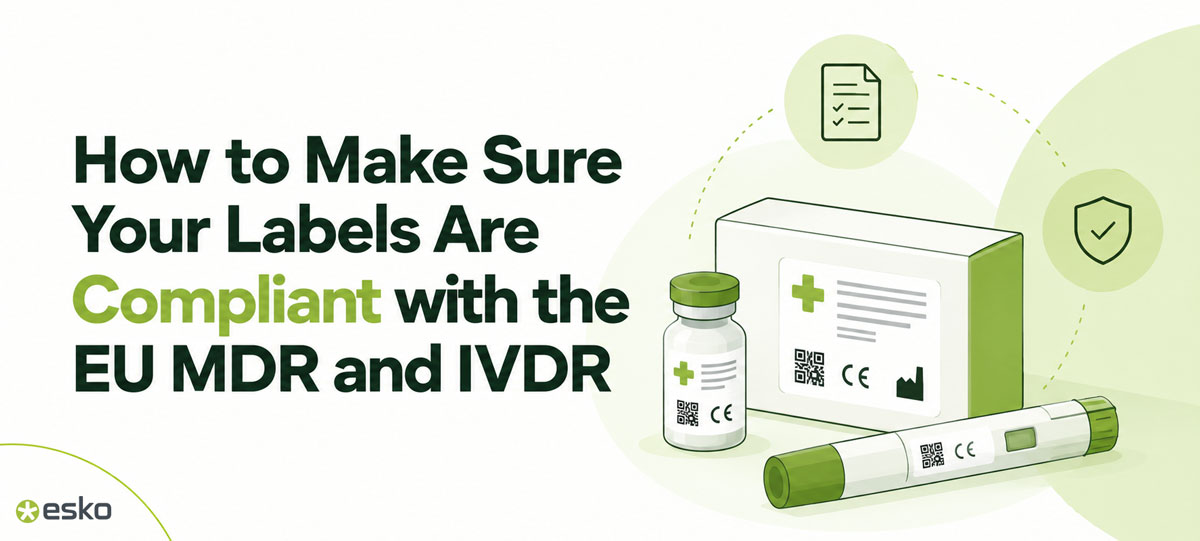
MDR and IVDR introduced significant changes to labeling and artwork requirements for medical device manufacturers.
Every label must now include:
- UDI (Unique Device Identification) for identification in the supply chain.
- Product name and serial number.
- Package content and purpose of the device.
- Manufacturer details (non-EU manufacturers must identify their authorized representative).
- Storage and handling instructions.
- Time limit for safe device usage and date of manufacture.
- Indication if a product is single-use.
- Precautions and warnings for the user.
UDI: More Than a Barcode on the Box
The UDI requirement goes further than placing a barcode on outer packaging.
The UDI carrier (whether a linear barcode, 2D DataMatrix, or RFID tag) must appear on the label of the device itself and, where applicable, on higher-level packaging. For reusable devices intended to be reprocessed, the UDI must also be applied directly to the device as a permanent mark. That mark must remain legible throughout the device’s intended lifetime and survive the reprocessing cycles it is designed for.
Durability and readability are not optional extras. They are part of the compliance requirement.
Packaging specifications have to work in the next step of the process, not just look correct on screen. Even details as basic as label orientation or core diameter can determine whether production runs smoothly or stops on the filling line.
Your artwork team needs to plan for this at the design stage. Where the UDI carrier goes, what format it takes, and how it survives sterilization or cleaning are decisions that affect label layout, material choice, and print specification. Getting those details wrong means a non-compliant label, not just a cosmetic issue.
Authorised Representative Symbol: The "EU REP" Transition
MDCG guidance published in 2026 addresses the transition from the “EC REP” symbol to “EU REP” under the amended EN ISO 15223-1 standard. Both symbols remain acceptable during a long transition period, with exclusive compliance via the amended standard required only from 17 June 2031.
For your artwork team, this means checking your symbol libraries and label templates now. If your templates still carry “EC REP,” they are not yet non-compliant, but updating them proactively avoids a last-minute scramble as the deadline approaches.
EUDAMED Registration and Label Data Alignment
UDI is not only a label element. It is also the key identifier in EUDAMED, the European database for medical devices.
As of 28 May 2026, four EUDAMED modules are mandatory: Actor Registration, UDI/Devices Registration, Notified Bodies and Certificates, and Market Surveillance. That means the device data you register in EUDAMED must be consistent with what appears on your label. If your label shows a different UDI, device name, or manufacturer detail than your EUDAMED registration record, you have a compliance gap, and it will be visible to regulators.
This connects label governance directly to your registration workflow. A label change that affects UDI or device identity data is not just a design update. It triggers a EUDAMED update too. Teams that manage these two processes in separate silos are carrying real risk.
Instructions for Use (IFU): What Must Be Included, and in What Format
UDI is not only a label element. It is also the key identifier in EUDAMED, the European database for medical devices.
As of 28 May 2026, four EUDAMED modules are mandatory: Actor Registration, UDI/Devices Registration, Notified Bodies and Certificates, and Market Surveillance. That means the device data you register in EUDAMED must be consistent with what appears on your label. If your label shows a different UDI, device name, or manufacturer detail than your EUDAMED registration record, you have a compliance gap, and it will be visible to regulators.
This connects label governance directly to your registration workflow. A label change that affects UDI or device identity data is not just a design update. It triggers a EUDAMED update too. Teams that manage these two processes in separate silos are carrying real risk.
Electronic IFUs: What Changed in 2025
Commission Implementing Regulation (EU) 2025/1234, published in June 2025, expanded the conditions under which IFUs may be provided electronically for MDR devices intended for professional users.
If your device is used exclusively in a professional healthcare setting and lay use is not reasonably foreseeable, you may now have a broader pathway to electronic-only IFU delivery. Where lay use is reasonably foreseeable, paper IFUs remain required.
This is a meaningful change for packaging and artwork teams managing IFU formats across a product portfolio. If you are maintaining separate print-ready and digital IFU versions, it is worth reviewing which products now qualify for electronic-only delivery and updating your automated artwork workflow accordingly. For a closer look at how life sciences teams are managing this shift, see how automation is reshaping leaflet management in life sciences.
Language Requirements: Every Member State Has Its Own Rules
IFU content is only part of the challenge. Every EU Member State can specify which languages must appear on labels and accompanying information sold in their territory.
A device sold across 10 Member States may require 10 different language versions of the label and IFU, and the requirements are not uniform. The European Commission publishes reference tables covering language requirements by country, including notes on GUI and app-language expectations for software-based devices. If your team is not tracking these tables as part of the artwork workflow, you are likely missing requirements for at least some markets.
Localization is not a translation task that sits outside the compliance process. It is a compliance task that requires the same structured content management, version control, approval routing, and audit trail as any other label change. Managing it in a spreadsheet or by email creates gaps that are hard to close when a regulator asks for evidence.
For us, the traceability of changes is very important. That is why we appreciate the WebCenter workflow solution.
What Should You Do to Stay Compliant?

Compliance with MDR and IVDR requires structured changes to both your quality-checking process and your label proofing methods.
Here is how to prepare:
- Start with a gap analysis. Analyze where your existing procedures stand against the new regulations. Studying that gap helps you fill it strategically with a robust plan.
- Prepare a compliance checklist. List the regulations applicable to your product labels and identify what changes are needed in each category. This gives you a clear plan for incorporating new requirements into your existing labels and IFUs.
- Systematize the approval process. Labeling changes require input from design, legal, and medical teams. Set up a step-by-step approval process, divide responsibilities clearly, and create accountability at each stage. WebCenter Go gives reviewers a browser-based interface to view, annotate, and approve artwork without needing software installed, keeping comments in one place and giving you a clear, auditable record of who approved what and when. For teams that need to go further, Verify Comply adds AI-powered artwork compliance checks directly inside WebCenter Go, automatically verifying copy, barcodes, and required symbols against defined rulebooks before files go to press.
- Build localization into the workflow from the start. Do not treat language versions as a downstream task. Map the Member State language requirements for each market early in the artwork process, and route each language version through the same structured approval and version control steps as the master label. This is the only way to maintain a defensible audit trail across your full distribution footprint.
- Align label data with EUDAMED registration records. Treat any label change that affects UDI, device identity, or manufacturer details as a dual update: label and registration record together. Build a check into your change-control process so that EUDAMED records are reviewed whenever a relevant label revision is initiated. Teams using WebCenter Enterprise for artwork and label management can connect label versioning and approval workflows to the broader change-control process, making that alignment traceable and repeatable.
- Account for supply interruption obligations. From 10 January 2025, Article 10a obligations under MDR/IVDR require manufacturers of certain devices to notify direct customers and the relevant competent authority when an anticipated interruption or discontinuation could create a serious harm risk. Downstream economic operators must then cascade that information unchanged. This is not a labeling requirement in the traditional sense, but it is a live regulatory obligation that your change-control and communications processes need to account for.
How WebCenter Go Can Help
Staying compliant with MDR and IVDR means managing labeling, IFUs, version control, approvals, and localization in one connected system.
WebCenter Go provides comparison, version control, and efficient proofing tools that help your brand stay compliant while maintaining creativity and consistency of brand voice. It also helps you align and speed up your approval process, so nothing falls through the cracks.
Designed for mid-market brands, it is faster to deploy and more affordable than enterprise-grade alternatives, making it a practical starting point for teams building out a structured label management process.
It is vitally important that our team check every facet of their designs, but the difficulty has been in ensuring that happens quickly without compromising on accuracy.
Wrapping Up
MDR and IVDR have brought significant changes in favor of end users and the general public. For medical device manufacturers, that means major changes to labeling and quality management.
You need to make sure your products are compliant with the latest guidelines to avoid legal action, fines, or costly product recalls. That requires a strong system that handles all labeling and IFUs in one place and streamlines the approval process to make it faster and more accurate.
If you’d like to see first-hand how WebCenter Go can support your compliance journey, talk to our experts today.