
Hey there prepress professionals, we know how tough your job can be.
Deadlines keep tightening, artwork keeps arriving in different states of readiness, and even a small miss can turn into a costly press stop or reprint.
Missing fonts, poor-quality images, incorrect color modes, bleed and trim problems, inconsistent styles, unreadable text, and barcode issues… these are just some of the issues you face daily.
For single-site converters, those mistakes can disrupt a busy day on press. For multi-site packaging groups, the same errors can multiply across plants, workflows, and approval chains, making consistency even harder to maintain.
As turnaround expectations increase, editing incoming files has become more risky, because it’s easy to miss a problem or introduce a new one while trying to move faster.
That’s why more packaging teams are looking for prepress software that can automatically identify and fix issues, support accurate text and color changes in PDF files, and reduce the chance of last-minute scrambles. ArtPro+ is designed to handle those tasks and help eliminate prepress errors across the workflow.
Below are 20 ways ArtPro+ helps packaging teams reduce mistakes, improve consistency, and keep jobs moving.
Most Common Errors during the Prepress Process
Missing fonts, poor quality images, incorrect color modes—these are just some of the issues you face daily.
Add in the stress of handling bleed and trim problems, ensuring consistent styles, and maintaining text and barcode readability, and it’s no wonder the process can feel overwhelming.
Why Are We Seeing an Increase in Errors during the Prepress Process?
With growing demand to turn more jobs around at a quicker rate, it’s no surprise that editing incoming files is becoming increasingly risky.
Why?
Because it’s all too easy to miss issues and unintentionally introduce errors at this stage of the prepress process under normal circumstances – let alone when operators feel forced to rush…
How Can We Minimize Mistakes with Prepress Software?
Imagine being able to automatically identify and fix print quality issues, easily adjust fonts, or change print colors in a PDF file without hassle.
No more poor-quality printing, missed details, or last-minute scrambles.
That’s why we created ArtPro+, a tool designed to handle all those tricky elements.
20 Ways to Eliminate Prepress Errors with ArtPro+
1. Trap Files with Ease
Save time and, more importantly, ensure accuracy with ArtPro+ aesthetic trapping functionality, regardless of the print technology used.
Complex designs can be trapped in minutes without compromising graphics.
For converters working across multiple presses or sites, consistent trapping behavior also helps standardize output from job to job.
If you want a deeper look at how object-based trapping supports packaging production, see PowerTrapper.
2. Use PDF Action Lists
Eliminate repetitive, time-consuming tasks by automating prepress actions for future use, without special programming or scripting skills.
Simply drag repeatable actions into a list, then use them directly in ArtPro+ or run them fully automated in an Esko Automation Engine workflow.
That way, you never miss a click and can complete jobs consistently in less time.
This kind of automation becomes especially valuable when a team is handling high volumes or coordinating work across plants.
For a real-world example, see this Etiketten Carini case study, which shows how automation and Action Lists can improve throughput and consistency.
3. Recognize and Edit Text
Fed up retyping entire paragraphs?
ArtPro+ recognizes text objects in a PDF and combines them into meaningful text boxes.
It also makes outlined fonts editable through character and font recognition, so changes to outlined text can be handled as efficiently as live text.
That reduces the risk of transcription mistakes and helps teams make faster, cleaner edits.
If your workflow includes Illustrator-based packaging artwork, see Text Recognition for more detail on outlined-to-editable text conversion.
4. Activate Fonts Automatically
Reduce time wasted on copy changes by ensuring the right font is used every time.
With integration to Extensis Universal Type Server, the necessary fonts are selected automatically, helping operators complete text amends with more confidence and fewer font-related prepress errors.
In a busy environment, especially where multiple users touch the same job, automatic font activation helps keep output consistent.
5. Optimize Screening
Increase print quality by applying object-based screening.
ArtPro+ offers real-time access to Esko Imaging Engine screens, custom dot shapes, and calibration curves.
The screening quality tools also alert users to moiré and screening conflicts, helping teams catch issues before they reach press. For flexo and other demanding packaging applications, that kind of early visibility is critical.
Learn more about the screening and RIP environment in Imaging Engine.
6. Only Make Intended Changes
Save time searching for tiny amendments made by a client or colleague.
With ArtPro+, ‘Compare’ acts as a digital spot-the-difference tool that highlights changes between versions.
That makes it easier to confirm what changed, what didn’t, and whether any unintended edits slipped in.
In multi-approval workflows, this is especially useful for keeping version control tight and avoiding rework.
7. Get Your Colors Right
What happens to spot colors when printed?
ArtPro+ uses true spectral color data to help ensure an accurate and reliable color experience.
With color information embedded in the PDF, ArtPro+ scans the system for available printer ICC profiles to support proper PDF exchange.
For digitally printed colors, it can also indicate deviations beyond the target Delta E tolerance.
For teams managing multiple brands or multiple production sites, that kind of color control helps reduce variation and keeps output aligned across locations.
If you are interested in advanced color matching using AI and automation, learn more about Print Clone.
8. Stress Test Your File
Often, you don’t know where an incoming PDF originated, which is why preflighting is a necessary step in the workflow. It verifies files against specific characteristics or limitations to avoid expensive press stops.
With Preflight powered by Enfocus, ArtPro+ automatically checks file and object properties against more than 200 criteria, from missing fonts and low-resolution or RGB images to small type and thin lines.
Violations are identified in seconds and can be fixed automatically or flagged for attention.
As Bart Tielemans makes clear:
“Converting artwork into a print-ready file involves a wide range of prepress activities — from preflight checks and file cleanup to barcode creation, color management, trapping and approvals — and these processes benefit from integrated tools that automate and standardize them.“
Today, preflight is also increasingly being paired with AI-led compliance checks for regulated packaging content, especially where allergens, claims, barcodes, and formatting rules must be verified before release.
That broader quality layer is part of the shift toward more structured artwork review.
See Comply for more on AI-driven compliance checks, and Packaging Preflight for packaging-specific validation.
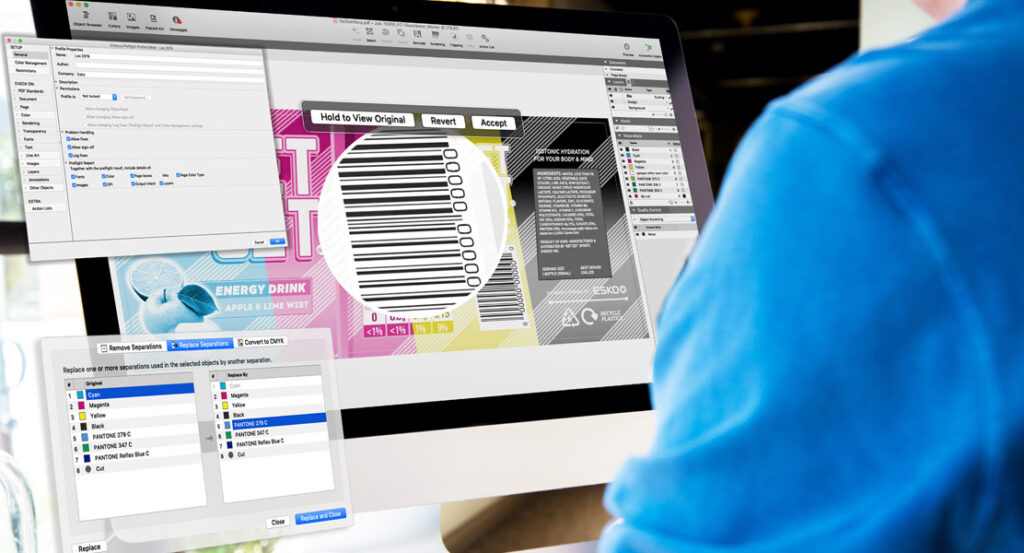
9. Recognize Barcodes
Incorrect barcodes can be very expensive errors, and they are often the hardest to spot.
With ArtPro+ barcode recognition, you can ensure correct reproduction of the provided barcodes.
Codes supplied with the artwork, but not yet verified, can be converted into reliable Esko barcodes, while ‘Compare’ helps highlight deviations so customizations are not missed.
Barcode validation matters even more as packaging moves toward smarter, data-rich codes and broader 2D barcode adoption.
This makes it important to validate not only the presence of a barcode, but also its type, placement, and the content within it as packaging requirements evolve.
For more context, see how artwork mismanagement can contribute to recalls.
10. Make Consistent Color Changes
Accelerate manual color matching, replace and convert colors, and speed up the workflow.
With ArtPro+, you can globally edit a color instead of changing the color of each individual component of the design.
That reduces manual effort and helps maintain consistency across complex packaging artwork, especially when multiple spot colors or brand variants are involved.
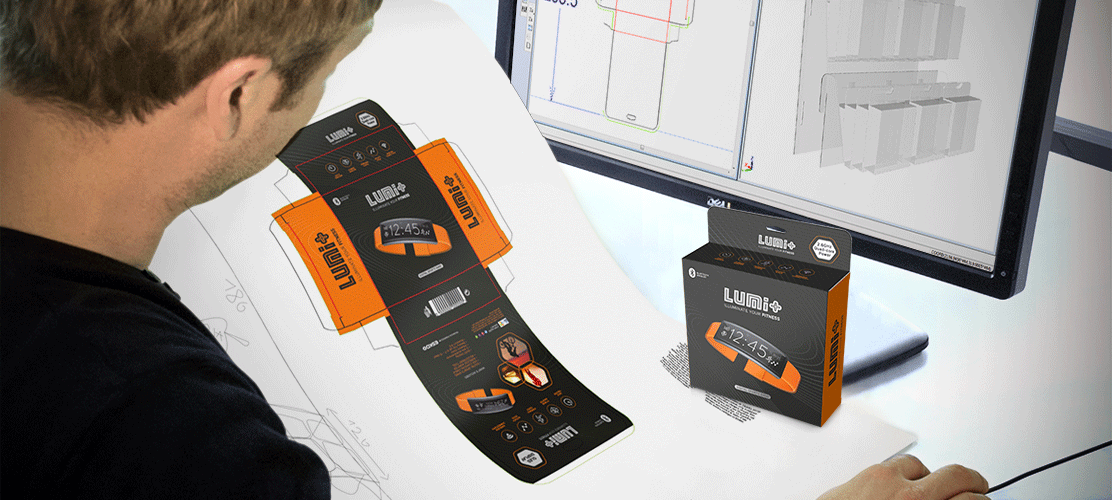
11. Link Structural Design
Many printing errors happen when graphics do not fit the structural design file. ArtPro+ helps ensure CAD and graphics stay aligned by placing native Esko ArtiosCAD files.
This lets you link structural design files to the packaging design so structural updates are reflected and mistakes are reduced later in production.
ArtPro+ also leverages the intelligence of ArtiosCAD files to automatically trim and bleed blanks in a layout, define station numbers, or use the die manufacturing file to drive print control marks.
For teams working with connected packaging development, this alignment is essential because structural changes can otherwise ripple into artwork and approval errors.
See the Esko and Ricoh Latin America strategic alliance announcement for more on connected end-to-end packaging workflows.
12. View Your Packaging in 3D
Examine every angle of your design in ArtPro+ with full high-resolution 3D.
This helps you understand how graphics will appear in the final packaging context and prevents hidden or incomplete artwork from being sent for approval or production.
It is especially useful when artwork needs to be checked against folds, panels, or curved surfaces before anything reaches the pressroom.
For a packaging preview workflow example, see how Studio helped Nike.
13. Understand the Graphics
Make confusion over content a thing of the past. With ArtPro+, the dynamic object browser and breadcrumb inspectors clarify how selected artwork is composed, helping teams make edits at the right level to achieve the intended result.
Increased visibility matters when artwork contains nested objects, grouped elements, or inherited attributes that can be difficult to interpret quickly. It helps reduce the risk of editing the wrong layer or missing a critical component in a complex file.
14. Don’t Run into Hidden PDF Issues
ArtPro+ constantly monitors the state of objects and properties and warns you about possible downstream issues.
In modern packaging workflows, those hidden issues can include unsupported processing-step data, linked-content problems, and PDF compatibility concerns that only show up later if they are not caught early.
This is especially relevant as more teams move toward native PDF-based production and need to preserve processing-step information throughout the workflow.Want to see how it works in the real world?
Check out the Stratus Packaging Group case study, which highlights native-PDF handling and ISO processing-step considerations.
15. Achieve Perfect Flexo Print
Enhance flexo print quality with flexo print simulation, which shows typical artifacts such as breakouts or dot gain so you can anticipate and control print behavior more effectively.
That makes it easier to avoid surprises on press and improve consistency from job to job.
Newer flexo-focused updates also place more emphasis on plate efficiency and waste reduction, helping teams optimize output while reducing unnecessary material use.
For more on flexo innovation and plate-making improvements, learn how AI is powering the next evolution of Quartz technology in flexo and explore solutions for tradeshops and premedia.
16. Block Non-Printing Content
Do not ruin your plates or cylinders with non-printing content such as cutting or creasing lines.
ArtPro+ supports ISO 19593-1 Processing Steps, helping prevent processing-step information from affecting the artwork.
This is particularly important in native PDF workflows, where preserving technical intent without letting non-printing elements leak into production output is a key part of avoiding prepress errors.
17. Printing Unit Support
Prevent confusion and reduce costly reprints with easy control over print decks and ink order for surface and reverse-printed packaging and labels.
By assigning printing unit information to separations, teams can avoid the need for proxy files when proofing and sharing.
That makes the workflow clearer for operators and reduces the chance of ink-order mistakes, especially in complex label and packaging jobs.
18. Integrated Metadata
Say goodbye to time-consuming double entry and the risk of mistyping critical job information.
As part of a connected workflow using Esko Automation Engine , ArtPro+ willcan retrieve job information and parameters from your ERP or MIS system, so everything is already present and correct before production begins.
That is especially valuable in larger operations where multiple plants need to work from the same job data and standards.
Connected, cloud-enabled workflow models are also becoming more important as packaging teams look for faster collaboration across sites and systems.
This broader shift toward SaaS-based connectivity is reflected in Esko’s cloud and workflow direction.
19. Make VDP Easy
Ensure every variant of a variable data printing job is composed correctly.
VDP Preflight in ArtPro+ validates the database and the resulting artworks against definable rules before you go to print. That helps catch errors in personalized or versioned packaging before they become expensive production issues.
As VDP workflows become more tightly linked to content governance and compliance, validation is no longer just about whether the database is technically correct. It is also about whether the resulting artwork still meets the packaging rules that govern copy, layout, and regulated content.For more on VDP workflows, see DeskPack Dynamic VDP.
20. Fix Thin Parts
Save time and eliminate errors by correcting and enhancing thin parts with a single click.
This helps prevent small features or glyphs from disappearing during printing and avoids reprints caused by missed objects or poor print quality.
The Fix-Thin-Parts functionality in ArtPro+ can compensate for Asian characters as well as generic artwork, and only in the areas where it is needed.
That makes it especially valuable for packaging artwork that includes fine typography, intricate symbols, or delicate line work that could otherwise fail on press.
Packaging Prepress Is Moving Beyond Production Checks
Eliminating prepress errors is no longer only about catching missing fonts or low-resolution images.
Packaging teams are also being asked to manage compliance, traceability, smarter barcode requirements, and more connected workflows across plants and systems.
That is why ArtPro+ matters in modern prepress. It helps teams reduce production mistakes, improve flexo output, preserve structural accuracy, validate variable data, and support the growing need for rule-based artwork review.
As Jan De Roeck makes clear:
“Brands are introducing variants more frequently and run lengths are getting shorter; that puts enormous pressure on converters to be faster and more accurate — automation and integrated workflows reduce risk and speed time-to-market.”
In a packaging environment where speed and accuracy must coexist, those capabilities help keep jobs moving without sacrificing control.
Now that we have explored 20 ways ArtPro+ can help reduce errors in your prepress process, it is time to get started.