Written by Geert de Proost
Director, Software Product Offering – Converters, Esko
Growth in the label and packaging industry is no longer limited by presses, plates, or prepress capacity.
Increasingly, it is constrained at the very first step of the process: job onboarding.
As brand owners demand more SKUs, shorter runs, and ever-faster lead times, the moment where a customer order is translated into a production-ready job has become the most fragile, and least scalable, part of the workflow.
When onboarding slows down, everything downstream feels it. Presses sit idle. Schedules slip. Core KPIs tied to print-for-pay productivity suffer.
Despite major investments in automation further along the value chain, many converters are discovering that growth is now gated not by production speed, but by how efficiently customer intent is captured, validated, and approved before production even starts.
In an environment where press utilization remains sacred, this upstream friction has become a silent growth limiter.
Automation Didn’t Remove the Bottleneck, it Relocated it
Faced with this pressure, converters did what they have always done: they invested in automation. Over the past decade, prepress automation has seen widespread adoption.
Solutions such as automated workflows and file handling, particularly in labels, where digital printing accelerated complexity, have delivered real efficiency gains.
But automation follows a simple law: it exposes the weakest link.
As prepress became faster and more predictable, inefficiencies elsewhere became impossible to ignore. Today, that weakest link is increasingly the Customer Service Representative (CSR).
CSRs now operate at the intersection of:
- Shorter runs
- More frequent orders
- Rapid SKU proliferation
- Small, infrequent buyers
Yet while prepress has digitized, customer service workflows remain largely unchanged. Email is still the dominant operating system. Job onboarding, clarification, approvals, and status updates are managed through endless threads, phone calls, and interruptions.
The result is not just slower response times, but rising stress, inconsistent service quality, and the assumption that growth inevitably requires more headcount.
That assumption is flawed.
The Daily Reality Inside Customer Service
Spend time inside almost any label or folding carton converter and the same patterns emerge:
Incomplete or Unclear Job Input
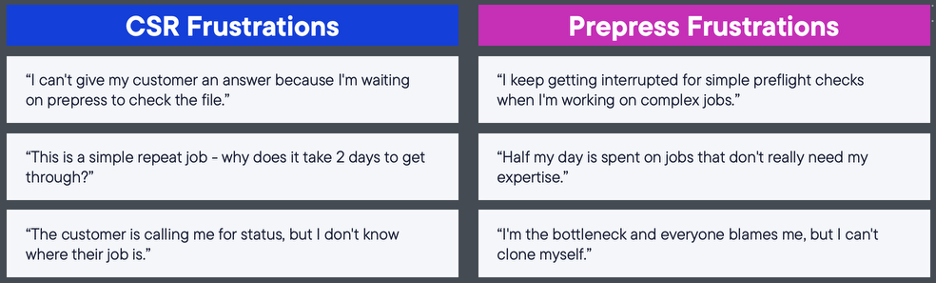
Print buyers submit jobs by email, often missing critical information. CSRs respond with clarification questions. More emails follow. Before a job can even be evaluated, momentum is lost.
Slow Responses Despite Best Intentions
To answer a quote or feasibility question, CSRs typically depend on prepress or structural design to run checks. These teams are focused on production-critical work and understandably resist interruptions. The delay may be hours or days, followed by highly technical feedback that must be translated back to the customer.
A simple quote response can easily take two to four days, and every customer revision restarts the cycle.
Limited Status Visibility
Once an order is in progress, customers want reassurance. CSRs, lacking real-time visibility, must chase internal stakeholders to determine job status and delivery risk, adding friction for everyone involved.
Ever-Lasting Approval Cycles
Final customer approval is one of the most underestimated bottlenecks. Email-based reviews, technical misunderstandings, and unclear feedback create long approval loops that delay production and force schedule reshuffling.
Despite MIS systems being officially designated as the CSR’s main tool, it quickly becomes clear that Microsoft Outlook is the real production environment. As volumes increase, the chaos becomes unmanageable.
Add the rise of micro-brands, startups, and customers who need more guidance but order smaller volumes, and the strain becomes structural, not incidental.
The Root Causes are Structural, Not Personal
Across converters, the same underlying issues repeat:
- Offline, email-driven customer communication
- Manual and inconsistent job onboarding
- Strong dependency on prepress and CAD for basic validation
- Organizational walls between departments
These are not people problems. They are workflow design problems.
Turning Customer Service into a Growth Accelerator
Solving this challenge does not mean removing the human element. On the contrary, customer service is built on trust and personal interaction. The objective is to remove friction while maintaining relationships.
Esko S2 was built around the three pillars that underpin a scalable, modern customer service model.
1. Empowering CSRs with the Right Capabilities
Most CSR delays exist because critical expertise is locked inside other departments’ tools. Preflight, validation, and structural intelligence are available, just not to the people who need them first.
By selectively exposing these capabilities directly to CSRs, entire layers of iteration disappear. Automatic preflight with visual, customer-friendly feedback, or access to approved structural designs, eliminates waiting and translation steps.
The CSR remains the owner of the customer relationship, but this way, they no longer have to wait for answers.
2. Connecting Departments Digitally
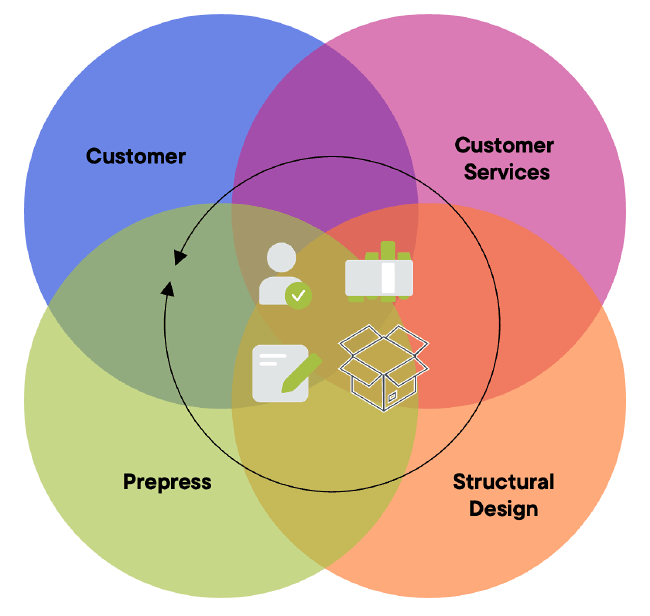
Empowerment alone is insufficient without connectivity. Departments must be digitally linked around shared workflows.
When CSRs can assign tasks, track progress, and see risk indicators in real time, they regain control over growing job volumes.
Transparency replaces chasing, and customer inquiries can be answered instantly without escalation.
3. Introducing Intentional Customer Self-Service
Customer portals are often labeled “web-to-print,” but the more relevant question is: Is it web-to-print or web-to-CSR?
Labels and packaging are primarily a B2B industry. Customers grow over time, relationships matter, and complexity varies widely. Thus, a one-size-fits-all portal rarely succeeds.
The most effective approach is phased, including:
- Shared visual job views to eliminate misunderstanding
- Online access to order history and reorders (which represent up to 70% of jobs)
- Guided creation of modified or new jobs, supported by packaging intelligence and AI
In this model, the portal does not replace the CSR. Rather, it becomes a CSR assistant, scaling expertise while preserving trust.
Growth Without Headcount is Not a Paradox
Trust takes years to build and moments to lose.
Large, disruptive web-to-print projects often fail because they replace trusted processes instead of extending them.
By building on existing packaging workflows, data, and technology, converters can create a smooth path toward digitized, scalable customer interaction.
The next productivity leap in labels and packaging will not come from faster presses alone. It will come from removing friction at the front end, turning customer service from a bottleneck into a competitive advantage.
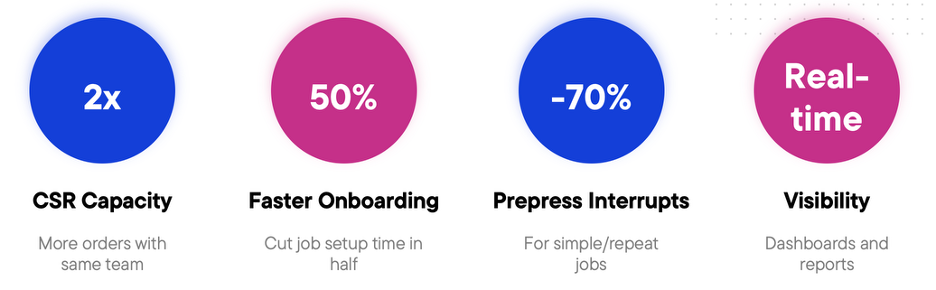
Growth without additional headcount is not only possible, but also fast becoming a necessity.