
Written by Gouri Sasidharan
Content Specialist, Esko

Written by Gouri Sasidharan
Content Specialist, Esko
Holidays are around, and one thing hard to miss is the Starbucks themed holiday cup.
For brands, seasonal and limited-edition packs are one of the most exciting projects to work on, such as customized Christmas packaging for your favorite cosmetics, personalized Diwali chocolate wrappers, limited editions of Star Wars cereal boxes, summer refresh editions, and more. They’re designed to delight, stand out, and tap into a seasonal storyline.
But behind the shimmer is a harsh truth: these SKUs are risk magnets.
They’re fast-moving, heavily marketing-led, and often built on top of an existing base of SKUs. And that’s exactly why errors slip in — outdated ingredient lists, old claim icons, text squeezed into decorative layouts, and panels misplaced on unfamiliar dielines.
Regulatory Affairs teams already run on tight bandwidth, so when a last-minute festive SKU lands in the inbox, it often means firefighting mode.
What makes seasonal SKUs especially tricky is that they’re rarely built from scratch. They’re almost always variations of existing products that are expected to follow the same regulatory rigor as a full-time SKU.
Seasonal projects usually start as hopeful emails like:
“Just a small fall edition with minimal changes. Need approval today.”
And from there chaos begins.
Teams often take last year’s festive file, add new design flair, and forget that the base SKU went through a formulation update in March. So, the artwork now proudly carries an ingredient list that belongs to the archives. It’s like giving your product a throwback moment no one asked for, and it’s definitely not compliant.
Your design folders tend to have collections of brand assets, including outdated cruelty-free icons, obsolete vegan badges, or a recyclable logo that is quietly retired. A new designer might drag and drop them without realizing they’re technically extinct. Regulatory affairs usually discover this when they have a deja vu moment and ask themselves, “Why does this look so familiar?”.
Festive packs come loaded: mandalas, glitter strokes, snowflakes, fairy lights, and the poor ingredient list gets 1.5pt font size and a gold-on-gold treatment. Good luck spotting the allergens through the sparkle.
New shapes or pack formats like hampers, tins, or cylindrical boxes almost guarantee some shifts. Nutrition panel on the wrong side, address block under a flap, MRP box hiding behind a fold (which I have encountered a lot of times); seasonal dielines are the Bermuda Triangle for mandatory content.
Mini-packs and promotional SKUs are festive favorites. But as the pack shrinks, something has to shrink with it, and it’s rarely the festive artwork. Mandatory text suffers first. The RA team ends up decoding information that looks like it was printed specifically for ants.
One festive campaign often means multiple variants such as different colors, formats, languages, or retailer-specific versions, all needing to review. Regulatory teams end up repeating the same checks across artwork that is mostly similar, but not similar enough to skip.
Here’s what actually happens behind the scenes:
Reviewers open the same Excel checklist they’ve been using since forever, such as multiple tabs, cryptic comments, and that one mysterious row labelled “DO NOT DELETE.” They go line-by-line, hoping muscle memory will catch what festive enthusiasm may have broken.
Regulatory ends up toggling between PDFs, formulation decks, reference claims, and base SKU specs. You might even end up staring at a third file named “Final_Final_v3_Final(UseThisOne).pdf”.
RA either copy-pastes ingredients into Notepad or cross-checks two PDFs side-by-side, playing a compliance version of “Spot the Difference.” The allergens are the tiny, almost invisible Easter eggs no one wants to miss.
Every reviewer has their own unofficial list of “things that always go wrong in festive packs.” None of these lives in a shared system. So, each review gets done from scratch, every single year, for every single variant.
Seasonal packs may be short-lived on shelves, but errors live long in audit trails, retailer rejections, and consumer shout outs, sorry…call outs.
Even if sold for just a few weeks, a seasonal SKU is a proper product with real regulatory obligations. Outdated claims, missing allergens, or incorrect declarations can all trigger legal issues.
Festive SKUs often get printed in large pre-booked batches. One mistake, wrong icon, or missing line, and everything gets scrapped. And by the time you reprint, the season is over.
Seasonal launches get amplified on social media. When a claim or allergen error surfaces, it spreads far faster than in regular SKUs.
Missing MRP boxes, incorrect pack declarations, or tiny mandatory text often get blocked at Quality Check checkpoints. Nothing kills festive momentum like a shipment stuck in sorting.
It’s the chance of the year for your copywriter or designer to bring that zing to your packaging artwork. It can sometimes get overcarried, and missing one compliance element can derail the entire campaign.
Here’s your go-to list of things to tick off before signing off on festive or limited-edition packaging. Think of it as your compliance radar plus a few extra warning flares for seasonal surprises.
Why it matters: Even a tiny typo in ingredient lists or missing allergen info can trigger compliance issues, and seasonal SKUs are just as regulated as year-round ones.
Why it matters: Seasonal artwork often uses creative typography and decorative versions of symbols. Make sure your regulatory must-haves didn’t get lost under the sparkle.
Why it matters: Minor graphic shifts like moving a barcode off the dieline or cutting the nutrition panel into a fold can ruin compliance just as easily as a mislabeled ingredient.
Why it matters: Seasonal creativity is fun as long as it doesn’t eclipse the essentials that keep your packaging compliant and recognizable.
Why it matters: Seasonal SKUs often introduce new structural formats, and each format shift means new compliance traps unless you check them off deliberately.
Why it matters: Documentation helps if an auditor asks why a seasonal claim or ingredient list changed at the last minute.
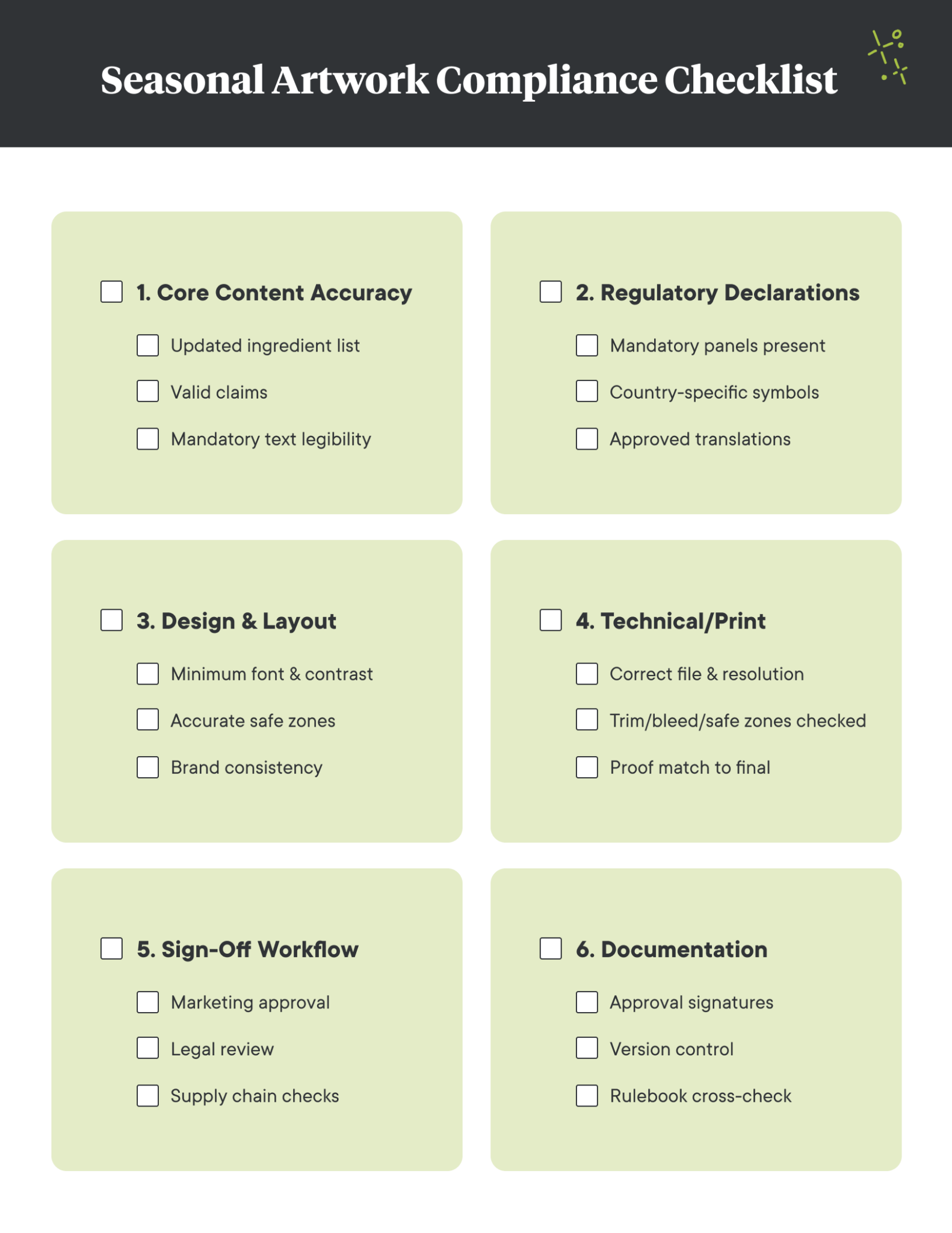
With an AI-powered label compliance tool such as Comply, you can cross all the above-mentioned labeling and branding checkpoints.
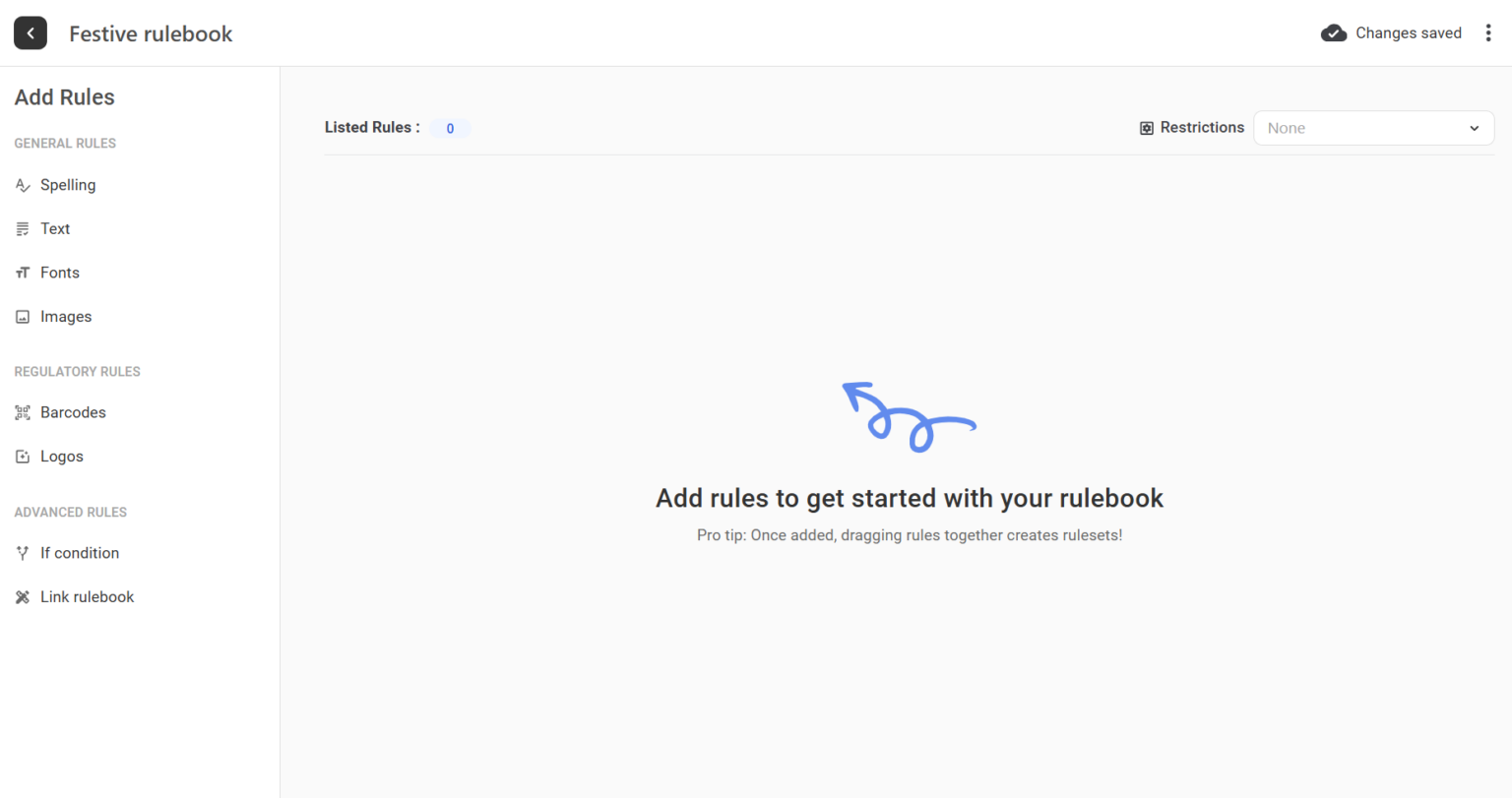
Comply lets you customize rulebooks that act like a compliance safety net for every Christmas, Eid, Winter, or limited-edition design. Here’s how you can set up your seasonal rulebooks:
Begin by duplicating your existing, everyday rulebook (on Comply) where all the details are added that already check:
This ensures your seasonal SKU doesn’t accidentally drop a fundamental requirement just because it’s wearing festive decor. Think of this as your compliance backbone.
Festive layouts love to push boundaries, which is great for creativity, and sometimes questionable for legibility.
Your rulebook can enforce a minimum font size and range for every text or copy.
If the designer sacrifices compliance to make room for fireworks, Comply catches it first.
Seasonal SKUs are mostly image-heavy, and that’s exactly why image validation matters.
With image checks, ComplyAI can:
You don’t have to rely on visual memory anymore to spot whether that icon is from 2021 or 2025.
Barcodes are often treated as an afterthought in seasonal packs until they don’t scan.
Rulebooks can automatically check:
This avoids last-minute panic when retailers flag scanning failures during inbound quality check.
Seasonal packs sometimes tweak formulations or reuse old messaging.
Rulebooks can enforce logic such as:
This removes subjective interpretation from claim approvals.
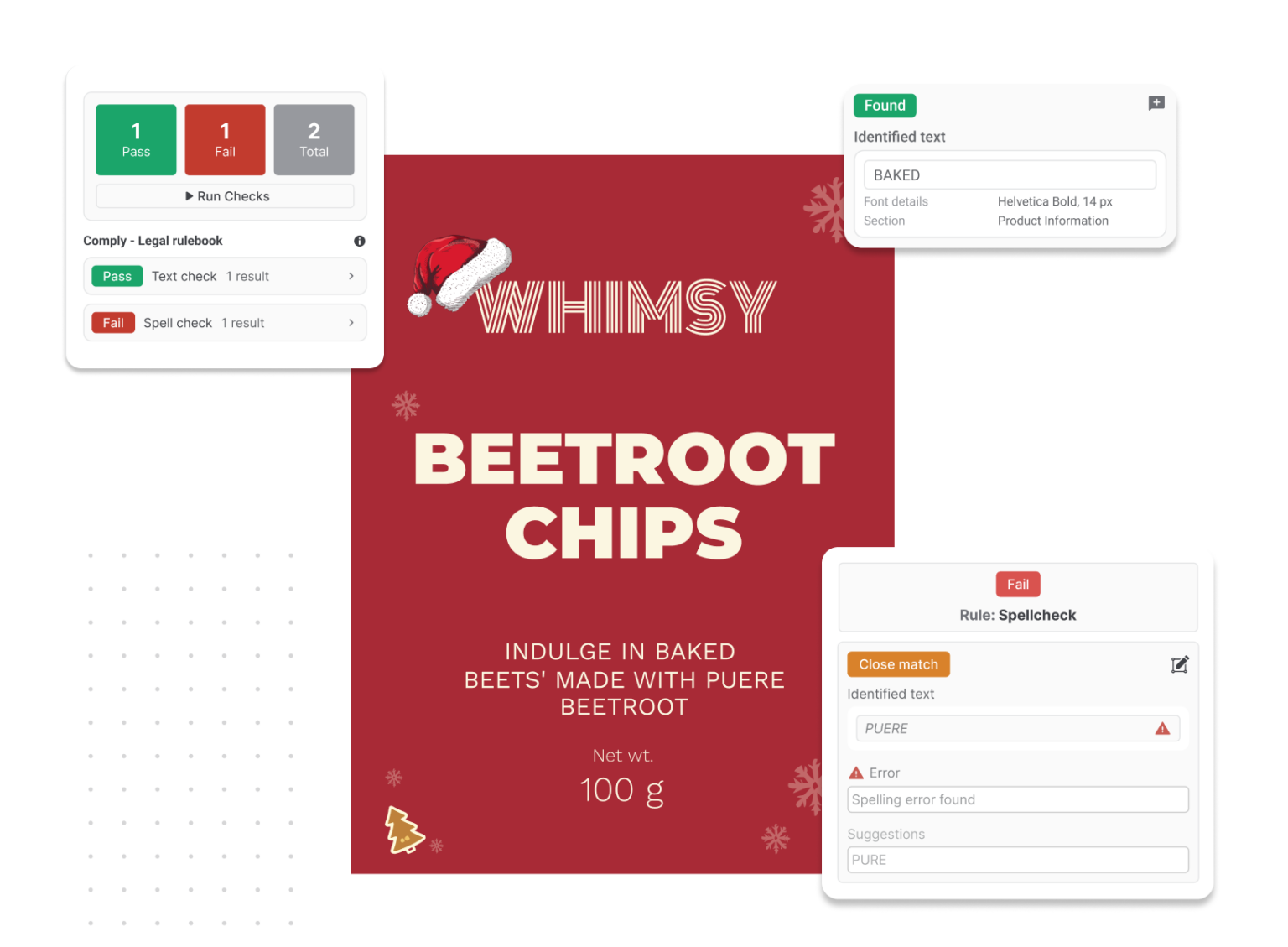
Once you set up your rulebooks, you can:
Now we know that with limited timelines, manual checks simply can’t keep up with decorative layouts, reused assets, or shifting dielines across packaging files. With the right guardrails, your seasonal packs can shine without putting RA through a holiday horror story.
Comply helps you cut review time, catch predictable festive errors early, and prevent costly reprints.
To give your regulatory affairs team the compliance confidence they crave, book a demo.
Gouri, a content specialist at Esko, loves adding a dash of creativity to everything she writes. She dedicates her craft to creating and optimizing content for clarity and impact. On weekends, you can probably spot her exploring new cafés or at movies.